analog computing
 21:42
Future Computers Will Be Radically Different (Analog Computing)
13.2M views • 4 years ago
Veritasium
Veritasium explains why analog computing may suit AI workloads, covering old analog computers, The Analog Thing and Mythic's analog chips that use flash memory for neural network inference. It argues digital hardware is hitting limits.
 20:13
The Most Powerful Computers You've Never Heard Of
13.7M views • 4 years ago
Veritasium
Veritasium traces analog computers from the Antikythera mechanism and Kelvin's tide-predicting machines to fire control and modern analog approaches. It explains how these machines computed continuously rather than digitally.
 18:31
Fourier Optics used for Optical Pattern Recognition
103K views • 6 years ago
Huygens Optics
Huygens Optics explains the Fourier transform and shows how a lens performs one optically. A DLP projector is used as a Fourier filter to do simple pattern recognition on lithographic character patterns.
 18:15
So... the minute hand shows progression — apparently we think of time in wildly different ways
706K views • 4 years ago
Technology Connextras
A Technology Connections video essay on how analog and digital clocks shape different mental models of time, with the minute hand acting as a progress indicator.
 19:22
Mechanical circuits: electronics without electricity
8.7M views • 4 years ago
Steve Mould
Steve Mould shows Spintronics, a set of mechanical components such as resistors, capacitors and transistors linked by chains, that give an intuitive feel for how electrical circuits work.
 18:57
Why the Soviet Computer Failed
4.2M views • 4 years ago
Asianometry
An Asianometry explainer on why the Soviet Union, once a leading computing power, fell far behind the US in computers by the 1980s. It traces the gap from the 1960s onward despite strong state support for science.
 11:33
A new way to visualize General Relativity
3.6M views • 6 years ago
ScienceClic English
ScienceClic explains why the rubber sheet analogy for general relativity is misleading and offers a new visualization that includes the curvature of time and shows gravity as motion through curved spacetime.
 23:33
Why Do Mainframes Still Exist? What's Inside One? 40TB, 200+ Cores, AI, and more!
1.2M views • 3 years ago
Dave's Garage
Dave Plummer tours the IBM z16 mainframe from design through factory assembly, test lab, accelerators and water cooling. He explains why mainframes still exist and what makes them reliable.
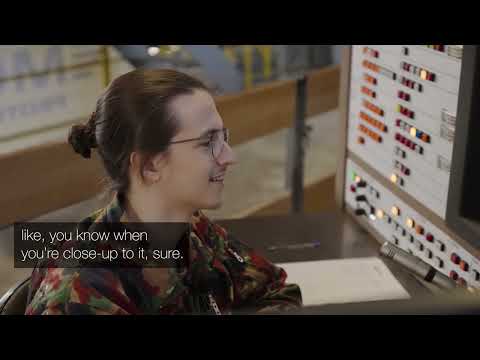 4:40
This 1970s tank simulator drives through a tiny world
12M views • 4 years ago
Tom Scott
Tom Scott visits the Swiss Military Museum to see the last surviving 1970s tank-driving simulator. It uses a real camera moving over a miniature model landscape rather than any computer graphics.
 17:05
How Physicists Created a Holographic Wormhole in a Quantum Computer
2.4M views • 3 years ago
Quanta Magazine
Quanta Magazine explains the 2022 experiment that claimed to create a holographic wormhole on Google's quantum computer. The description now notes that a later independent analysis questioned whether any wormhole was created.
 34:00
Math's Fundamental Flaw
30.8M views • 5 years ago
Veritasium
Veritasium's explainer on Godel's incompleteness theorems and the limits of mathematical proof, tracing set theory, Hilbert's program and the road to Turing and modern computing.
 24:07
AI can't cross this line and we don't know why.
2.5M views • 2 years ago
Welch Labs
A Welch Labs explainer on neural scaling laws and the compute-efficient frontier, asking why model loss seems to hit a line it cannot cross. It draws an analogy to an ideal gas law for AI.
 24:30
Is It Really Impossible To Cool A Datacenter In Space?
1.1M views • 7 months ago
Scott Manley
Scott Manley explains the thermal balance of spacecraft and how a satellite could be configured to radiate away the heat from datacenter-scale computing in space. His rough numbers suggest it is feasible.
 27:16
How Do Night Vision Goggles Work?
8.4M views • 3 years ago
Veritasium
Veritasium visits the US Navy's Crane facility to test top night vision goggles. It explains how image intensifier tubes and thermal or digital systems work and compares the generations of the technology.
 43:00
The step-by-step, mechanical logic of old pinball machines
1.1M views • 2 years ago
Technology Connections
Technology Connections takes apart the step-by-step electromechanical logic of a 1970s pinball machine. He shows how relays, steppers and switches track state and score without electronics.
 10:31
Why We Should NOT Look For Aliens - The Dark Forest
17.7M views • 4 years ago
Kurzgesagt – In a Nutshell
Kurzgesagt animated explainer on the Dark Forest answer to the Fermi Paradox. It argues that if advanced civilizations exist, staying silent may be the safest strategy because revealing yourself invites a first strike.