analog computing
 19:27
Quantum Computing Expert Explains One Concept in 5 Levels of Difficulty | WIRED
8M views • 8 years ago
WIRED
IBM's Dr. Talia Gershon explains quantum computing to five people of increasing expertise: a child, teen, college student, grad student and professional. The WIRED series format moves from simple analogies to technical detail.
 13:14
How Analog Color TV Works: The Beginnings
503K views • 8 years ago
Technology Connections
Technology Connections explains the early history of analog color television, from the 1954 start of modern color broadcasting, and how shadow masks work in CRTs. It is the first in a series on how analog color TV works.
 16:47
Lines of Light: How Analog Television Works
1.5M views • 9 years ago
Technology Connections
Technology Connections explains how analog television produced moving images without computers, covering scanning, CRTs and standards like NTSC and PAL. It is part of a series on analog TV.
 8:38
Diffie-Hellman Key Exchange
938K views • 14 years ago
Art of the Problem
A short explainer on the history and mechanics of public key cryptography and the Diffie-Hellman key exchange. It uses a mixing-paint-colors analogy to show how two parties can agree on a shared secret in public.
 18:31
Fourier Optics used for Optical Pattern Recognition
103K views • 6 years ago
Huygens Optics
Huygens Optics explains the Fourier transform and shows how a lens performs one optically. A DLP projector is used as a Fourier filter to do simple pattern recognition on lithographic character patterns.
 18:15
So... the minute hand shows progression — apparently we think of time in wildly different ways
706K views • 4 years ago
Technology Connextras
A Technology Connections video essay on how analog and digital clocks shape different mental models of time, with the minute hand acting as a progress indicator.
 16:36
Hacking at Quantum Speed with Shor's Algorithm | Infinite Series
238K views • 9 years ago
PBS Infinite Series
PBS Infinite Series explains how Shor's algorithm lets a quantum computer break RSA encryption, building on earlier episodes about cryptography and the math of quantum computers. It works through the idea step by step.
 12:24
The 1988 VIDEO Floppy Disk Camera: Canon Xap Shot RC-250
452K views • 8 years ago
LGR
LGR looks at the 1988 Canon Xap Shot, a still video camera that records photos to a floppy disk as analog NTSC signal rather than digital data.
 19:22
Mechanical circuits: electronics without electricity
8.7M views • 4 years ago
Steve Mould
Steve Mould shows Spintronics, a set of mechanical components such as resistors, capacitors and transistors linked by chains, that give an intuitive feel for how electrical circuits work.
 18:57
Why the Soviet Computer Failed
4.2M views • 4 years ago
Asianometry
An Asianometry explainer on why the Soviet Union, once a leading computing power, fell far behind the US in computers by the 1980s. It traces the gap from the 1960s onward despite strong state support for science.
 11:33
A new way to visualize General Relativity
3.6M views • 6 years ago
ScienceClic English
ScienceClic explains why the rubber sheet analogy for general relativity is misleading and offers a new visualization that includes the curvature of time and shows gravity as motion through curved spacetime.
 12:35
The Mathematics of Quantum Computers | Infinite Series
718K views • 9 years ago
PBS Infinite Series
A PBS Infinite Series episode explaining the mathematics of quantum computers, including how qubits store complex numbers and how quantum computation differs from classical computation. Hosted by Kelsey Houston-Edwards.
 5:24
Diffie-Hellman Key Exchange
547K views • 14 years ago
Art of the Problem
A short Art of the Problem clip explaining Diffie-Hellman key exchange, using a paint mixing analogy for one-way functions and touching on modular arithmetic and discrete logarithms.
 17:04
These Are Not Pixels: Revisited
611K views • 8 years ago
Technology Connections
Technology Connections follows up on his analog TV video to clear up the debate over whether CRT phosphor dots are pixels. He explains the shadow mask, color triads and how they relate to the scanned picture.
 11:27
CGA Graphics - Not as bad as you thought!
2.4M views • 10 years ago
The 8-Bit Guy
The 8-Bit Guy covers IBM's 1981 CGA graphics system, including how composite output and artifacting produced extra colors beyond the nominal palette. He argues CGA looked better in period than it does on RGB monitors.
 15:09
Mouse Cursor History (and why I made my own)
3M views • 8 years ago
Posy
Posy gives a short history of the computer mouse cursor, from early straight pointers to the tilted arrow, comparing Apple and Windows designs. He then explains why he designed his own cursor set and offers it as a free download.
 12:04
Anagrams, but where you can break apart letters: "Anagraphs"
256K views • 8 years ago
suckerpinch
Tom Scott-style exploration by suckerpinch (Tom7) of generalized anagrams where letters can be broken into pieces, called anagraphs, with a whimsical computational approach.
 17:31
How Quantum Computers Break Encryption | Shor's Algorithm Explained
3.4M views • 7 years ago
minutephysics
MinutePhysics explains Shor's algorithm, showing how a quantum computer factors large integers by finding the period of a number modulo N. It walks through the modular arithmetic and number theory that give the exponential speedup over classical factoring, and why this threatens encryption.
 4:40
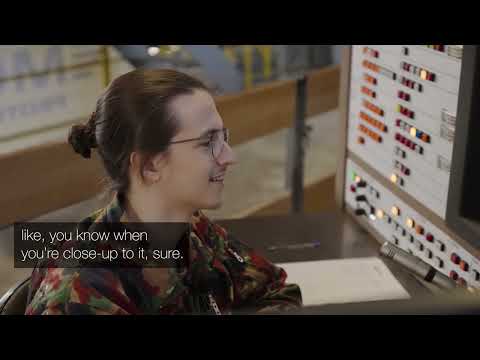
This 1970s tank simulator drives through a tiny world
12M views • 4 years ago
Tom Scott
Tom Scott visits the Swiss Military Museum to see the last surviving 1970s tank-driving simulator. It uses a real camera moving over a miniature model landscape rather than any computer graphics.
 9:20
An astonishing old calculator - Numberphile
794K views • 8 years ago
Numberphile
Cliff Stoll shows and explains his two Friden EC-132 electronic calculators for Numberphile. The video covers how these early machines worked, including their unusual acoustic delay line memory.
 17:05
How Physicists Created a Holographic Wormhole in a Quantum Computer
2.4M views • 3 years ago
Quanta Magazine
Quanta Magazine explains the 2022 experiment that claimed to create a holographic wormhole on Google's quantum computer. The description now notes that a later independent analysis questioned whether any wormhole was created.
 9:41
How Steve Jobs got the ideas of GUI from XEROX
272K views • 12 years ago
Ringo Pebam
A short video telling how Xerox PARC invented the graphical user interface and how Steve Jobs's 1979 visit influenced Apple's Lisa.
 15:27
Why Not Just: Think of AGI Like a Corporation?
163K views • 7 years ago
Robert Miles AI Safety
Robert Miles asks whether corporations can be thought of as artificial general superintelligences and how far the analogy holds. He argues the differences, such as being limited by employees' capabilities, matter for AI safety.
 7:41
Is This What Quantum Mechanics Looks Like?
6.2M views • 10 years ago
Veritasium
Veritasium shows silicone oil droplets bouncing on a vibrating bath, a physical analogue of pilot wave theory that reproduces quantum-like behavior such as double-slit patterns.
 12:06
Hawking Radiation
1.3M views • 8 years ago
PBS Space Time
PBS Space Time explains Stephen Hawking's prediction of Hawking radiation and how black holes can emit radiation and slowly evaporate. It goes beyond the common particle-antiparticle analogy.
 10:18
How to Stop a Riot
5.2M views • 9 years ago
Wendover Productions
Wendover Productions explains counterintuitive riot control techniques based on research, showing that effective tactics tend to avoid violence.
 12:16
LCCS: The LCD / CRT Hybrid from JVC
2.3M views • 7 years ago
Technology Connections
A Technology Connections video on JVC's LCCS, a display hybrid that cycles a color LCD shutter over a monochrome CRT to produce field-sequential color without dots or stripes. It builds on his earlier videos about analog TV and compatible color.
 4:02
Only Two Countries Can Still Claim Antarctica
7.9M views • 10 years ago
CGP Grey
CGP Grey explains the history and legal status of territorial claims on Antarctica. It covers the overlapping national claims and the Antarctic Treaty that freezes them.
 10:31
Why We Should NOT Look For Aliens - The Dark Forest
17.7M views • 4 years ago
Kurzgesagt – In a Nutshell
Kurzgesagt animated explainer on the Dark Forest answer to the Fermi Paradox. It argues that if advanced civilizations exist, staying silent may be the safest strategy because revealing yourself invites a first strike.