aws lambda
 24:07
AI can't cross this line and we don't know why.
2.5M views • 2 years ago
Welch Labs
A Welch Labs explainer on neural scaling laws and the compute-efficient frontier, asking why model loss seems to hit a line it cannot cross. It draws an analogy to an ideal gas law for AI.
 28:28
What is PLUS times PLUS?
2.2M views • 1 year ago
2swap
2swap explores lambda calculus using John Tromp's lambda diagrams, with animated beta-reductions, asking what PLUS times PLUS gives. It touches on Church encodings and the equivalence of Turing machines and lambda calculus.
 31:39
Parking Laws Are Strangling America | Climate Town
1.9M views • 3 years ago
Climate Town
Climate Town traces the history of American parking minimums, how they came from shaky research and ITE guides, and how they shape zoning, cities and housing costs. It is a long, comedic video essay.
 45:13
You've (Likely) Been Playing The Game Of Life Wrong
11.6M views • 11 months ago
Veritasium
Veritasium explains why many real-world systems follow power laws rather than normal distributions. It covers self-organized criticality, with simulations of sandpiles, magnetism and forest fires.
 4:22
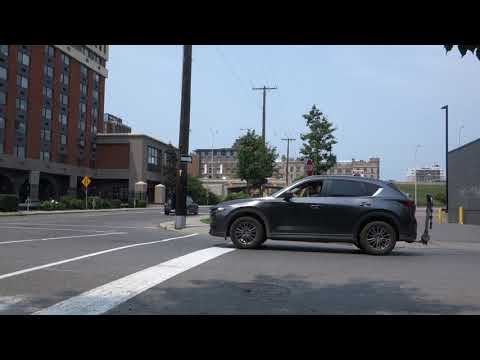
Idaho Stop for Cyclists? Drivers Already Do It!
34K views • 5 years ago
Oh The Urbanity!
A short urbanism video presenting original observations of how drivers treat stop signs, to argue that cyclists rolling through them under an Idaho stop is no different. It filmed intersections in Ottawa.
 7:10
What People Get Wrong About Dense Urban Living
76K views • 4 years ago
Oh The Urbanity!
Oh The Urbanity! argues that most city dwellers live in dense residential neighbourhoods outside downtown, which can be calm and peaceful. It draws on older, denser parts of Toronto and Montreal.
 19:40
How I Designed a Free Music Font for 5 Million Musicians (MuseScore 3.6)
608K views • 5 years ago
Tantacrul
Tantacrul explains how he and engraver Simon Smith designed the free music notation font for MuseScore 3.6. It draws on the history of the SCORE notation application by Leland Smith.
 11:01
How Bankrupt American Cities Stay Alive - Debt [ST04]
2M views • 5 years ago
Not Just Bikes
Not Just Bikes explains how many American suburbs, built all at once rather than incrementally, cannot cover their infrastructure costs and survive on growing debt. It draws on Strong Towns' work on the growth Ponzi scheme.
 18:10
A London Accent from the 14th to the 21st Centuries
7.2M views • 5 years ago
Simon Roper
Linguist Simon Roper reconstructs how a London accent would have sounded from the 14th to the 21st centuries, reading passages in period pronunciation. It draws on the Cambridge History of the English Language.
 33:16
Work.
1.7M views • 3 years ago
Historia Civilis
Historia Civilis traces the history of work and time discipline, comparing modern working hours with those of medieval peasants and the changes brought by clocks and industrialization. It draws on works such as Schor's The Overworked American.
 27:40
The Biggest Misconception in Physics
14.2M views • 1 year ago
Veritasium
Veritasium explores why energy is not conserved in general relativity, using Emmy Noether's theorem linking symmetries to conservation laws. Physicists interviewed explain energy loss in an expanding universe.
 17:52
Holy Post - Race in America
1.7M views • 6 years ago
Holy Post Media
Phil Vischer of VeggieTales and Holy Post gives an 18-minute history of racial injustice in America, covering why anger persists despite civil rights laws. It is told from an evangelical Christian perspective and adapted from a class he co-taught.
 38:26
Racing the Beam Explained - Atari 2600 CPU vs. CRT Television
400K views • 5 years ago
Retro Game Mechanics Explained
Retro Game Mechanics Explained shows how the Atari 2600 draws images with almost no video memory, by having the CPU race the CRT beam line by line. It walks through the techniques in detail.
 28:46
Space Shades: Humanity's Last Hope | Answers With Joe
1.1M views • 6 years ago
Joe Scott
Joe Scott takes a serious look at space sunshades as a climate fix, asking how big they would need to be, what they would cost and whether they would work. He draws on Roger Angel's paper and launch options.
 14:28
How Lexus Fixed Tesla's Bad Idea: Steer-By-Wire Yoke
7M views • 3 years ago
Engineering Explained
Engineering Explained compares Lexus's steer-by-wire yoke on the RZ 450e with Tesla's yoke. It covers how steer-by-wire works and how variable steering ratios address the yoke's flaws.
 23:34
Why Democracy Is Mathematically Impossible
10.1M views • 2 years ago
Veritasium
Veritasium explains why no voting system can be perfectly fair, drawing on Arrow's theorem and the work of Eric Maskin. It looks at problems with systems like first-past-the-post and ranked-choice voting.
 22:54
Did People Used To Look Older?
21M views • 4 years ago
Vsauce
Vsauce explores whether people in past decades really looked older than people of the same age today, or whether photographic and cultural factors make them seem so. It draws on old photos, yearbooks and perception research.