aws lambda
 5:33
Adam Ruins Everything - The Truth About the McDonald's Coffee Lawsuit
978K views • 9 years ago
truTV
An Adam Ruins Everything segment on the real facts of the McDonald's hot coffee lawsuit, covering the severity of the burns and the corporate PR campaign that painted it as frivolous.
 24:07
AI can't cross this line and we don't know why.
2.5M views • 2 years ago
Welch Labs
A Welch Labs explainer on neural scaling laws and the compute-efficient frontier, asking why model loss seems to hit a line it cannot cross. It draws an analogy to an ideal gas law for AI.
 8:16
Why Asimov's Laws of Robotics Don't Work - Computerphile
873K views • 11 years ago
Computerphile
Rob Miles explains for Computerphile why simple rule sets like Asimov's Three Laws cannot make robots and AI safe. Terms like harm and human are too ambiguous to specify precisely.
 28:28
What is PLUS times PLUS?
2.2M views • 1 year ago
2swap
2swap explores lambda calculus using John Tromp's lambda diagrams, with animated beta-reductions, asking what PLUS times PLUS gives. It touches on Church encodings and the equivalence of Turing machines and lambda calculus.
 13:02
Noether's Theorem and The Symmetries of Reality
1.1M views • 8 years ago
PBS Space Time
PBS Space Time explains Noether's theorem: conservation laws such as energy and momentum are consequences of deeper symmetries. It also covers why those laws hold only under certain conditions.
 31:39
Parking Laws Are Strangling America | Climate Town
1.9M views • 3 years ago
Climate Town
Climate Town traces the history of American parking minimums, how they came from shaky research and ITE guides, and how they shape zoning, cities and housing costs. It is a long, comedic video essay.
 7:23
How Trees Bend the Laws of Physics
5M views • 14 years ago
Veritasium
Veritasium explains how trees lift water from roots to the top of tall trunks, using transpiration pull and the negative pressure that liquid water can sustain. It explains why trees do not need pumps or valves.
 45:13
You've (Likely) Been Playing The Game Of Life Wrong
11.6M views • 11 months ago
Veritasium
Veritasium explains why many real-world systems follow power laws rather than normal distributions. It covers self-organized criticality, with simulations of sandpiles, magnetism and forest fires.
 21:05
The Zipf Mystery
28.7M views • 11 years ago
Vsauce
Vsauce's explainer on Zipf's law, the pattern in which the frequency of a word is inversely related to its rank. It shows the pattern across many domains and discusses why it remains unexplained.
 4:22
Idaho Stop for Cyclists? Drivers Already Do It!
34K views • 5 years ago
Oh The Urbanity!
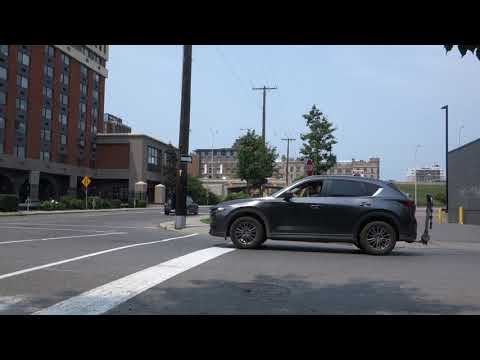
A short urbanism video presenting original observations of how drivers treat stop signs, to argue that cyclists rolling through them under an Idaho stop is no different. It filmed intersections in Ottawa.
 12:22
Is Most Published Research Wrong?
6.2M views • 10 years ago
Veritasium
Veritasium explains why a large share of published research findings may be false, covering p-values, p-hacking, publication bias and low replication rates. It draws on John Ioannidis's well-known paper and describes reforms such as preregistration.
 7:10
What People Get Wrong About Dense Urban Living
76K views • 4 years ago
Oh The Urbanity!
Oh The Urbanity! argues that most city dwellers live in dense residential neighbourhoods outside downtown, which can be calm and peaceful. It draws on older, denser parts of Toronto and Montreal.
 19:40
How I Designed a Free Music Font for 5 Million Musicians (MuseScore 3.6)
608K views • 5 years ago
Tantacrul
Tantacrul explains how he and engraver Simon Smith designed the free music notation font for MuseScore 3.6. It draws on the history of the SCORE notation application by Leland Smith.
 11:01
How Bankrupt American Cities Stay Alive - Debt [ST04]
2M views • 5 years ago
Not Just Bikes
Not Just Bikes explains how many American suburbs, built all at once rather than incrementally, cannot cover their infrastructure costs and survive on growing debt. It draws on Strong Towns' work on the growth Ponzi scheme.
 8:25
Akira Kurosawa - Composing Movement
10.8M views • 11 years ago
Every Frame a Painting
An Every Frame a Painting video essay on how Akira Kurosawa used movement, weather and composition to tell stories. It draws on clips and interviews with other filmmakers.
 41:35
The Alt-Right Playbook: How to Radicalize a Normie
4.5M views • 7 years ago
Innuendo Studios
A video essay from the Alt-Right Playbook series that explains how extremist movements draw ordinary people in, using deniable rhetoric, bad-faith games, and gradual escalation. It draws on books about the alt-right, male radicalization, and cult-style brainwashing.
 6:47
The US Has More Tribes Than the World Has Countries
7.3M views • 6 years ago
CGP Grey
CGP Grey explains why "Indian" is often preferred over "Native American" in the United States, especially near reservations, and how many tribes exist in the US. He draws on conversations with people who identify as Indian.
 18:10
A London Accent from the 14th to the 21st Centuries
7.2M views • 5 years ago
Simon Roper
Linguist Simon Roper reconstructs how a London accent would have sounded from the 14th to the 21st centuries, reading passages in period pronunciation. It draws on the Cambridge History of the English Language.
 33:16
Work.
1.7M views • 3 years ago
Historia Civilis
Historia Civilis traces the history of work and time discipline, comparing modern working hours with those of medieval peasants and the changes brought by clocks and industrialization. It draws on works such as Schor's The Overworked American.
 27:40
The Biggest Misconception in Physics
14.2M views • 1 year ago
Veritasium
Veritasium explores why energy is not conserved in general relativity, using Emmy Noether's theorem linking symmetries to conservation laws. Physicists interviewed explain energy loss in an expanding universe.
 9:07
Which key is the saddest?
1.3M views • 9 years ago
Adam Neely
Musician Adam Neely examines whether certain keys sound sadder than others, looking at the history of tuning systems and temperaments and at how instrument timbre shapes the emotional character we hear. It draws on historical aesthetics writing and audio examples.
 2:58
First Follower: Leadership Lessons from Dancing Guy
8.8M views • 16 years ago
Derek Sivers
Derek Sivers annotates a short clip of a lone dancer at a festival, showing how a first follower turns a ridiculous act into a movement. He draws out lessons about leadership and making it easy to follow.
 7:37
Satoshi Kon - Editing Space & Time
4M views • 12 years ago
Every Frame a Painting
A video essay from Every Frame a Painting on animator Satoshi Kon and his editing style, which distorts and warps space and time. It draws on his four features and one TV series.
 19:20
The Constitution of Athens
1.5M views • 8 years ago
Historia Civilis
Historia Civilis explains the constitution of ancient Athens, including its assembly, offices and use of sortition to choose leaders. It draws on Aristotle and Plutarch.
 14:24
Why Japan Arrests Foreigners
8.6M views • 7 years ago
Paolo fromTOKYO
Paolo fromTOKYO explains why foreign tourists get arrested in Japan, covering strict laws and the justice system's very high conviction rate.
 4:51
The UK Election Results Were the Worst in History
8.1M views • 11 years ago
CGP Grey
CGP Grey explains how the 2015 UK general election showed the flaws of first-past-the-post voting, with parties like UKIP winning many votes but few seats.
 17:52
Holy Post - Race in America
1.7M views • 6 years ago
Holy Post Media
Phil Vischer of VeggieTales and Holy Post gives an 18-minute history of racial injustice in America, covering why anger persists despite civil rights laws. It is told from an evangelical Christian perspective and adapted from a class he co-taught.
 15:28
The Braitenberg Vehicles
65K views • 10 years ago
Brian Douglas
Brian Douglas introduces Braitenberg vehicles, simple robots whose sensors are wired directly to motors yet show surprisingly lifelike behavior. He draws on Valentino Braitenberg's book Vehicles.
 13:41
The Physics of Life (ft. It's Okay to be Smart & PBS Eons!)
771K views • 8 years ago
PBS Space Time
PBS Space Time, together with It's Okay to be Smart and PBS Eons, asks how a universe drifting toward disorder produced something as complex as life. It presents the idea that the laws of physics, through thermodynamics, may actually favor the emergence of life.
 9:35
Is Your Red The Same as My Red?
34M views • 13 years ago
Vsauce
Vsauce explores qualia and whether different people experience colors the same way. It draws on color blindness, Mary's room, the explanatory gap and subjective experience.
 38:26
Racing the Beam Explained - Atari 2600 CPU vs. CRT Television
400K views • 5 years ago
Retro Game Mechanics Explained
Retro Game Mechanics Explained shows how the Atari 2600 draws images with almost no video memory, by having the CPU race the CRT beam line by line. It walks through the techniques in detail.
 15:15
WHY Exercise is so Underrated (Brain Power & Movement Link)
4.3M views • 9 years ago
Joseph Everett - WIL
A video arguing that exercise matters for the brain as much as the body, linking movement, the nervous system and BDNF to learning and memory. It draws on research connecting complex movement to brain development.
 6:43
The high cost of free parking
4.6M views • 9 years ago
Vox
A Vox explainer on how mandatory parking minimums and free parking impose hidden costs on cities. It draws on Donald Shoup's work and gives the history of parking requirements.
 3:38
The Shortest-Splitline Algorithm: a Gerrymandering Solution [Bonus Video]
692K views • 15 years ago
CGP Grey
A short CGP Grey bonus video explaining the shortest-splitline algorithm, which draws electoral districts by repeatedly splitting a state along its shortest dividing line while balancing population. It is offered as a neutral, algorithmic fix for gerrymandering.
 23:34
Why Democracy Is Mathematically Impossible
10.1M views • 2 years ago
Veritasium
Veritasium explains why no voting system can be perfectly fair, drawing on Arrow's theorem and the work of Eric Maskin. It looks at problems with systems like first-past-the-post and ranked-choice voting.
 22:54
Did People Used To Look Older?
21M views • 4 years ago
Vsauce
Vsauce explores whether people in past decades really looked older than people of the same age today, or whether photographic and cultural factors make them seem so. It draws on old photos, yearbooks and perception research.