data
 29:05
Datacenters Behaving Like Acoustic Weapons
1.8M views • 8 months ago
Benn Jordan
Benn Jordan investigates infrasound and low-frequency noise from data centers, including xAI's Colossus and a crypto mine, and reports his own experiments on the effects. The video covers the health and community impacts on nearby residents.
 28:11
Why Everyone Is Talking About Data Centers In Space
408K views • 10 months ago
Scott Manley
Scott Manley examines why SpaceX, Google and others are looking at orbital data centers. He walks through the economics, heat rejection and solar power arguments, with links to the Lumen/Starcloud and Google Suncatcher papers.
 24:30
Is It Really Impossible To Cool A Datacenter In Space?
1.1M views • 7 months ago
Scott Manley
Scott Manley explains the thermal balance of spacecraft and how a satellite could be configured to radiate away the heat from datacenter-scale computing in space. His rough numbers suggest it is feasible.
 28:23
The Fast Fourier Transform (FFT): Most Ingenious Algorithm Ever?
2.3M views • 5 years ago
Reducible
Reducible's visual walkthrough of the Fast Fourier Transform, motivated by polynomial multiplication. It shows how the FFT's key ideas can be discovered by asking the right questions.
Topic match · Algorithms & data structures 42:36
30 Weird Chess Algorithms: Elo World
965K views • 7 years ago
suckerpinch
Tom Scott-style absurdist tour by Tom7 of SIGBOVIK chess projects: a tournament of 30 weird chess algorithms used to rate a color- and piece-blind chess program. Topics include mirrors, arithmetic encoding, perverted game tree search and a diluted Stockfish.
Topic match · Algorithms & data structures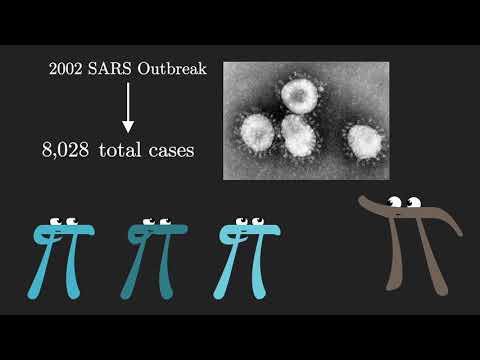 23:12
Simulating an epidemic
5.2M views • 6 years ago
3Blue1Brown
3Blue1Brown builds toy SIR models to simulate how an epidemic spreads and tests scenarios like social distancing, travel restrictions, central gathering places and quarantine. It was made during the early COVID-19 outbreak.
Topic match · Data visualization & information design 26:33
The Most Underrated Algorithm
10.8M views • 4 years ago
Veritasium
Veritasium tells the story of the Fast Fourier Transform, from its use in detecting nuclear tests to Cold War politics, and how it could have changed the arms race. It includes a short, intuitive explanation of what the Fourier transform does.
Topic match · Algorithms & data structures 20:08
Fast Inverse Square Root — A Quake III Algorithm
6M views • 5 years ago
Nemean
A walkthrough of the Quake III fast inverse square root, explaining where the constant 0x5f3759df comes from. It covers IEEE 754 floats, the bit hack that approximates a logarithm, and a Newton's method refinement.
Topic match · Algorithms & data structures 45:13
You've (Likely) Been Playing The Game Of Life Wrong
11.6M views • 11 months ago
Veritasium
Veritasium explains why many real-world systems follow power laws rather than normal distributions. It covers self-organized criticality, with simulations of sandpiles, magnetism and forest fires.
Topic match · Data science & statistics 26:48
Algorithmic Redistricting: Elections made-to-order
584K views • 5 years ago
AlphaPhoenix
AlphaPhoenix uses Monte Carlo simulation and annealing-style methods to draw North Carolina congressional district maps, both gerrymandered and fair. He focuses on the fascinating computational problem rather than the politics.
Topic match · Algorithms & data structures 30:38
Solving Wordle using information theory
11.8M views • 4 years ago
3Blue1Brown
3Blue1Brown uses Wordle as an excuse to teach information theory and entropy, building a solver that picks guesses by expected information and incorporating word frequencies.
Topic match · Algorithms & data structures 28:47
Someone improved my code by 40,832,277,770%
3.1M views • 4 years ago
Stand-up Maths
Matt Parker follows the community effort to speed up his slow Wordle-solving code, which ended up running hundreds of millions of times faster. He walks through the techniques contributors used.
Topic match · Algorithms & data structures 27:12
How They Caught The Golden State Killer
10.1M views • 5 years ago
Veritasium
Veritasium explains how investigators caught the Golden State Killer using forensic genealogy, matching crime scene DNA to distant relatives in public genealogy databases. It also covers the privacy implications of DNA databases.
Topic match · Privacy, surveillance & cybercrime 21:24
Why are people mean on Twitter? - Smarter Every Day 214
957K views • 7 years ago
SmarterEveryDay
Destin Sandlin of Smarter Every Day examines how bad actors and bots use Twitter, drawing on the released Russian IRA dataset and interviews. It asks why interactions on the platform turn hostile.
Topic match · Privacy, surveillance & cybercrime 30:53
I Saved a PNG Image To A Bird
2.1M views • 1 year ago
Benn Jordan
Benn Jordan's video about storing a PNG image in a living bird, a starling that learns to reproduce encoded sounds. It mixes ornithology, audio engineering, and data encoding.
 20:55
Why ChatGPT Can't Draw a Full Glass of Wine
6.3M views • 1 year ago
Alex O'Connor
Alex O'Connor shows that ChatGPT cannot draw a wine glass filled to the brim, and ties the failure to David Hume's missing shade of blue. It asks what the failure says about how image models learn.
 27:11
The Art Of Poison-Pilling Music Files
1.1M views • 1 year ago
Benn Jordan
Musician Benn Jordan explains and demonstrates adversarial noise that poison-pills music files against AI training and scraping.
 35:33
How does Computer Memory Work? 💻🛠
5.5M views • 4 years ago
Branch Education
A 36-minute animated deep dive from Branch Education into how DRAM works. It shows how memory connects to the CPU and how billions of bits are stored in nanoscale capacitor cells. It also covers why DRAM sits between SSDs and the processor.
Topic match · Hardware (other) 35:49
Breaking The Creepy AI in Police Cameras
3.8M views • 1 year ago
Benn Jordan
Benn Jordan explains how Flock Safety's license plate cameras log and share vehicle locations, and explores how adversarial AI can defeat them. It covers weak security and the surveillance risks of private police-camera networks.
Topic match · Privacy, surveillance & cybercrime 23:33
Why Do Mainframes Still Exist? What's Inside One? 40TB, 200+ Cores, AI, and more!
1.2M views • 3 years ago
Dave's Garage
Dave Plummer tours the IBM z16 mainframe from design through factory assembly, test lab, accelerators and water cooling. He explains why mainframes still exist and what makes them reliable.
Topic match · Cloud, DevOps & reliability 27:14
Transformers, the tech behind LLMs | Deep Learning Chapter 5
11.6M views • 2 years ago
3Blue1Brown
3Blue1Brown's visual explanation of how transformers and GPT-style language models work, tracing data through tokens, embeddings and attention.
 55:46
How Much Do Rockets Pollute? Are They Bad For Our Air?
1.3M views • 6 years ago
Everyday Astronaut
Everyday Astronaut's Tim Dodd runs an hour-long, data-driven analysis of what rockets actually emit and how that compares with airliners and other industries. It breaks down exhaust by propellant type, per-passenger and total emissions, and ways launches could be cleaner.
 25:59
The Truth About Electric Towing
529K views • 1 year ago
Aging Wheels
Aging Wheels tests how towing trailers affects the range of electric trucks, including a Silverado EV. It shows that trailer aerodynamics matters far more than added weight.
 26:13
The Smartphone CPU Review You NEED to Watch!
345K views • 4 years ago
Geekerwan
Geekerwan reviews smartphone CPUs by power efficiency rather than benchmark scores, with test methodology and chapters on Qualcomm, Apple, Samsung and Google chips. It explains why high benchmark scores can coexist with heat and poor battery life.
 28:09
How does Starlink Satellite Internet Work?📡☄🖥
9.9M views • 4 years ago
Branch Education
Branch Education explains how Starlink works, from the ground dish and satellites to phased-array beam steering and data routing. Animations cover how a beam stays connected to a satellite moving at 27,000 km/h.
 20:58
“Too Much Thermal Paste” – Benchmark of Thermal Paste Quantity
3.3M views • 8 years ago
Gamers Nexus
Gamers Nexus benchmarks how the amount and application method of thermal paste affect CPU cooling. It compares pea-sized dots, thin spreads and large blobs with Thermal Grizzly Kryonaut.
 35:13
I built a QR code with my bare hands to see how it works
9.7M views • 2 years ago
Veritasium
Veritasium builds a QR code by hand to explain how it works. It covers the history of Morse code and barcodes, how QR codes encode data, why damaged codes still scan, and how safe they are.