reference frames
 1:01:59
Null References: The Billion Dollar Mistake - Tony Hoare
66K views • 7 years ago
JoseCan
Tony Hoare's InfoQ talk in which he describes introducing null references in ALGOL W in 1965 and calls it his billion-dollar mistake. He discusses language designer responsibility and run-time checks.
 59:38
8 Frames in 16ms: Rollback Networking in Mortal Kombat and Injustice 2
94K views • 7 years ago
GDC Festival of Gaming
A 2018 GDC talk by NetherRealm's Michael Stallone on the engine changes, optimizations and tooling needed to roll back and re-simulate up to 8 frames in 16 ms in Mortal Kombat and Injustice 2. It is a deep dive into deterministic rollback netcode.
 1:39:25
CppCon 2016: Herb Sutter “Leak-Freedom in C++... By Default.”
149K views • 10 years ago
CppCon
Herb Sutter's CppCon 2016 talk on lifetime safety in C++, aiming for code free of leaks and dangling pointers by default. It covers smart pointers, ownership, reference counting pitfalls and deferred reclamation resembling garbage collection.
 11:02
Imaging at a trillion frames per second | Ramesh Raskar
3.2M views • 14 years ago
TED
Ramesh Raskar presents femto-photography, a technique that captures a trillion frames per second, fast enough to show light itself moving through a scene. He discusses possible uses such as cameras that see around corners or inside the body.
 1:01:20
Indistinguishable From Magic: Manufacturing Modern Computer Chips
209K views • 14 years ago
Andor Gafotas
A HOPE09 talk on how modern computer chips are manufactured, from 22nm transistors to ultra-clean fabs and the tricks used to pattern tiny features with light. It frames chipmaking as hacking electrical engineering and physics.
 34:21
Plover: Thought to Text at 240 WPM
109K views • 13 years ago
Next Day Video
Mirabai Knight's PyCon 2013 talk on Plover, a free cross-platform stenography engine that lets people write at up to 240 WPM on ordinary hardware, including a demo of coding by steno.
 1:04:41
Jonathan Blow - Preventing the Collapse of Civilization (English only)
268K views • 7 years ago
bus
Jonathan Blow's DevGAMM 2019 talk argues that software knowledge is being lost between generations and that growing layers of abstraction could lead to a decline in technological civilization.
 36:10
Dr. Jason Fung - 'Therapeutic Fasting - Solving the Two-Compartment Problem'
6.4M views • 10 years ago
Low Carb Down Under
Dr. Jason Fung, a nephrologist, explains therapeutic fasting as a treatment for obesity and type 2 diabetes. He frames it around the two-compartment problem of fat storage and insulin resistance.
 1:00:11
CppCon 2015: Kate Gregory “Stop Teaching C"
181K views • 11 years ago
CppCon
Kate Gregory argues at CppCon 2015 that C++ should be taught without starting from C: no char* strings, printf or raw arrays at first, with references before pointers.
 1:03:22
What your Differential Pairs Wish You Knew with Rick Hartley - AltiumLive Keynote
107K views • 7 years ago
Altium
Rick Hartley's AltiumLive keynote on differential pairs in PC boards. He argues the rules from cables and twisted pairs do not carry over, and covers which pair geometry gives the best impedance control, the right spacing, routing practice and how much skew is acceptable.
 46:06
Gtk to Qt - a strange journey [linux.conf.au 2014]
46K views • 12 years ago
Konstantin Bläsi
Dirk Hohndel explains why the Subsurface dive log project migrated from Gtk to Qt, the obstacles encountered, and advice for other applications frustrated with Gtk. It is a linux.conf.au 2014 talk.
 1:10:23
Civil War General-Purpose Computing | Cory Doctorow | Talks at Google
91K views • 14 years ago
Talks at Google
Cory Doctorow's Talks at Google lecture on the coming civil war over general-purpose computing. He argues that locked-down devices, DRM, and surveillance threaten user control of computers.
 32:07
Larry Hastings - Removing Python's GIL: The Gilectomy - PyCon 2016
49K views • 10 years ago
PyCon 2016
Larry Hastings explains what Python's GIL is, what problems it solves and how it works, and presents his Gilectomy project to remove it, including the performance and C-extension obstacles.
 1:02:36
The Pervert's Guide to Computer Programming Languages - SXSW
28K views • 9 years ago
Vulk Coop
A SXSW talk by W Watson that uses Lacanian psychoanalysis, with nods to Zizek, to critique popular programming languages. It argues that people choose and defend languages for emotional and ideological reasons rather than rational ones.
 39:06
[AUDIO FIXED] The Truth Cannot be Sexist - Steven Pinker on the biology of sex differences
272K views • 9 years ago
Gravitahn
An excerpt of the 2005 Harvard debate in which Steven Pinker gives his prepared case on biological sex differences and the under-representation of women in science. It covers cross-cultural patterns in preferences and abilities and the overlap between male and female distributions.
 1:04:25
Practical Creativity
355K views • 9 years ago
GDC Festival of Gaming
Raph Koster's 2014 GDC Next talk on what science says about creativity, with practical steps game designers and developers can use to be more creative. It frames creativity as applying existing patterns in new contexts.
 1:01:08
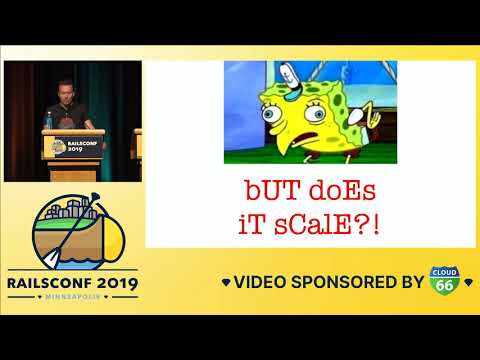
RailsConf 2019 - Opening Keynote by David Heinemeier Hansson
46K views • 7 years ago
Confreaks
David Heinemeier Hansson's opening keynote at RailsConf 2019 argues against the expectation of payment for open source work, drawing on his experience releasing Rails. It also includes lighter asides about the industry.
 1:01:40
Four Dimensional Maths: Things to See and Hear in the Fourth Dimension - with Matt Parker
3.1M views • 11 years ago
The Royal Institution
Matt Parker gives a hands-on Royal Institution talk on how four-dimensional shapes appear in a 3D world, with props like straw frames, Mobius strips and a knitted hat. It is a playful general-audience tour of the fourth dimension.
 43:37
Lambda World 2018 - What FP can learn from Smalltalk by Aditya Siram
25K views • 7 years ago
Lambda World
Aditya Siram argues that functional programming has much to learn from Smalltalk's interactivity, using Pharo and Squeak to show live, visual, explorable programming environments.
 50:50
The Search for the Perfect Door - Deviant Ollam
1.4M views • 10 years ago
Shakacon LLC
Deviant Ollam shows that most physical attacks on doors bypass the lock, with photo and video examples of how doors, frames and hardware get defeated. It is a physical security talk from Shakacon.
 13:40
Free software, free society: Richard Stallman at TEDxGeneva 2014
487K views • 12 years ago
TEDx Talks
Richard Stallman's TEDxGeneva 2014 talk describing how nonfree programs give companies control over users and what users can do to regain control. It introduces the free software movement and the four freedoms.
 26:13
Animation Bootcamp: An Indie Approach to Procedural Animation
786K views • 9 years ago
GDC Festival of Gaming
David Rosen of Wolfire Games explains how simple procedural techniques can produce fluid, interactive character animation from very few keyframes. Examples come from Overgrowth, Receiver and Black Shades, from his 2014 GDC session.
 30:50
Why Google Stores Billions of Lines of Code in a Single Repository
317K views • 11 years ago
@Scale
Rachel Potvin describes the scale of Google's codebase and its custom monolithic source repository. She explains the reasons for the monorepo model, the tooling that makes it workable, and its tradeoffs.
 18:19
Why city flags may be the worst-designed thing you've never noticed | Roman Mars
5.2M views • 11 years ago
TED
Roman Mars gives a funny TED talk on vexillology, laying out five basic principles of good flag design and why many city flags fail them.
 31:09
Bringing the Unix Philosophy to Big Data by Bryan Cantrill: FutureStack13
18K views • 12 years ago
New Relic
Bryan Cantrill presents Manta, an object store with in-situ compute that lets tools like grep, awk, and sed run map-reduce style over huge data. He frames it as bringing the Unix philosophy to big data.
 2:45
Using JSLint For Evil
15K views • 15 years ago
ryantravistate
A three-minute clip in which Douglas Crockford explains why he allowed the JSLint reference implementation to be used for evil. It recounts the license clause and how corporate lawyers reacted.
 1:07:34
What Happens When Maths Goes Wrong? - with Matt Parker
3.3M views • 7 years ago
The Royal Institution
Matt Parker's Royal Institution talk based on his book Humble Pi, covering everyday mathematical mistakes and spurious patterns that went wrong in engineering and software. It mixes stand-up comedy with stories of coincidence and error.
 26:56
The Implementation of Rewind in Braid
141K views • 9 years ago
GDC Festival of Gaming
Jonathan Blow's GDC talk explains how the time-rewind mechanic in Braid was designed and implemented, including the technical hurdles such as memory limits and state history. It covers both design and engineering concerns.
 36:27
ChatOps at GitHub - Jesse Newland
32K views • 13 years ago
Rubyfuza
Jesse Newland describes how GitHub uses Hubot, its chat bot, to run operations such as deployment, monitoring, graphing and provisioning from chat rooms. He explains how this improves shared awareness and remote work culture.
 43:23
AI Ethics, Impossibility Theorems and Tradeoffs - Chris Stucchio | Crunch 2018
2K views • 7 years ago
CraftHub Events
Chris Stucchio presents the ethical principles behind algorithmic decision making and shows with examples from lending, criminology and education that they cannot all be satisfied at once. The talk frames AI fairness as a set of quantitative tradeoffs.
 52:59
David Kriesel: Lies, damned lies and scans
58K views • 11 years ago
Free and Open Source Software Conference (FrOSCon) e.V.
David Kriesel's FrOSCon talk on how Xerox scancopiers, due to JBIG2 compression, silently replaced digits in scanned documents. He walks through how he discovered the bug and why it is so dangerous.
 1:21:05
Where Does Growth Come From? | Clayton Christensen | Talks at Google
802K views • 10 years ago
Talks at Google
Clayton Christensen speaks at Google on where growth comes from, covering disruption, market-creating versus efficiency innovation, and jobs to be done. He also touches on measuring your life.
 55:44
AWS re:Invent 2018: How AWS Minimizes the Blast Radius of Failures (ARC338)
37K views • 7 years ago
Amazon Web Services
An AWS re:Invent 2018 talk on how AWS limits the blast radius of failures. It covers design techniques such as cell-based architecture and shuffle sharding.
 1:40:27
CppCon 2014: Herb Sutter "Back to the Basics! Essentials of Modern C++ Style"
323K views • 12 years ago
CppCon
Herb Sutter revisits basic C++ questions in light of C++11 and C++14: how to declare and initialize variables, pass values to functions, write loops, and use smart pointers. It covers auto, rvalue references, range-for, uniform initialization, lambdas, unique_ptr and shared_ptr.
 18:33
Is the world getting better or worse? A look at the numbers | Steven Pinker
1.6M views • 8 years ago
TED
Steven Pinker's TED talk presents data on homicide, war, poverty and pollution to argue that the world has improved over the past decades. He frames progress as problem-solving, not inevitability.
 27:02
You Have No Idea How Wrong You Are
108K views • 15 years ago
SisyphusRedeemed
A talk given at the 2011 Nammour Symposium at Sacramento State arguing that past generations were wrong about nearly everything, so we should expect to be wrong too. It tours the many surprising ways scientific beliefs have failed, drawing on pessimistic induction.
 15:16
Donald Sadoway: The missing link to renewable energy
777K views • 14 years ago
TED
MIT professor Donald Sadoway argues that grid-scale storage is the missing piece for renewable energy. He sketches at the blackboard how large, cheap liquid-metal batteries could store wind and solar power.
 33:23
ReactiveConf 2017 - Tom Dale: Secrets of the Glimmer VM
3K views • 8 years ago
ReactiveConf
Tom Dale explains the internals of the Glimmer VM, Ember's rendering engine, which compiles templates to opcodes. The talk includes a performance benchmark demo.
 1:10:02
Building Software at Google Scale Tech Talk
58K views • 14 years ago
Google TechTalks
Google engineers describe Google's internal build system, a unified, language-agnostic system used across the company. It was presented as a 2012 NYC tech talk.
 1:03:14
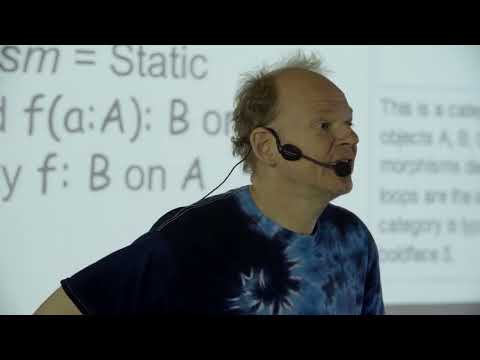
Category Theory, The essence of interface-based design - Erik Meijer
74K views • 11 years ago
FooCafe
Erik Meijer argues that category theory is the mathematicians' version of interface-based design. He shows that Java 8 lambdas and method references form a Cartesian closed category.