simulation
 5:26
Neural Network Learns The Physics of Fluids and Smoke | Two Minute Papers #118
209K views • 9 years ago
Two Minute Papers
Two Minute Papers covers a paper on speeding up fluid and smoke simulation with convolutional networks. It contrasts the approach with earlier regression forest methods.
Topic match · Computer graphics & rendering 6:18
Animated Voting Methods
16K views • 9 years ago
Unify The Vote
An animated simulation comparing single-winner voting methods such as plurality, instant runoff and STAR. Colored regions show which candidate wins as a randomized electorate shifts across a two-dimensional political space, building on Ka-Ping Yee's earlier diagrams.
 10:15
Using ground relays with Starlink
506K views • 6 years ago
Mark Handley
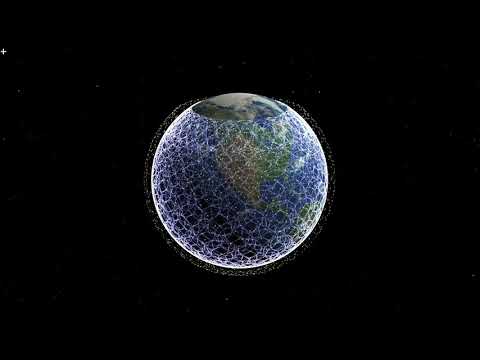
Mark Handley of UCL explains, with simulation visualizations, how early Starlink satellites without inter-satellite links could still give low-latency wide-area communication by hopping via ground relays. He shows it can beat fibre on many long paths.
 4:14
Computer Color is Broken
4.3M views • 11 years ago
minutephysics
MinutePhysics explains that computers store brightness nonlinearly, so blurring and blending colors in raw RGB gives wrong, dark results. It shows why mixed colors, such as in gradients, look off.
Topic match · Computer graphics & rendering 9:32
Disney's Practical Guide to Path Tracing
914K views • 10 years ago
Walt Disney Animation Studios
Walt Disney Animation Studios' short introduction to path tracing, showing how rays are traced and bounced through a virtual scene to simulate light. It explains how this approach is used in animated films.
Topic match · Computer graphics & rendering 4:17
AI Learns Noise Filtering For Photorealistic Videos | Two Minute Papers #215
65K views • 8 years ago
Two Minute Papers
A Two Minute Papers episode on NVIDIA's recurrent denoising autoencoder, which cleans up noisy Monte Carlo path-traced image sequences. It shows how a neural network can produce usable renders from very few samples.
Topic match · Computer graphics & rendering 8:09
Google Earth’s Incredible 3D Imagery, Explained
3.1M views • 9 years ago
Nat and Friends
A short explainer from Nat and Friends on where Google Earth's 3D imagery comes from, how it is stitched together, and how often it is updated. It describes aircraft carrying camera rigs and photogrammetry that turns the photos into 3D models.
Topic match · Computer graphics & rendering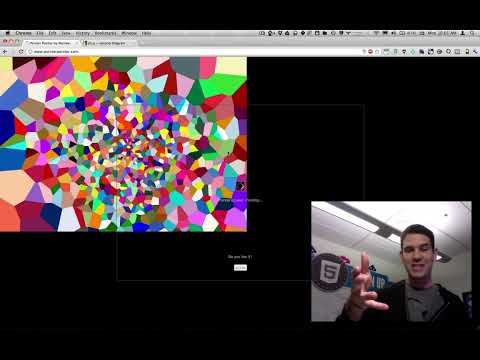 3:45
pointerpointer.com's use of voronoi, canvas, and javascript
40K views • 14 years ago
Paul Irish
Paul Irish explains how pointerpointer.com works. It uses a hidden canvas of colored Voronoi regions to look up which photo matches the cursor position.
Topic match · Computer graphics & rendering 8:28
The Fastest Way to Board a Plane Feels Like the Slowest
37.5M views • 7 years ago
CGP Grey
CGP Grey compares airplane boarding methods, based on an arXiv paper, and shows why the intuitive back-to-front approach is slow while random or outside-in boarding does better.
 7:16
Unix and Google
9K views • 10 years ago
FOAM
A short animated simulation comparing how Multics and Unix were developed, showing why Unix's small composable programs and pipes gave it a efficiency advantage. It frames Unix as a moonshot achievable by a small team.
 14:34
Visualization of Quantum Physics (Quantum Mechanics)
2.8M views • 9 years ago
udiprod
An animated visualization of basic quantum mechanics using a free particle, with simulations based on the actual equations. It covers waves, particles, and how measurement collapses the wavefunction.
 6:47
Starlink revisions, Nov 2018
173K views • 7 years ago
Mark Handley
Mark Handley of UCL looks at how SpaceX's November 2018 revisions to the Starlink constellation affect network behavior. The video visualizes the orbits and routing and estimates latencies, building on his earlier video and research paper.