standards
No strong matches for “standards”. Here are the closest videos.
 16:47
Lines of Light: How Analog Television Works
1.5M views • 9 years ago
Technology Connections
Technology Connections explains how analog television produced moving images without computers, covering scanning, CRTs and standards like NTSC and PAL. It is part of a series on analog TV.
Topic match · Audio & video engineering 10:00
How A London Orchestra Broke International Law
270K views • 7 years ago
12tone
12tone tells the story of pitch inflation and how concert A came to be standardized at 440 Hz, including attempts at legal standards. It is a short music history explainer.
 9:12
Uncovered - Dangerous Secrets of the DOT Helmet Standard
1.1M views • 8 years ago
FortNine
FortNine argues that the US DOT motorcycle helmet standard (FMVSS 218) is badly outdated and weak. It compares it with Snell and ECE standards and points to where you can look up test reports for your own helmet.
 14:27
Why is TV 29.97 frames per second?
2.2M views • 10 years ago
Stand-up Maths
Matt Parker explains the history behind NTSC television running at 29.97 frames per second rather than 30, tracing it to the backward-compatible addition of color. He walks through the arithmetic behind the odd ratio.
Topic match · Audio & video engineering 7:00
CD / Color
2.9M views • 6 years ago
Captain Disillusion
Captain Disillusion's comedic, fast-paced explainer on how color works in cameras, displays and video. It covers the biology of color perception and what it means for screens.
Topic match · Audio & video engineering 13:55
Segmented Displays
7.2M views • 4 years ago
Posy
Posy explores segmented displays, from the seven-segment display to alternative designs with fewer or more segments, with patents and history.
Topic match · Audio & video engineering 12:31
The Superheterodyne Radio: No really, that's its name
987K views • 7 years ago
Technology Connections
Technology Connections explains why the superheterodyne radio has its name and how mixing frequencies lets it tune stations well. It walks through the underlying wave phenomena and algebra and why the design solved a hard tuning problem.
Topic match · Audio & video engineering 4:20
Why Snow and Confetti Ruin YouTube Video Quality
10.4M views • 10 years ago
Tom Scott
Tom Scott explains why confetti and snow wreck video quality, using interframe compression and bitrate. He demonstrates it live by changing the quality on screen.
Topic match · Audio & video engineering 13:14
How Analog Color TV Works: The Beginnings
503K views • 8 years ago
Technology Connections
Technology Connections explains the early history of analog color television, from the 1954 start of modern color broadcasting, and how shadow masks work in CRTs. It is the first in a series on how analog color TV works.
Topic match · Audio & video engineering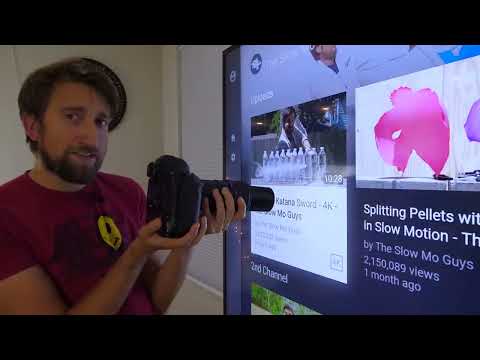 11:39
How a TV Works in Slow Motion - The Slow Mo Guys
45.7M views • 8 years ago
The Slow Mo Guys
The Slow Mo Guys film a TV and screens with a high-speed camera to show how displays build an image. The footage includes CRT-style scanning and how pixels light up over time.
Topic match · Audio & video engineering 16:29
Why Sony's Beta Videotape System Failed--and failed hard (Part 1)
1.5M views • 9 years ago
Technology Connections
Part one of Technology Connections' account of the VHS versus Betamax format war. It argues Sony was caught off guard by JVC's cheaper, more practical VHS system.
Topic match · Audio & video engineering 13:09
Moon Landings Faked? Filmmaker Says Not!
1.4M views • 13 years ago
VideoFromSpace
A filmmaker explains why the Apollo moon landing footage could not have been faked in a studio, based on the video and film technology of the late 1960s. He walks through the limits of cameras, frame rates and effects of the era.
Topic match · Audio & video engineering 12:24
The 1988 VIDEO Floppy Disk Camera: Canon Xap Shot RC-250
452K views • 8 years ago
LGR
LGR looks at the 1988 Canon Xap Shot, a still video camera that records photos to a floppy disk as analog NTSC signal rather than digital data.
Topic match · Audio & video engineering 17:04
These Are Not Pixels: Revisited
611K views • 8 years ago
Technology Connections
Technology Connections follows up on his analog TV video to clear up the debate over whether CRT phosphor dots are pixels. He explains the shadow mask, color triads and how they relate to the scanned picture.
Topic match · Audio & video engineering 12:16
LCCS: The LCD / CRT Hybrid from JVC
2.3M views • 7 years ago
Technology Connections
A Technology Connections video on JVC's LCCS, a display hybrid that cycles a color LCD shutter over a monochrome CRT to produce field-sequential color without dots or stripes. It builds on his earlier videos about analog TV and compatible color.
Topic match · Audio & video engineering 9:51
Comparing Beta & VHS on Quality: Was Beta Really Better?
710K views • 9 years ago
Technology Connections
Technology Connections compares Betamax and VHS picture quality using footage from a 1979 RCA VCR and argues the Beta quality advantage was largely marketing.
Topic match · Audio & video engineering 8:26
Why don't subtitles match dubbing?
2M views • 2 years ago
Tom Scott
Tom Scott explains why subtitles often differ from dubbed dialogue, covering how translation, timing and reading speed shape each. It features translators and voice talent working in several languages.
Topic match · Audio & video engineering 18:32
The world depends on a collection of strange items. They're not cheap
12.6M views • 3 years ago
Veritasium
Veritasium visits NIST to explain Standard Reference Materials, the carefully characterized items such as peanut butter used to calibrate instruments and keep measurements consistent. It covers why they exist and why they are expensive.
 12:07
Why We Can't Have Small Trucks Anymore - Blame the EPA
2M views • 3 years ago
All Cars with Jon
All Cars with Jon explains how EPA fuel economy rules, especially the footprint-based CAFE formula, push automakers away from small trucks.
 12:23
Xanadu Basics 1a - VISIBLE CONNECTION
20K views • 8 years ago
TheTedNelson
Ted Nelson explains the original Xanadu hypertext idea of visible connection, the notion that links between documents should be shown and preserved. He argues that the Web and current document standards lost this concept.
 8:52
Is America Actually Metric?
3.4M views • 9 years ago
Veritasium
Veritasium explains that the US signed the Metre Convention in 1875 and that all US customary units are officially defined in terms of metric standards. It also touches on the standard kilogram.