video codecs
 4:20
Why Snow and Confetti Ruin YouTube Video Quality
10.4M views • 10 years ago
Tom Scott
Tom Scott explains why confetti and snow wreck video quality, using interframe compression and bitrate. He demonstrates it live by changing the quality on screen.
 14:20
Reveal Invisible Motion With This Clever Video Trick
2.8M views • 6 years ago
Steve Mould
Steve Mould explains motion amplification and video magnification, techniques that find tiny changes in video invisible to the eye and exaggerate them. He covers the MIT research and industrial uses such as diagnosing vibrating machinery.
 7:00
CD / Color
2.9M views • 6 years ago
Captain Disillusion
Captain Disillusion's comedic, fast-paced explainer on how color works in cameras, displays and video. It covers the biology of color perception and what it means for screens.
Topic match · Audio & video engineering 12:24
The 1988 VIDEO Floppy Disk Camera: Canon Xap Shot RC-250
452K views • 8 years ago
LGR
LGR looks at the 1988 Canon Xap Shot, a still video camera that records photos to a floppy disk as analog NTSC signal rather than digital data.
 16:29
Why Sony's Beta Videotape System Failed--and failed hard (Part 1)
1.5M views • 9 years ago
Technology Connections
Part one of Technology Connections' account of the VHS versus Betamax format war. It argues Sony was caught off guard by JVC's cheaper, more practical VHS system.
 13:09
Moon Landings Faked? Filmmaker Says Not!
1.4M views • 13 years ago
VideoFromSpace
A filmmaker explains why the Apollo moon landing footage could not have been faked in a studio, based on the video and film technology of the late 1960s. He walks through the limits of cameras, frame rates and effects of the era.
Topic match · Audio & video engineering 9:51
Comparing Beta & VHS on Quality: Was Beta Really Better?
710K views • 9 years ago
Technology Connections
Technology Connections compares Betamax and VHS picture quality using footage from a 1979 RCA VCR and argues the Beta quality advantage was largely marketing.
Topic match · Audio & video engineering 5:10
Will YouTube Ever Run Out Of Video IDs?
10.1M views • 10 years ago
Tom Scott
Tom Scott explains YouTube's 11-character video IDs, which are base-64 encoded 64-bit numbers, and whether YouTube could ever run out of them. It covers counting systems and base 64 briefly.
 6:43
Explained: "Go Fast" UFO Video - Not Low and Not Fast - Like a Balloon!
156K views • 7 years ago
Mick West
Mick West analyzes the Navy "Go Fast" UFO footage and shows with simple trigonometry and the data overlay that the object is slow and high up, consistent with a balloon. He explains how parallax makes it look fast and argues the original TV claims were wrong.
 8:04
Khan Academy and the Effectiveness of Science Videos
1.7M views • 15 years ago
Veritasium
Veritasium examines research suggesting science explainer videos like Khan Academy's make students feel they understand while tests show they have not learned, because misconceptions go unaddressed. It suggests how to partly fix this.
 14:27
Why is TV 29.97 frames per second?
2.2M views • 10 years ago
Stand-up Maths
Matt Parker explains the history behind NTSC television running at 29.97 frames per second rather than 30, tracing it to the backward-compatible addition of color. He walks through the arithmetic behind the odd ratio.
Topic match · Audio & video engineering 5:07
7 Minutes of Terror: Curiosity Rover's Risky Mars Landing | Video
1.2M views • 14 years ago
VideoFromSpace
NASA's animated explanation of the Curiosity rover's Mars landing, which relied on a complex automated sequence taking about seven minutes. It features NASA engineers discussing the risks before the 2012 landing.
 8:25
Akira Kurosawa - Composing Movement
10.8M views • 11 years ago
Every Frame a Painting
An Every Frame a Painting video essay on how Akira Kurosawa used movement, weather and composition to tell stories. It draws on clips and interviews with other filmmakers.
 12:41
My Video Got 2 Companies Shut Down! (And even worse negative ion products)
5.6M views • 5 years ago
The Thought Emporium
The Thought Emporium follows up on his earlier video showing negative ion products are radioactive, reporting that Amazon pulled listings and companies shut down. He tests more radioactive quack products with a Geiger counter and cloud chamber.
 10:39
This Video Has 77,321,815 Views
77.3M views • 6 years ago
Tom Scott
Tom Scott's video whose title shows its own live view count, and the story of how he made that work. It explains why open APIs were once common and why they largely disappeared.
 18:25
How Star Wars was saved in the edit
3.2M views • 8 years ago
RocketJump
A video essay on how the editors of Star Wars: A New Hope recut and rearranged the footage to rescue the film. It walks through specific changes that improved pacing and drama.
 17:04
These Are Not Pixels: Revisited
611K views • 8 years ago
Technology Connections
Technology Connections follows up on his analog TV video to clear up the debate over whether CRT phosphor dots are pixels. He explains the shadow mask, color triads and how they relate to the scanned picture.
Topic match · Audio & video engineering 12:16
LCCS: The LCD / CRT Hybrid from JVC
2.3M views • 7 years ago
Technology Connections
A Technology Connections video on JVC's LCCS, a display hybrid that cycles a color LCD shutter over a monochrome CRT to produce field-sequential color without dots or stripes. It builds on his earlier videos about analog TV and compatible color.
Topic match · Audio & video engineering 12:02
Nintendo - Putting Play First
997K views • 10 years ago
Game Maker's Toolkit
Game Maker's Toolkit examines Nintendo's design approach of starting from a core play mechanic, making it fun, and building around it. Examples include Mario's jump and Luigi's Mansion's vacuum.
 9:06
Vancouver Never Plays Itself
2.2M views • 11 years ago
Every Frame a Painting
A video essay from Every Frame a Painting about Vancouver, a major film production city that almost never appears onscreen as itself. It shows clips of films and TV shot there that pass the city off as somewhere else.
 8:42
Michael Bay - What is Bayhem?
3.3M views • 12 years ago
Every Frame a Painting
An Every Frame a Painting video essay on Michael Bay's style, 'Bayhem', covering his camera movement, composition, color and editing. It argues that even if you dislike his films, they teach something about visual perception.
 8:00
Edgar Wright - How to Do Visual Comedy
11.4M views • 12 years ago
Every Frame a Painting
An Every Frame a Painting video essay analysing how Edgar Wright creates visual comedy through framing, camera movement, editing, sound effects and music.
 4:30
Watching This Video Disqualifies You From Jury Duty for Life
21.2M views • 12 years ago
CGP Grey
CGP Grey explains jury nullification, a juror's power to acquit despite the law, and why mentioning it can get you struck from jury selection.
 8:35
Buster Keaton - The Art of the Gag
8.4M views • 10 years ago
Every Frame a Painting
An Every Frame a Painting video essay on Buster Keaton's visual comedy, examining how he built and framed his gags. It uses clips from his silent films to show the thinking behind them.
 7:37
Satoshi Kon - Editing Space & Time
4M views • 12 years ago
Every Frame a Painting
A video essay from Every Frame a Painting on animator Satoshi Kon and his editing style, which distorts and warps space and time. It draws on his four features and one TV series.
 4:17
AI Learns Noise Filtering For Photorealistic Videos | Two Minute Papers #215
65K views • 8 years ago
Two Minute Papers
A Two Minute Papers episode on NVIDIA's recurrent denoising autoencoder, which cleans up noisy Monte Carlo path-traced image sequences. It shows how a neural network can produce usable renders from very few samples.
 13:55
Segmented Displays
7.2M views • 4 years ago
Posy
Posy explores segmented displays, from the seven-segment display to alternative designs with fewer or more segments, with patents and history.
Topic match · Audio & video engineering 12:31
The Superheterodyne Radio: No really, that's its name
987K views • 7 years ago
Technology Connections
Technology Connections explains why the superheterodyne radio has its name and how mixing frequencies lets it tune stations well. It walks through the underlying wave phenomena and algebra and why the design solved a hard tuning problem.
Topic match · Audio & video engineering 13:14
How Analog Color TV Works: The Beginnings
503K views • 8 years ago
Technology Connections
Technology Connections explains the early history of analog color television, from the 1954 start of modern color broadcasting, and how shadow masks work in CRTs. It is the first in a series on how analog color TV works.
Topic match · Audio & video engineering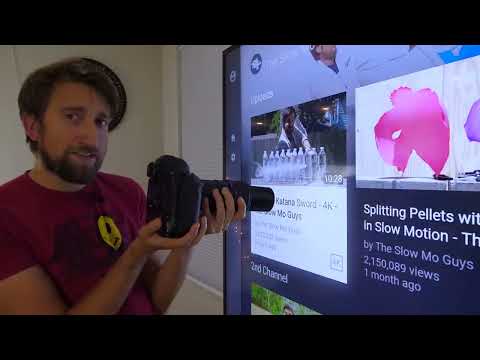 11:39
How a TV Works in Slow Motion - The Slow Mo Guys
45.7M views • 8 years ago
The Slow Mo Guys
The Slow Mo Guys film a TV and screens with a high-speed camera to show how displays build an image. The footage includes CRT-style scanning and how pixels light up over time.
Topic match · Audio & video engineering 16:47
Lines of Light: How Analog Television Works
1.5M views • 9 years ago
Technology Connections
Technology Connections explains how analog television produced moving images without computers, covering scanning, CRTs and standards like NTSC and PAL. It is part of a series on analog TV.
Topic match · Audio & video engineering 8:26
Why don't subtitles match dubbing?
2M views • 2 years ago
Tom Scott
Tom Scott explains why subtitles often differ from dubbed dialogue, covering how translation, timing and reading speed shape each. It features translators and voice talent working in several languages.
Topic match · Audio & video engineering 5:06
Ion drive: The first flight
2.4M views • 7 years ago
nature video
Nature video showing MIT researchers flying the first plane with no moving parts, powered by an ion drive that creates an ionic wind from high-powered electrodes. The 5m-wide craft flies across a sports hall.
 4:11
Laniakea: Our home supercluster
8.3M views • 12 years ago
nature video
A short Nature video on the discovery that our home supercluster is Laniakea, redefined by mapping the flow of galaxies rather than their density. It names the structure with a Hawaiian word meaning 'immeasurable heaven'.
 9:04
Jackie Chan - How to Do Action Comedy
25.4M views • 11 years ago
Every Frame a Painting
Every Frame a Painting analyzes how Jackie Chan stages action comedy, with nine principles such as starting from a disadvantage, using the environment, clear shots, and keeping action and reaction in the same frame.
 11:27
CGA Graphics - Not as bad as you thought!
2.4M views • 10 years ago
The 8-Bit Guy
The 8-Bit Guy covers IBM's 1981 CGA graphics system, including how composite output and artifacting produced extra colors beyond the nominal palette. He argues CGA looked better in period than it does on RGB monitors.
 16:30
Who cares about topology? (Old version)
3.3M views • 10 years ago
3Blue1Brown
An older 3Blue1Brown video on why topology matters, built around the inscribed rectangle problem. It walks through how tori and Mobius strips appear in the solution. The channel later replaced it with an updated version.
 18:39
This equation will change how you see the world (the logistic map)
17.1M views • 6 years ago
Veritasium
A Veritasium video on the logistic map, showing how a simple population equation leads to chaos and bifurcation. It connects the idea to convection, neuron firing and the Mandelbrot set, with interactive animations.
 6:26
Slow Motion Flipping Cat Physics | Smarter Every Day 58
11.3M views • 14 years ago
SmarterEveryDay
Destin of Smarter Every Day films a cat falling in high-speed slow motion to show how cats right themselves in midair, and introduces the physics behind it.
 7:42
Extremely Large Numbers 1 - Introduction
20K views • 11 years ago
Giroux Studios
The first video in a series on extremely large numbers, introducing the topic with examples. Later parts go deep into the fast-growing hierarchy.