How To Contact The Voyager 2 Probe (PART 1)
EEVdiscover2 HN recommenders · recommended in 2 months, 2017-2024
93K views · 9 years ago · tutorial · evergreen
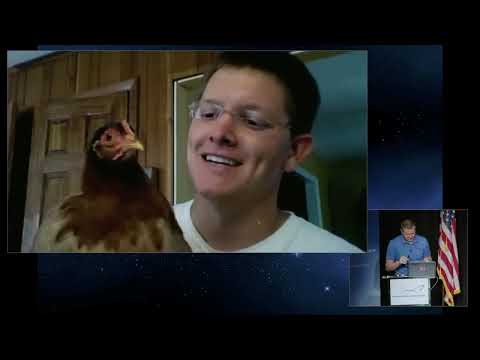
Dave Jones of EEVblog and Richard Stephenson tour the 70m DSS43 dish at the Canberra Deep Space Communication Complex and explain how NASA talks to Voyager 2. It covers the transmitters, receivers and tracking involved.
Recommended in Voyager threads as the best look at how operators actually contact the probe.
 13:01
Pinging The Voyager 2 Probe (PART 2)
EEVdiscover
75K views • 9 years ago
 19:59
EEVblog 1547 (Part 1) - Contacting the Voyager 2 Space Probe
EEVblog
71K views • 3 years ago
 1:03:45
How We Diagnosed and Fixed the 2023 Voyager 1 Anomaly from 15 Billion Miles Away
Flight Software Workshop
17K views • 1 year ago
 40:05
"Uptime 15,364 days - The Computers of Voyager" by Aaron Cummings
Strange Loop Conference
349K views • 7 years ago
 35:25
Saving Voyager 1! - Bruce Waggoner at !!Con 2024
!!Con
8K views • 2 years ago
 11:01
Pulling Clear Images Directly Off Satellites | GOES-15,16,17 and Himawari 8 HRIT
The Thought Emporium
635K views • 8 years ago
 10:15
Using ground relays with Starlink
Mark Handley
506K views • 6 years ago
 27:58
Build an electroluminescent glass panel display -- an Apollo DSKY
Applied Science
522K views • 7 years ago
 7:00
1,000km Cable to the Stars - The Skyhook
Kurzgesagt – In a Nutshell
13M views • 6 years ago
 22:49
EEVblog 1637: Solar Freakin' Space Mirrors! - Reflect Orbital DEBUNKED
EEVblog
112K views • 2 years ago
 33:43
TSP #183 - Starlink Dish Phased Array Design, Architecture & RF In-depth Analysis
The Signal Path
171K views • 5 years ago
 1:02:29
EEVblog #555 - 555 Timer Kit
EEVblog
370K views • 12 years ago
 28:09
How does Starlink Satellite Internet Work?📡☄🖥
Branch Education
9.9M views • 4 years ago
 6:47
Starlink revisions, Nov 2018
Mark Handley
173K views • 7 years ago
 12:31
The Superheterodyne Radio: No really, that's its name
Technology Connections
987K views • 7 years ago
 1:01:42
34C3 - The Ultimate Apollo Guidance Computer Talk
media.ccc.de
324K views • 8 years ago
 1:05:20
I Was SCARED To Say This To NASA... (But I said it anyway) - Smarter Every Day 293
SmarterEveryDay
5M views • 2 years ago
 31:12
The Insane Engineering of James Webb Telescope
Real Engineering
8.8M views • 4 years ago
 2:15
It's Quieter in the Twilight | Trailer | SF48
Boston SciFi
10K views • 3 years ago
 12:36
Why the Muon g-2 Results Are So Exciting!
PBS Space Time
1.5M views • 5 years ago
6 comments from Hacker News
Well, we need much more on our end than the power of a cellular signal- For instance, one of the support antenna dishes of the Deep Space Network is DSS-42 in Canberra... which is a 70 meter diameter parabolic dish. And the transmit power on our side is in the tens of kilowatts. Literally tens of thousands of times more power needed than a cell phone and directed by a 70 meter dish.... We need that because the dish on the Voyager probes is 'only' 3.7 meters. Still... not a cell phone antenna. That said, the transmit power of the Voyagers is tiny in comparison to ours and it is closer to that of the cell phone analogy- still more, however, at about 23 watts [1]. So, our end task of receiving that, by the time it gets to us, is damn impressive indeed I think. [0] ▶ this video [1] link
Video recommendation: How To Contact The Voyager 2 Probe ( ▶ this video ) and Pinging The Voyager 2 Probe ( link ) by EEVDiscover
Yes, there was even some new lately. "Voyager Spacecraft Detect an Increase in The Density of Space Outside The Solar System" link Dave Jones made a coupe of videos about the Deep Space Station in Canberra. ▶ this video
Dave Jones of EEVBlog has a nice series of videos talking to Richard Stephenson, Operations Supervisor at the DSN's Canberra site. How To Contact The Voyager 2 Probe: Part 1: ▶ this video Part 2: link Part 3: link (the playlist is a mess, and videos are unordered) There are also a couple of Behinde the Scenes videos.
Haven't worked in this field, but here are some episodes discussing the topic: link link link link link ▶ this video I think what you are talking about is mostly just normal engineering in the sense that the process is similar. What really makes space unique isn't space as such but that there is no real-world (real-space?) testing, no inspections after the fact or do-overs.
There are high gain antennas on both ends, and use of error correcting codes, as well as extremely high grade low noise amplifiers on the Earth side. The Voyagers have a 3.7m diameter parabolic radio dish, larger than the Hubble space telescope's mirror even. That alone provides a huge amount of gain on communications. Additionally, the spacecraft have 10s of watts of power available for transmitting signals, which is a fair bit considering (while on the other end the ground stations have up to hundreds of thousands of watts to transmit). The ground-stations in the deep space network (DSN) are tens of meters across, a small antenna is 34m, the biggest ones are 70m across. That also provides a huge amount of gain alone. It means that there is more area to collect signals from the spacecraft and it means that the beam from the ground station to the spacecraft is much tighter, concentrating the total transmission power into a smaller cross-sectional area at the distance of the spacecraft. The spacecraft also uses error correcting codes, which involve transmitting many more bits than the underlying data, but in such a way that errors due to noise are not only detectable but correctable. On top of all of that you have the state of the art low noise amplifiers in the DSN antennae. A typical low noise amplifier is a carefully built electronics assembly made by experts. The DSN amplifiers? They use 99.95% purity ruby rods chilled to 4 degrees above absolute zero to form microwave MAS