Understanding the Toyota RAV4 Hybrid
WeberAuto3 HN recommenders · recommended in 3 months, 2023-2026
1.7M views · 5 years ago · lecture · evergreen
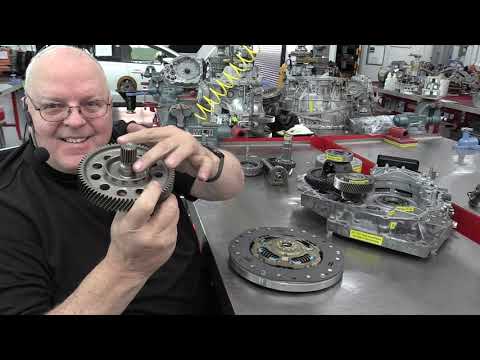
Weber State's Professor Kelly explains the Toyota RAV4 Hybrid transaxle, including its planetary gearset eCVT and all nine operating modes. It also covers how the engine reaches nearly 40 percent thermal efficiency.
HN points to it as the clearest hands-on explanation of how Toyota hybrids work.
 4:37
Hybrid Power Split Device. eCVT transmission.
David Patience
285K views • 6 years ago
 25:15
Understanding the Honda CR-V Hybrid E-Drive
WeberAuto
941K views • 5 years ago
 14:57
Prius Hybrid Drive Explained
Niels Blaauw
1.1M views • 10 years ago
 14:28
The Unfortunate Truth About Toyota's Hydrogen V8 Engine
Engineering Explained
2.4M views • 4 years ago
 13:52
Is A Toyota SUV "Greener" Than A Tesla?
Engineering Explained
427K views • 5 years ago
 16:19
BMW's Hydrogen V12 Engine Is A Hilarious Engineering Stunt
Engineering Explained
503K views • 3 years ago
 14:32
Why Gas Engines Are Far From Dead - Biggest EV Problems
Engineering Explained
4.4M views • 6 years ago
 10:06
The Future of the Internal Combustion Engine - /INSIDE KOENIGSEGG
The Drive
1.5M views • 13 years ago
 9:31
How Differential Gear works (BEST Tutorial)
ConceptVBS
9.3M views • 17 years ago
 10:56
Model Y E36: The Octovalve Episode
Munro Live
317K views • 6 years ago
 14:58
The Truth about Hydrogen
Real Engineering
5.7M views • 8 years ago
 9:41
Spinning Levers - How A Transmission Works (1936)
US Auto Industry
11.5M views • 14 years ago
 25:50
I put Koenigsegg’s freevalve tech on a Miata... It runs and drives!
Wesley Kagan
1.1M views • 5 years ago
 10:56
Tesla Is Lightyears Ahead Of... Tesla
SuperfastMatt
1.4M views • 5 years ago
 12:08
Tesla Model 3's motor - The Brilliant Engineering behind it
Sabin Civil Engineering
8M views • 5 years ago
 16:19
KSP Doesn't Teach: Rocket Engine Plumbing
Scott Manley
1.1M views • 10 years ago
 1:51:13
A4 / V2 Rocket in detail: Turbopump
Astronomy and Nature TV
1.8M views • 7 years ago
 3:20
Tank Safety: Hydrogen Tank Gunshot | Toyota
Toyota USA
122K views • 10 years ago
 12:27
Mach-E Thermal System Part 2: A Detailed Comparison to the Model Y
Munro Live
225K views • 5 years ago
 41:44
Comparing Tesla, Ford, & VW's Electrical Architectures
Munro Live
381K views • 5 years ago
7 comments from Hacker News
I understood after I watched the brilliant Weber Auto video on it, published 5 years ago[0]. I liked it so much I "gently" encouraged my partner to get a Yaris hybrid, which gets about 69mpg average. It's not unusual to see 80+ on individual trips. She was a little sceptical about having an auto at first, because us Europeans still think it's 1980 and that manuals are superior, but she came around after a few minutes of driving. To be fair, though, classic "slushbox" autos actually were/are garbage, as are chain actuated CVTs. The hybrid system gets you immediate acceleration like an electric, none of this awful lag you get with a slushbox. It's hilarious to me that 34mpg is considered remarkably good, though. I know it's a "minivan" but my Golf GTI gets 42mpg and is actually fun and arguably cool. I can also fit 5 people, furniture, and 2.4m lengths of timber in it comfortably. [0] ▶ this video
The planetary gear "eCVT" systems that Toyota and Ford use in many models are mechanically a lot simpler than a traditional automatic or sequential manual transmission. Few moving parts and no clutches at all. I don't know what the long term reliability of those drivetrains is is but I wouldn't be surprised if it's measurably measurably better than a traditional transmission + engine. There's a long educational video from Weber State University that gives a good walkthrough of what's going on in those things. ▶ this video
> Toyota-style hybrid drives could be a lot lighter The hybrid electric motor in a Toyota is already pretty comparable in weight to the motor in TFA, but obviously much less powerful. You can see the main hybrid motor of a RAV4 at [0]. If memory serves both the Camry and RAV4 hybrid models are only 2-300 lbs heavier than their gas counterparts. 0: ▶ this video
A quick Web search seems to indicate that's either a) not actually a CVT at all, or at best b) a planetary gear used as a power-splitting device to connect electric and ICE power sources to a conventional CVT. So this compares rather favourably, by actually being a geared CVT, which Toyota's "eCVT" apparently isn't at all. Sources: link (From: link ) ▶ this video (Long, 39 min!) Ooh, aah, now I get it (I think): Yes, the output RPM of the "eCVT" is indeed continuously variable. But that's just how all planetary gearboxes with two power inputs (as here, ICE and e-motor) work: The output RPM is a function of both the input RPMs, a (weighted) average of them if you will. So you can vary the output RPM while holding one of the input RPMs constant, simply by varying the other input RPM. Here Toyota presumably wants to keep the ICE working at the most economical RPM, while allowing the vehicle to move at varying speeds, which they achieve by varying the RPM of the electric motor. (In practice, Toyota uses two electric motors, but AFAICS the principle also applies to just one. TBH I'm not sure why they need two, but then I'm only halfway through that long video.) So yeah, the "eCVT" is kind of "a CVT", but only if you have two power sources simultaneously. It can't apply a continuously varying gear ratio from just one power input to a power output, which is what is usually meant by "power transmission". TL;DR: This can vary the gear ratio from a single power source to your wheels; To
The "eCVT" in the Toyota hybrid system isn't a CVT at all, but rather a system that uses the electric motors with planetary gearsets to keep the engine operating as close to its optimal RPM as possible: ▶ this video
Most of the images there are broken, all I see are some conceptual block diagram type things. Find a teardown of the hybrid unit and compare to a teardown of any automatic, look at the actual internal complexity and moving parts. I was surprised. Here's a video of the P710: ▶ this video
Toyota's eCVT? Not at all. The gas engine can drive the front wheels directly. link Conceptual explanation of the system. ▶ this video Weber Auto giving an extensive hands on explanation.