#NoEstimates (Allen Holub)
Allen Holub2 HN recommenders · recommended in 2 months, 2019-2025
259K views · 11 years ago · talk · evergreen
Allen Holub's keynote arguing that estimation is harmful, particularly in Agile, and presenting planning approaches based on data and flow instead. It covers the distinction between estimation and data-driven prediction.
Recommended in estimation and sprint debates as a well-reasoned account of where waste is and isn't in agile.
 1:02:30
"Agile Methods The Good, the Hype and the Ugly," Bertrand Meyer
Association for Computing Machinery (ACM)
18K views • 11 years ago
 40:39
Agile is Dead • Pragmatic Dave Thomas • GOTO 2015
GOTO Conferences
1.5M views • 11 years ago
 1:07:58
Software Art Thou: Glenn Vanderburg - Real Software Engineering
Zendesk
35K views • 8 years ago
 42:59
"How NOT to Measure Latency" by Gil Tene
Strange Loop Conference
119K views • 11 years ago
 44:35
Object-Oriented Programming is Bad
Brian Will
2.6M views • 10 years ago
 1:04:48
"Performance (Really) Matters" with Emery Berger
Association for Computing Machinery (ACM)
7K views • 6 years ago
 18:41
Refterm Lecture Part 1 - Philosophies of Optimization
Molly Rocket
93K views • 5 years ago
 40:27
"Finding bugs without running or even looking at code" by Jay Parlar
Strange Loop Conference
42K views • 7 years ago
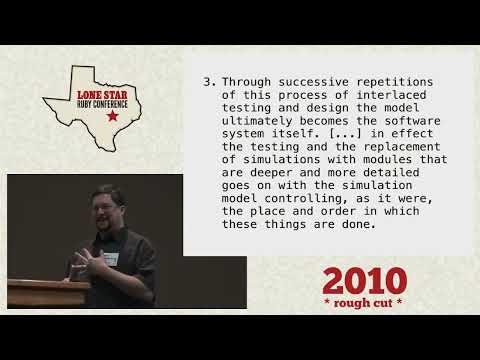 51:57
Lone Star Ruby Conference 2010 Real Software Engineering by Glenn Vanderburg
Confreaks
30K views • 15 years ago
 45:50
"The Mess We're In" by Joe Armstrong
Strange Loop Conference
398K views • 12 years ago
 46:37
Zebras All the Way Down - Bryan Cantrill, Uptime 2017
Code & Supply
49K views • 9 years ago
 1:29:27
The Forgotten Art of Structured Programming - Kevlin Henney [C++ on Sea 2019]
cpponsea
245K views • 7 years ago
 50:01
Simplicity Ain't Easy - Stuart Halloway
ClojureTV
24K views • 13 years ago
 41:47
Glenn Vanderburg of LivingSocial on why software development is an engineering discipline
O'Reilly
17K views • 11 years ago
 4:57
Rich Hickey rants about HttpServletRequest in 1080p: Death By Specificity from Clojure Made Simple
Fred Overflow
43K views • 6 years ago
 1:10:05
Are We There Yet - Rich Hickey
Zhang Jian
24K views • 7 years ago
 46:40
Andrew Kelley: A Practical Guide to Applying Data Oriented Design (DoD)
ChimiChanga
415K views • 2 years ago
 27:29
Software Engineering's Greatest Hits
Greg Wilson
25K views • 5 years ago
 11:48
John Rauser keynote: "Statistics Without the Agonizing Pain" -- Strata + Hadoop 2014
O'Reilly
61K views • 12 years ago
 42:15
"Performance Matters" by Emery Berger
Strange Loop Conference
502K views • 7 years ago
7 comments from Hacker News
▶ this video #NoEstimates Yes, be agile. Yes, measure all the things. But estimation sets everyone up for disappointment.
Planning doesn't mean estimation though; we all know it's just guesswork, and basing business decisions on guesswork is madness. On top of that it's a lot of wasted time and effort. Milestones and projections is a much more constructive approach, simply tracking the number of tasks in your backlog over time will give you an increasingly correct projection of when the project will be finished. ▶ this video
One could write a solid critique of sprints and how they help or don't, and where time is wasted, but this article is overzealous and comes off as motivated more by anger than reasoning. If you want a well-reasoned discussion of where the waste is and isn't, I highly recommend Allen Holub's talk #NoEstimates [0]. [0] ▶ this video
Apparently if you do zero estimating (or just count the amount of stories), it makes ZERO difference when calculating your cumulative-flow diagram. ▶ this video Money segment is at the 26m15s mark. The wasted effort of trying to estimate stories provides zero business value in this context.
Thank you for your comment! > But I don't get how they went from that to "estimations are bad". It seems to me that they're just doing better estimations now by looking at historical data? For me personally, I went from estimations are just really poor even for the most simple things and not worth the effort. It is correct that is can still be seen as migrating to a better form of estimation. If you look at the conference talk by Allen Holub[1]. He tries to make the distinction between estimation and prediction is that the latter is only data driven. > Maybe the team leader is confused because they thought this was a man-hour estimation? And they're now afraid that one developer will work full-time five days on it? That could be the case. I never looked at it that way. > Doesn't this imply that their 10 minute estimation was done completely without asking the team? Yes, it was done with just the team lead and me. We migrated away from Scrum at that point and we did not do full team refinement with estimations sessions pre-sprint. We would collaborate on the technical solution for any story when we would pick it. This could be full team to two engineers. The engineer that brought up the bug would probably bring up the bug. > Really? You couldn't consider the complexity of a release process you designed yourself? You honestly thought this was a 10 minute task even though you knew you were dealing with a legacy system? Yes, I honestly did! It was just a simple code change in our
he also links to a conference talk about this. "you can make a claim that estimates are based on past behavior, but the fact is that what you're implementing is something that hasn't been implemented before. So any kind of measurement that you've made of something that has happened in the past is not going to impact what you're doing now" ▶ this video
There's an interesting video by Allen Holub that I've seen on the somewhat related topic of ridding software development of estimates (#NoEstimates)[1]. He argues that they're responsible for deadlines that are impossible to meet due to them being based completely on a guess. He then goes on to talk about how we can still get predictive power without giving estimates. I found it extremely interesting and highly recommend it. [1] ▶ this video