CppCon 2017: Titus Winters “C++ as a "Live at Head" Language”
CppCon7 HN recommenders · recommended in 7 months, 2017-2022
53K views · 9 years ago · talk · evergreen
Titus Winters' CppCon 2017 talk argues for C++ and Google's Abseil to be maintained as a live at head language, relying on testing and automated tooling rather than never changing or promising no compatibility. It covers Hyrum's law and the limits of semantic versioning.
Recommended whenever versioning, semver, monorepos and backward compatibility are debated, for its nuanced treatment of dependencies.
 1:29:06
CppCon 2015: Herb Sutter "Writing Good C++14... By Default"
CppCon
193K views • 11 years ago
 1:54:00
Can C++ be 10x Simpler & Safer? - Herb Sutter - CppCon 2022
CppCon
277K views • 3 years ago
 56:52
CppCon 2014: Zaika Antoun "Microsoft w/ C++ to Deliver Office Across Different Platforms, Part II"
CppCon
7K views • 12 years ago
 1:40:46
CppCon 2015: Bjarne Stroustrup “Writing Good C++14”
CppCon
351K views • 11 years ago
 1:47:45
CppCon 2017: Herb Sutter “Meta: Thoughts on generative C++”
CppCon
105K views • 9 years ago
 1:00:16
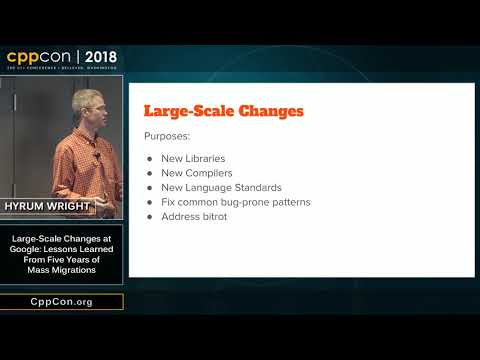
CppCon 2018:H. Wright “Large-Scale Changes at Google: Lessons Learned From 5 Yrs of Mass Migrations”
CppCon
16K views • 8 years ago
 1:16:14
Spec-ulation Keynote - Rich Hickey
ClojureTV
135K views • 9 years ago
 1:02:33
CppCon 2017: Kate Gregory “10 Core Guidelines You Need to Start Using Now”
CppCon
144K views • 9 years ago
 59:31
CppCon 2014: Zaika Antoun "Microsoft w/ C++ to Deliver Office Across Different Platforms, Part I"
CppCon
21K views • 12 years ago
 1:39:25
CppCon 2016: Herb Sutter “Leak-Freedom in C++... By Default.”
CppCon
149K views • 10 years ago
 1:15:46
CppCon 2017: Matt Godbolt “What Has My Compiler Done for Me Lately? Unbolting the Compiler's Lid”
CppCon
178K views • 9 years ago
 1:36:27
CppCon 2016: Dan Saks “extern c: Talking to C Programmers about C++”
CppCon
175K views • 10 years ago
 1:19:52
CppCon 2016: Jason Turner “Rich Code for Tiny Computers: A Simple Commodore 64 Game in C++17”
CppCon
264K views • 10 years ago
 1:00:46
CppCon 2018: Stoyan Nikolov “OOP Is Dead, Long Live Data-oriented Design”
CppCon
271K views • 8 years ago
 1:33:12
De-fragmenting C++: Making Exceptions and RTTI More Affordable and Usable - Herb Sutter CppCon 2019
CppCon
90K views • 7 years ago
 1:40:27
CppCon 2014: Herb Sutter "Back to the Basics! Essentials of Modern C++ Style"
CppCon
323K views • 12 years ago
 1:29:54
CppCon 2015: Chandler Carruth "Tuning C++: Benchmarks, and CPUs, and Compilers! Oh My!"
CppCon
188K views • 11 years ago
 57:39
CppCon 2016: Chandler Carruth “Garbage In, Garbage Out: Arguing about Undefined Behavior..."
CppCon
94K views • 10 years ago
 54:01
Abseil's Open Source Hashtables: 2 Years In - Matt Kulukundis - CppCon 2019
CppCon
22K views • 7 years ago
 1:27:46
CppCon 2014: Mike Acton "Data-Oriented Design and C++"
CppCon
862K views • 12 years ago
14 comments from Hacker News
This kind of comment is not helpful at all, I use Rust today however, yet I cannot sometimes deny, it's better to use C depending on the target and restrictions by hardware compilers. Every language has downsides/upsides and time. There is a nice quote by Titus Winters: “Engineering is programming integrated over time”[0], this helped me a lot in learning that context matter for tools/languages/frameworks, and you can learn with their mistakes. [0]: ▶ this video
Usually that problem is dealt with combination of: * Automation. * Ability to change other people's code safely, possibly gated by code review approval. Cultural and technical (e.g. unit tests must exist and be maintained) barriers may apply. * Making incremental changes that are backward compatible (at least until you migrated all clients so you can cleanup later) I recommend this talk ▶ this video (even if the scope is broader than your question) (ex-googler)
> If you go listen to Google people talk about dependency/version management. It's like they think it's global lock vs inconsistency. Monorepo or chaos. This false choice irks me. I watched this talk: ▶ this video I’d say this is a much more nuanced look at dependencies & versioning. We all know these days that something like semantic versioning is not enough, because it is too easy to depend on behavior which the developers of your dependencies did not expect you to depend on. So you need something more powerful than just having a bunch of developers get together and agree not to break each others’ code. Bazel is a part of that solution—if you can analyze and understand the dependencies in a project, and do so in a very automatic and reliable way, you can provide people with tools tools for updating downstream code when upstream code changes. I think people are focusing too much on Bazel as only a build system and not as part of a platform for building developer tooling, and people are focusing too much on Bazel’s original incarnation as a build system for a massive monorepo. I think there’s also a reality that we must deal with that is—as software gets larger and more complex, and as we have more dependencies, relying on version pinning for stability is losing ground as a technique for making our software more reliable. We have many more dependencies in our software now, so just subscribing to a mail feed of all of the version bumps in the libraries you use would be enough to dr
100% agree. Semver is a _social_ construct not a _technical_ one. There is Semver the spec as originally designed, and Semver as it is currently observed. Semver has become something other than it was originally intended, likely because the idea of "breaking changes" ends up being way more encompassing than people wanted to admit [1]. To ignore that reality is a futile fight. [1] - ▶ this video
Not that cut and tried as it depends what "goes into production" means. As an example: Lets say I have an open-source library that I am developing. It is currently version 0.x.y and someone depends on it (without my knowledge because that is usually how it is). Is that now in Production? Should I be forced to make it 1.0.0 even though I am still making large numbers of breaking changes? That is a simple example off the top of my head. I am watching ▶ this video (Linked from another comment) and he goes into good details about issues with Semver.
For another perspective on “semver is a lie,” see the “Live at Head” talk from Titus Winters of the Google core C++ team. ▶ this video TL;DW: By Hyrum’s law, at sufficient scale, there’s no such thing as a non-breaking change (including changing comments). Embrace that, and test sufficiently that you can always take the latest dependency but detect when it breaks.
Specifically, absl (Google's C++ library already provides this guarantee). In general the idea is that they will provide backwards compatibility for 5 years, and provide tooling to update source code to new constructs. This is covered somewhere in this talk: ▶ this video
Some here are saying "Why not just use Rust/D/Zig/Nim/Crystal if you're going to break backwards compatibility?" I believe the proposal is closer to "We've removed this old feature, run this tool to replace it with the new one." C++ will keep looking like C++, not like Rust. Here's Google's "Codebase Cultivator" explaining the idea for their Abseil library: ▶ this video I remember watching another talk where they propose something similar for the language itself, but I can't find it at the moment.
Semantic versioning isn't a silver bullet, unfortunately, due to the 'Diamond Dependency Problem'. That is, A depends on B and C, but B and C depend on different versions of D. Easy to fix, until you scale that up to thousands of nodes in a dependency graph. This talk is one of the better ones about this: ▶ this video
> add a huge tree of dependencies without having to think about it. Keep in mind that the alternative is "I have to build (or pull a prebuilt version of) the entirety of every repo that I depend on". An entire repo is always going to be larger than a single target. Yes you're right that pulling in the entirely of {{some large tool}} because you want `tool.strings.util.mangle_name` is bad. The alternatives are 1. (multi-repo) You stick mangle name in its own repo (think `left-pad`) 2. (monorepo) Depend on `tool` in its entirety 3. (either, though more common in multi-repo) Everyone re-implements mangle_name. If the way the name is mangled is important, and it changes in the future, you have major issues and incompatibilities. (think IPV4 -> IPV6 for an example where a "global" `parse_addr` function would have made everyone's lives easier). You can bet on the assumption that mangle_name will never change, but then you aren't doing software engineering[1] All of these are the wrong solution 4. Core utilities like this get factored out into their own files. In a multi-repo environment, everyone depends on the entire core/util repo. In a monorepo environment, you depend on the granular files you need. 4 is the only correct solution, and note that in a monorepo environment it results in you depending on fewer things than in a multi-repo environment. Yes there are a lot of ways to do things wrong, But that's true no matter what tooling you use. When used "correctly", monorepos have
> You are totally correct that to achieve the same performance, correctness, and overall master level "green"ness in a multirepo system you would have to either define or detect dependencies and dependent repos, build the entire affected chain, and test the result. That part is much easier in monorepo. You also would need to do that as an atomic operation (in the mono-repo + especially with a commit queue you're building on the atomicity of git). Having to unwinding that transaction if you aren't atomic can get you into a big mess at larger scales. Here's a good related talk: C++ as a "Live at Head" language: ▶ this video by Titus Winters (from Google).
Relevant talk by Google at CppCon last year focused on C++, but really talks about getting rid of versioning in general. ▶ this video
Lots of posts here frame it like "Yes, it's a bit of a complex language, but the C++ committee has the difficult job of keeping everything backwards compatible, so it's understandable." But that's not the reality. The reality is that they (or Stroustroup) made that decision, and that decision was a mistake. The correct way to deal with backwards compatibility issues is the way Go does it, namely to write tools to automatically upgrade code to a newer API [1]. And as that smug Google guy explained here [2], they have something like this for C++, too. They just don't bother sharing it with us peasants. The fundamental mistake of C++ is to religiously keep backwards-compatibility with everything for all eternity. It's so easy to say that backwards-compatibility is a good thing. It's obvious! But ultimately that decision is the reason for all the problems that C++ has. [1] link [2] ▶ this video
There is a great talk by their C++ dev team about how a build everything from source, mono repo really helps with C++ change enablement ▶ this video Personally, I’d have to agree that at a minimum a mono repo per distinct product role (server side in one mono repo, desktop software in one mono repo) is immensely valuable.