apollo
 8:43
Apollo 11 Saturn V Launch Camera E-8
10.5M views • 13 years ago
Mark Gray
Raw 500 fps footage from Camera E-8 on the launch tower for the Apollo 11 Saturn V liftoff, transferred in HD from the 16mm original. More than eight minutes of film covers about 30 seconds of real time.
 6:54
NASA | Earthrise: The 45th Anniversary
2.3M views • 12 years ago
NASA Goddard
NASA Goddard recreates the Apollo 8 Earthrise moment using Lunar Reconnaissance Orbiter data, narrated by Andrew Chaikin and synced with the astronauts' recorded conversation. It marks the flight's 45th anniversary.
Topic match · Space exploration & spaceflight 13:09
Moon Landings Faked? Filmmaker Says Not!
1.4M views • 13 years ago
VideoFromSpace
A filmmaker explains why the Apollo moon landing footage could not have been faked in a studio, based on the video and film technology of the late 1960s. He walks through the limits of cameras, frame rates and effects of the era.
Topic match · Space exploration & spaceflight 5:04
Why Can't we Remake the Rocketdyne F1 Engine?
4.2M views • 8 years ago
Curious Droid
Short Curious Droid video on why NASA could not simply rebuild the Saturn V's Rocketdyne F-1 engine for the SLS boosters. It explains that the engines were hand-tailored and that much of the know-how was never documented, so the blueprints were not enough.
Topic match · Space exploration & spaceflight 11:50
CNN, Feynman and the Challenger disaster
692K views • 11 years ago
vsrr83
A June 1986 CNN interview with physicist Richard Feynman about the Challenger disaster and the management failures he found while serving on the investigating commission.
Topic match · Space exploration & spaceflight 4:26
Dr. Robert Zubrin with a brilliant answer to "Why Should We Go To Mars?"
470K views • 10 years ago
Jamin Gray
A short clip of Dr. Robert Zubrin, author of The Case for Mars, answering why humanity should go to Mars. He argues that societies grow by challenging themselves and that exploration inspires young people.
Topic match · Space exploration & spaceflight 10:22
How Far Are The Nearest Stars?
3.7M views • 9 years ago
Cody'sLab
Cody's Lab builds a 200-billionth-scale model to show how far away the nearest stars are, using parallax and light speed. A short astronomy explainer on interstellar distances.
Topic match · Space exploration & spaceflight 7:35
End of Space – Creating a Prison for Humanity
14.6M views • 7 years ago
Kurzgesagt – In a Nutshell
Kurzgesagt explains how accumulating space junk could trigger a collision cascade (Kessler syndrome) that makes launches too dangerous and traps humanity on Earth.
Topic match · Space exploration & spaceflight 5:08
7 Minutes of Terror: The Challenges of Getting to Mars
3.2M views • 14 years ago
NASA Jet Propulsion Laboratory
NASA JPL engineers explain the final minutes of the Curiosity rover's entry, descent and landing on Mars, which combined aerobraking, a parachute and a skycrane. It lays out the tight sequence of events that all had to work automatically.
Topic match · Space exploration & spaceflight 8:39
How to Move the Sun: Stellar Engines
19.5M views • 6 years ago
Kurzgesagt – In a Nutshell
Kurzgesagt explains stellar engines such as the Shkadov thruster and Caplan thruster, which could move the Sun and solar system across the galaxy over millions of years to avoid hazards and reach new regions.
Topic match · Space exploration & spaceflight 16:01
Mars Helicopter (before it went to Mars)
6.2M views • 7 years ago
Veritasium
Veritasium's Derek Muller visits NASA JPL to see the Mars helicopter Ingenuity before it was mounted on the rover. He explains how it can fly in Mars's thin atmosphere with large, fast-spinning contra-rotating rotors and low mass, and covers power and cold.
Topic match · Space exploration & spaceflight 16:36
Mike Mullane - Normalisation of deviance - IAFF - Part 1
179K views • 11 years ago
Stuart Walker
Astronaut Mike Mullane explains normalisation of deviance, where teams gradually come to accept violations of their own safety standards. He uses the Challenger shuttle disaster as the main case, drawing on NASA's ignored warnings before the launch. It is the first part of a talk given to a fire-fighters' association.
Topic match · Space exploration & spaceflight 12:42
How To Terraform Venus (Quickly)
22.8M views • 5 years ago
Kurzgesagt – In a Nutshell
Kurzgesagt lays out a speculative plan to terraform Venus, covering its hostile atmosphere and how it might be made Earth-like, with a sources page linked.
Topic match · Space exploration & spaceflight 5:30
The Moon's Orbit is WEIRD
1.9M views • 2 years ago
minutephysics
A minutephysics explainer showing that the Moon's path around the Sun is not a spiral but closer to a 12-sided polygon with curved corners. It argues the Moon arguably orbits the Sun rather than the Earth.
Topic match · Space exploration & spaceflight 7:37
Should We Colonize Venus Instead of Mars?
4.8M views • 11 years ago
PBS Space Time
A PBS Space Time episode asking whether Venus would be a better colonization target than Mars. It covers Venus's habitable altitudes, floating balloon habitats, and the term surfacism.
Topic match · Space exploration & spaceflight 15:41
Why SpaceX is Making Starlink
7.4M views • 7 years ago
Real Engineering
Real Engineering explains why SpaceX is building Starlink, including the economics of satellite internet. It covers the latency advantage of light in vacuum over fiber for long-distance links.
Topic match · Space exploration & spaceflight 7:56
Building a Marsbase is a Horrible Idea: Let’s do it!
21.9M views • 7 years ago
Kurzgesagt – In a Nutshell
A Kurzgesagt animation walking through how a Mars base could be built and why it would be punishing, covering radiation, temperature extremes, toxic dust and the need for shielding.
Topic match · Space exploration & spaceflight 5:31
Space Oddity
56.8M views • 13 years ago
Rare Earth
Commander Chris Hadfield performs a revised version of David Bowie's Space Oddity, recorded aboard the International Space Station. It was released as a music video in 2013.
Topic match · Space exploration & spaceflight 5:07
7 Minutes of Terror: Curiosity Rover's Risky Mars Landing | Video
1.2M views • 14 years ago
VideoFromSpace
NASA's animated explanation of the Curiosity rover's Mars landing, which relied on a complex automated sequence taking about seven minutes. It features NASA engineers discussing the risks before the 2012 landing.
Topic match · Space exploration & spaceflight 8:32
Riding the Booster with enhanced sound
8.4M views • 14 years ago
Michael Interbartolo
Footage from a camera on a Space Shuttle solid rocket booster from liftoff through descent, with audio enhanced by Skywalker Sound from the original camera microphones. The sound is real, not foley.
Topic match · Space exploration & spaceflight 16:19
KSP Doesn't Teach: Rocket Engine Plumbing
1.1M views • 10 years ago
Scott Manley
Scott Manley explains the plumbing of rocket engines, including pressure-fed, gas generator, expander and staged combustion cycles. He shows why more complex designs exist and what they gain.
Topic match · Space exploration & spaceflight 11:07
How to achieve nanometer precision in space?
748K views • 4 years ago
Breaking Taps
Breaking Taps explains how the cryogenic mirror actuators on the James Webb Space Telescope achieve nanometer precision using flexures. It shows a 3D-printed replica and how one motor handles both coarse and fine motion.
Topic match · Space exploration & spaceflight 5:20
Neil deGrasse Tyson - We Stopped Dreaming (Episode 1)
2.4M views • 14 years ago
Evan Schurr
A short, music-driven video built from Neil deGrasse Tyson's remarks on why advancing the space frontier matters, contrasting NASA's small budget with war spending and stressing inspiration.
Topic match · Space exploration & spaceflight 9:17
The Incredible Sounds of the Falcon Heavy Launch (BINAURAL AUDIO IMMERSION) - Smarter Every Day 189
7.2M views • 8 years ago
SmarterEveryDay
Smarter Every Day shares a binaural audio recording of the SpaceX Falcon Heavy launch made by Trevor Mahlmann, with explanations of the sounds including the sonic booms of the landing boosters. It is meant to be heard with headphones.
Topic match · Space exploration & spaceflight 6:47
Starlink revisions, Nov 2018
173K views • 7 years ago
Mark Handley
Mark Handley of UCL looks at how SpaceX's November 2018 revisions to the Starlink constellation affect network behavior. The video visualizes the orbits and routing and estimates latencies, building on his earlier video and research paper.
Topic match · Space exploration & spaceflight 17:34
The Halo Drive
526K views • 7 years ago
Cool Worlds
Astrophysicist David Kipping presents the halo drive, a proposed way to propel a starship to a good fraction of light speed by gaining energy from a black hole. The video is based on his peer-reviewed paper and explains why energy is the main obstacle to interstellar flight.
Topic match · Space exploration & spaceflight 17:32
'Oumuamua Is Not Aliens
790K views • 7 years ago
PBS Space Time
PBS Space Time examines the interstellar object 'Oumuamua and the popular theories about it, including the light-sail hypothesis. It argues that a natural rock is the likeliest explanation.
Topic match · Space exploration & spaceflight 7:55
Low Latency Routing in Space
106K views • 8 years ago
HotNets Anonymous
A short visualization from HotNets researchers of routing and latency over SpaceX's proposed Starlink constellation, based on its FCC filings. It shows orbital shells, link topology and how inter-satellite routes could beat terrestrial fiber on long distances.
Topic match · Space exploration & spaceflight 14:32
Orbital Data Centers Yes or No
18K views • 1 year ago
Eager Space
Eager Space examines the practicality of putting data centers in orbit, walking through three scenarios with cost calculations and the launch cost reductions that would be required.
Topic match · Space exploration & spaceflight 11:01
Pulling Clear Images Directly Off Satellites | GOES-15,16,17 and Himawari 8 HRIT
635K views • 8 years ago
The Thought Emporium
The Thought Emporium shows how to receive clear images directly from GOES-15, 16 and 17 and Himawari 8 geostationary weather satellites with software-defined radio. It covers the extra effort needed to receive GOES data.
Topic match · Space exploration & spaceflight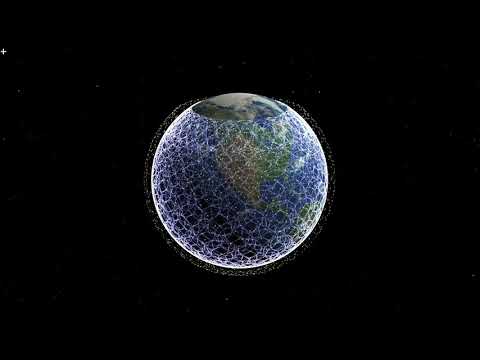 10:15
Using ground relays with Starlink
506K views • 6 years ago
Mark Handley
Mark Handley of UCL explains, with simulation visualizations, how early Starlink satellites without inter-satellite links could still give low-latency wide-area communication by hopping via ground relays. He shows it can beat fibre on many long paths.
Topic match · Space exploration & spaceflight 11:08
Can Spinlaunch Throw Rockets Into Space?
3.2M views • 4 years ago
Scott Manley
Scott Manley looks at SpinLaunch, which aims to throw launch vehicles out of a spinning launcher at hypersonic speed. He covers its recent Mach 1 test of a one-third scale launcher and the engineering problems that remain.
Topic match · Space exploration & spaceflight 17:49
How to Land the Space Shuttle... from Space
12.6M views • 10 years ago
Bret
Bret Copeland, in an astronaut costume, gives an energetic talk on how the Space Shuttle landed from orbit, including reentry and the unpowered glide. It includes real-time landing footage with HUD and audio.
Topic match · Space exploration & spaceflight 15:21
URBEX | Abandoned Soviet Space Shuttles (Buran) in Baikonur
4.3M views • 9 years ago
Exploring the Unbeaten Path
Urban explorers break into the Baikonur cosmodrome in Kazakhstan to film the abandoned Soviet Buran space shuttles. The video shows the decaying orbiters and the dangerous trip to reach them.
Topic match · Space exploration & spaceflight 13:01
Pinging The Voyager 2 Probe (PART 2)
75K views • 9 years ago
EEVdiscover
Part two of EEVblog's visit to the NASA/CSIRO Canberra Deep Space Communication Complex, showing the control room and how operators contact Voyager 2. It includes live data and spectrum displays.
Topic match · Space exploration & spaceflight 19:59
EEVblog 1547 (Part 1) - Contacting the Voyager 2 Space Probe
71K views • 3 years ago
EEVblog
EEVblog interviews Richard Stephenson of NASA's Canberra Deep Space Communications Complex about how the 70m DSS-43 dish is used to contact Voyager 2. It covers the ground antenna and low-noise receiver side of deep space communication. This is a 2023 re-release of a 2017 video.
Topic match · Space exploration & spaceflight 17:06
A conversation with Elon Musk about Starship
3.2M views • 7 years ago
Everyday Astronaut
Tim Dodd of Everyday Astronaut talks with Elon Musk right after Musk's 2019 Starship presentation. Musk discusses Starship's design, why SpaceX favors conventional engines over aerospikes, and how deleting parts and processes speeds up development.
Topic match · Space exploration & spaceflight 16:37
Does It Make Sense To Put Data Centers In Space? Can They Really Cost Less To Operate?
502K views • 2 years ago
Scott Manley
Scott Manley analyzes the idea of putting data centers in orbit, prompted by Lumen Orbit's funding. He examines the claimed advantage of constant solar power against launch cost, cooling and mass.
Topic match · Space exploration & spaceflight 15:27
Can The Human Body Handle Rotating Artificial Gravity?
3M views • 5 years ago
Scott Manley
Scott Manley surveys the research on whether people can adapt to rotating artificial gravity, from early Soviet centrifuge tests to modern studies. He concludes it is an engineering problem and discusses Coriolis effects and station radius.
Topic match · Space exploration & spaceflight 11:14
What Is A Rotating Detonation Engine - And Why Are They Better Than Regular Engines
1.4M views • 6 years ago
Scott Manley
Scott Manley explains rotating detonation engines, how they differ from pulsed detonation engines, and why thermodynamics predicts they beat traditional jet and rocket engines.
Topic match · Space exploration & spaceflight