audio
 9:17
The Incredible Sounds of the Falcon Heavy Launch (BINAURAL AUDIO IMMERSION) - Smarter Every Day 189
7.2M views • 8 years ago
SmarterEveryDay
Smarter Every Day shares a binaural audio recording of the SpaceX Falcon Heavy launch made by Trevor Mahlmann, with explanations of the sounds including the sonic booms of the landing boosters. It is meant to be heard with headphones.
 11:54
Tested: Where Does The Tone Come From In An Electric Guitar?
2.9M views • 4 years ago
Jim Lill
Guitarist Jim Lill methodically tests what in an electric guitar affects its tone, swapping parts on a partscaster and even trying a 2x4 body. He finds that wood and construction matter far less than people assume.
Topic match · Music theory, synthesis & production 14:27
Why is TV 29.97 frames per second?
2.2M views • 10 years ago
Stand-up Maths
Matt Parker explains the history behind NTSC television running at 29.97 frames per second rather than 30, tracing it to the backward-compatible addition of color. He walks through the arithmetic behind the odd ratio.
Topic match · Audio & video engineering 7:00
CD / Color
2.9M views • 6 years ago
Captain Disillusion
Captain Disillusion's comedic, fast-paced explainer on how color works in cameras, displays and video. It covers the biology of color perception and what it means for screens.
Topic match · Audio & video engineering 13:55
Segmented Displays
7.2M views • 4 years ago
Posy
Posy explores segmented displays, from the seven-segment display to alternative designs with fewer or more segments, with patents and history.
Topic match · Audio & video engineering 13:14
How Analog Color TV Works: The Beginnings
503K views • 8 years ago
Technology Connections
Technology Connections explains the early history of analog color television, from the 1954 start of modern color broadcasting, and how shadow masks work in CRTs. It is the first in a series on how analog color TV works.
Topic match · Audio & video engineering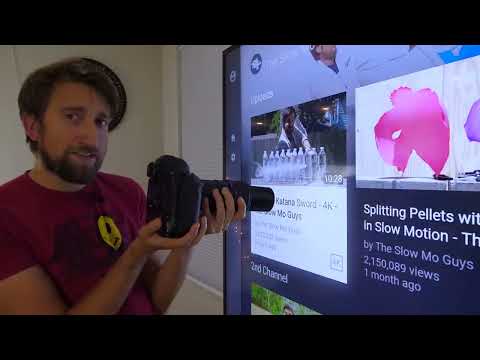 11:39
How a TV Works in Slow Motion - The Slow Mo Guys
45.7M views • 8 years ago
The Slow Mo Guys
The Slow Mo Guys film a TV and screens with a high-speed camera to show how displays build an image. The footage includes CRT-style scanning and how pixels light up over time.
Topic match · Audio & video engineering 16:29
Why Sony's Beta Videotape System Failed--and failed hard (Part 1)
1.5M views • 9 years ago
Technology Connections
Part one of Technology Connections' account of the VHS versus Betamax format war. It argues Sony was caught off guard by JVC's cheaper, more practical VHS system.
Topic match · Audio & video engineering 13:09
Moon Landings Faked? Filmmaker Says Not!
1.4M views • 13 years ago
VideoFromSpace
A filmmaker explains why the Apollo moon landing footage could not have been faked in a studio, based on the video and film technology of the late 1960s. He walks through the limits of cameras, frame rates and effects of the era.
Topic match · Audio & video engineering 12:24
The 1988 VIDEO Floppy Disk Camera: Canon Xap Shot RC-250
452K views • 8 years ago
LGR
LGR looks at the 1988 Canon Xap Shot, a still video camera that records photos to a floppy disk as analog NTSC signal rather than digital data.
Topic match · Audio & video engineering 17:04
These Are Not Pixels: Revisited
611K views • 8 years ago
Technology Connections
Technology Connections follows up on his analog TV video to clear up the debate over whether CRT phosphor dots are pixels. He explains the shadow mask, color triads and how they relate to the scanned picture.
Topic match · Audio & video engineering 16:47
Lines of Light: How Analog Television Works
1.5M views • 9 years ago
Technology Connections
Technology Connections explains how analog television produced moving images without computers, covering scanning, CRTs and standards like NTSC and PAL. It is part of a series on analog TV.
Topic match · Audio & video engineering 12:16
LCCS: The LCD / CRT Hybrid from JVC
2.3M views • 7 years ago
Technology Connections
A Technology Connections video on JVC's LCCS, a display hybrid that cycles a color LCD shutter over a monochrome CRT to produce field-sequential color without dots or stripes. It builds on his earlier videos about analog TV and compatible color.
Topic match · Audio & video engineering 9:51
Comparing Beta & VHS on Quality: Was Beta Really Better?
710K views • 9 years ago
Technology Connections
Technology Connections compares Betamax and VHS picture quality using footage from a 1979 RCA VCR and argues the Beta quality advantage was largely marketing.
Topic match · Audio & video engineering 8:26
Why don't subtitles match dubbing?
2M views • 2 years ago
Tom Scott
Tom Scott explains why subtitles often differ from dubbed dialogue, covering how translation, timing and reading speed shape each. It features translators and voice talent working in several languages.
Topic match · Audio & video engineering 9:07
Which key is the saddest?
1.3M views • 9 years ago
Adam Neely
Musician Adam Neely examines whether certain keys sound sadder than others, looking at the history of tuning systems and temperaments and at how instrument timbre shapes the emotional character we hear. It draws on historical aesthetics writing and audio examples.
Topic match · Music theory, synthesis & production 19:42
But what is the Fourier Transform? A visual introduction.
12.6M views • 8 years ago
3Blue1Brown
3Blue1Brown's animated visual introduction to the Fourier Transform, showing how a signal breaks into frequency components.
Topic match · Information theory & signal processing 18:07
The more general uncertainty principle, regarding Fourier transforms
2.3M views • 8 years ago
3Blue1Brown
3Blue1Brown shows how the uncertainty principle arises from Fourier transforms. A wave packet cannot be narrow in both position and frequency, so the principle is a property of waves rather than of measurement.
Topic match · Information theory & signal processing 15:12
JPEG DCT, Discrete Cosine Transform (JPEG Pt2)- Computerphile
697K views • 11 years ago
Computerphile
Mike Pound explains the discrete cosine transform and how it underpins JPEG compression. It is part two of Computerphile's JPEG series.
Topic match · Information theory & signal processing 18:31
Fourier Optics used for Optical Pattern Recognition
103K views • 6 years ago
Huygens Optics
Huygens Optics explains the Fourier transform and shows how a lens performs one optically. A DLP projector is used as a Fourier filter to do simple pattern recognition on lithographic character patterns.
Topic match · Information theory & signal processing 19:40
How I Designed a Free Music Font for 5 Million Musicians (MuseScore 3.6)
608K views • 5 years ago
Tantacrul
Tantacrul explains how he and engraver Simon Smith designed the free music notation font for MuseScore 3.6. It draws on the history of the SCORE notation application by Leland Smith.
Topic match · Music theory, synthesis & production 9:37
Characters, Symbols and the Unicode Miracle - Computerphile
2.1M views • 13 years ago
Computerphile
Tom Scott explains for Computerphile how Unicode and UTF-8 grew out of messy older character encodings to become the web's standard. It covers why the design works and how it handles worldwide text.
Topic match · Information theory & signal processing 10:50
The most feared song in jazz, explained
10.6M views • 7 years ago
Vox
Vox Earworm explains why John Coltrane's Giant Steps is so hard to improvise over: it is fast and moves through three keys. Musicians Braxton Cook and Adam Neely walk the host through the underlying music theory.
Topic match · Music theory, synthesis & production 15:09
Why you DON'T want Perfect Pitch
2.5M views • 5 years ago
Adam Neely
Adam Neely explains what perfect (absolute) pitch is, how it differs from relative and quasi-absolute pitch, and why he would not want it. He covers its drawbacks, including drift with age.
Topic match · Music theory, synthesis & production 14:06
Testing 432 Hz Frequencies (and temperaments)
4M views • 7 years ago
Adam Neely
Adam Neely tests the claims for tuning to A=432 Hz by trying the unusual tuning systems that its proponents' numerology requires. He compares how they sound against standard tuning and temperaments.
Topic match · Music theory, synthesis & production 16:26
Why Adults Can't Develop Perfect Pitch
1.8M views • 9 years ago
Rick Beato
Rick Beato argues that adults cannot develop true perfect pitch, which he ties to critical-period brain plasticity and language acquisition. He says it can only be developed in young children, and discusses the research behind this.
Topic match · Music theory, synthesis & production 15:07
The most mind-blowing concept in music (Harmonic Series)
1.3M views • 6 years ago
ANDREW HUANG
Andrew Huang explains the harmonic series, which he calls the foundation of almost all music. He builds the idea up step by step, with demonstrations of overtones and how harmonies derive from them.
Topic match · Music theory, synthesis & production 12:31
The Superheterodyne Radio: No really, that's its name
987K views • 7 years ago
Technology Connections
Technology Connections explains why the superheterodyne radio has its name and how mixing frequencies lets it tune stations well. It walks through the underlying wave phenomena and algebra and why the design solved a hard tuning problem.
Topic match · Information theory & signal processing 4:20
Why Snow and Confetti Ruin YouTube Video Quality
10.4M views • 10 years ago
Tom Scott
Tom Scott explains why confetti and snow wreck video quality, using interframe compression and bitrate. He demonstrates it live by changing the quality on screen.
Topic match · Information theory & signal processing 4:20
Why It's Impossible to Tune a Piano
4.1M views • 11 years ago
minutephysics
A minutephysics video explaining why a piano cannot be perfectly tuned, comparing equal temperament with just intonation and the math of harmonics.
Topic match · Music theory, synthesis & production 18:41
Emulating the DX7 the HARD way
23K views • 5 years ago
plgDavid
An episode of Plogue's chipresearch series on emulating the Yamaha DX7 from the hardware up. It covers the sub CPU and main CPU, address map investigation, cartridges, firmware analysis and a skeleton MAME driver.
Topic match · Music theory, synthesis & production 9:16
Floating Point Numbers - Computerphile
2.5M views • 12 years ago
Computerphile
Tom Scott explains for Computerphile how floating point numbers work, why moving the binary point is fast, and why it handles money badly.
Topic match · Information theory & signal processing 15:42
Jacob Collier Explains Music in 5 Levels of Difficulty ft. Herbie Hancock | WIRED
16.8M views • 8 years ago
WIRED
WIRED's 5 Levels format with Jacob Collier explaining harmony to a child, a teen, a college student, a professional and Herbie Hancock.
Topic match · Music theory, synthesis & production 10:00
How A London Orchestra Broke International Law
270K views • 7 years ago
12tone
12tone tells the story of pitch inflation and how concert A came to be standardized at 440 Hz, including attempts at legal standards. It is a short music history explainer.
Topic match · Music theory, synthesis & production 19:42
Using AI To Detect AI Music (and other music industry data-porn)
452K views • 1 year ago
Benn Jordan
Musician Benn Jordan uses AI to detect AI-generated music and digs into music industry data, including streaming payouts and sample library copyright problems. He covers ways to tell whether a track is human-made.
Topic match · Music theory, synthesis & production 11:07
The music theory of V A P O R W A V E
1.8M views • 10 years ago
Adam Neely
Adam Neely analyzes vaporwave through music theory, timbre and nostalgia, and includes a parody track made for the video. He also touches on the phenomenology of music.
Topic match · Music theory, synthesis & production 11:48
Will We Ever Run Out of New Music?
16.8M views • 13 years ago
Vsauce
Vsauce asks whether music will ever run out of new melodies. It counts the possible note combinations and discusses how common chord progressions and remixing affect originality.
Topic match · Music theory, synthesis & production 5:31
The hidden background noise that can catch criminals
5.8M views • 4 years ago
Tom Scott
Tom Scott explains Electrical Network Frequency analysis, where hum from the power grid in a recording is matched against grid logs to date and place it. He talks to a researcher and sets them a challenge.
 6:51
Star Size Comparison 2
48.7M views • 10 years ago
morn1415
A visual scale comparison of stars and cosmic objects, from planets up to some of the largest known stars, set to music. It is meant to convey the vastness of the universe.
 4:14
Experiment! How Does An Owl Fly So Silently? | Super Powered Owls | BBC
25.7M views • 10 years ago
BBC Earth
A BBC Earth clip from Super Powered Owls in which the team uses sensitive sound equipment to compare owl flight with other birds. It shows why owls fly almost silently.