bad ideas
 12:01
Why Electronic Voting Is Still A Bad Idea
5.1M views • 6 years ago
Tom Scott
Tom Scott explains why electronic voting is a bad idea. Elections must be trusted by everyone and attacks on software scale in ways attacks on paper do not, so open source or blockchain fixes do not solve it.
 10:36
Why Would AI Want to do Bad Things? Instrumental Convergence
274K views • 8 years ago
Robert Miles AI Safety
Robert Miles explains instrumental convergence: why an AGI with almost any goal would tend to pursue sub-goals like self-preservation and resource acquisition. It builds on Omohundro's basic AI drives and his orthogonality thesis video.
 8:21
Why Electronic Voting is a BAD Idea - Computerphile
2.3M views • 11 years ago
Computerphile
Tom Scott explains for Computerphile why electronic voting is a bad idea, arguing that paper ballots are transparent, auditable and hard to tamper with at scale. He covers why moving voting to phones, tablets or computers undermines trust and verifiability.
 10:51
Is olive oil safe at high heat? Does it taste bad?
1.9M views • 6 years ago
Adam Ragusea
Adam Ragusea examines whether olive oil is unsafe for high-heat cooking and whether it tastes bad when heated. He cites studies showing it is among the most stable cooking oils and that smoke-point worries are overblown.
 5:32
It's not you. Bad doors are everywhere.
10.6M views • 10 years ago
Vox
Vox's Joe Posner, with help from 99% Invisible, explains why bad doors are everywhere. It covers Don Norman's long-running complaint about doors and the idea that good design should not need instructions.
 55:46
How Much Do Rockets Pollute? Are They Bad For Our Air?
1.3M views • 6 years ago
Everyday Astronaut
Everyday Astronaut's Tim Dodd runs an hour-long, data-driven analysis of what rockets actually emit and how that compares with airliners and other industries. It breaks down exhaust by propellant type, per-passenger and total emissions, and ways launches could be cleaner.
 11:27
CGA Graphics - Not as bad as you thought!
2.4M views • 10 years ago
The 8-Bit Guy
The 8-Bit Guy covers IBM's 1981 CGA graphics system, including how composite output and artifacting produced extra colors beyond the nominal palette. He argues CGA looked better in period than it does on RGB monitors.
 13:00
The Dumbest Excuse for Bad Cities
3.1M views • 3 years ago
Not Just Bikes
Not Just Bikes takes on the common excuse that a country is simply too big or spread out for good transit and walkable cities. The video argues that city density and short everyday trips matter, not national size or overall population density.
 23:01
Safe Cycling Showdown - Good vs. Bad City Design - Plus 1 Minus 2
1.1M views • 5 years ago
Not Just Bikes
Not Just Bikes compares the same cycling trip to a hardware store in Calgary and in Amsterdam, using a 'plus 1 minus 2' format. It shows how street design shapes how safe and practical cycling is.
 6:01
Cambridge Ideas - Professor Risk
128K views • 16 years ago
Cambridge University
David Spiegelhalter, Professor of the Public Understanding of Risk, uses statistics to weigh everyday risks such as bacon sandwiches and cycling. The six-minute piece introduces micromorts as a way to compare the risk of dying.
 10:14
Is Meat Really that Bad?
9.2M views • 4 years ago
Kurzgesagt – In a Nutshell
A Kurzgesagt animated explainer on the climate and environmental cost of meat. It covers how beef drives deforestation and emissions, and how this compares with plant-based foods.
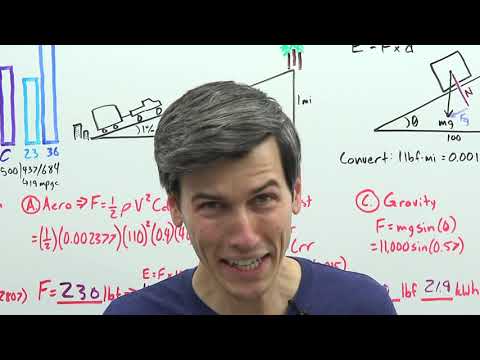 18:02
Why Teslas Are Bad At Towing (Today)
768K views • 6 years ago
Engineering Explained
Engineering Explained uses physics to show why today's electric cars, including Teslas, are poor at towing, pointing to battery energy density and weight. It examines Cybertruck and F-150 towing claims.
 9:40
Why American public transit is so bad | 2020 Election
6.7M views • 6 years ago
Vox
A Vox explainer from the 2020 election series on why American public transit is so poor. It traces the effect of the interstate highway system on cities and the resulting car dependence.
 14:28
How Lexus Fixed Tesla's Bad Idea: Steer-By-Wire Yoke
7M views • 3 years ago
Engineering Explained
Engineering Explained compares Lexus's steer-by-wire yoke on the RZ 450e with Tesla's yoke. It covers how steer-by-wire works and how variable steering ratios address the yoke's flaws.
 9:41
How Steve Jobs got the ideas of GUI from XEROX
272K views • 12 years ago
Ringo Pebam
A short video telling how Xerox PARC invented the graphical user interface and how Steve Jobs's 1979 visit influenced Apple's Lisa.
 11:28
Here's What's Preventing You From Finishing Projects
147K views • 5 years ago
Zack Freedman
Zack Freedman gives advice on why makers fail to finish projects, including scrapping bad ideas, showing work publicly and writing a plan that keeps projects fun. It is aimed at hardware DIY but generalizes.
 8:17
PHILOSOPHY - Michel Foucault
3.9M views • 11 years ago
The School of Life
A School of Life short introducing Michel Foucault, who questioned assumed progress in how society treats madness, medicine and sexuality.
 28:23
The Fast Fourier Transform (FFT): Most Ingenious Algorithm Ever?
2.3M views • 5 years ago
Reducible
Reducible's visual walkthrough of the Fast Fourier Transform, motivated by polynomial multiplication. It shows how the FFT's key ideas can be discovered by asking the right questions.
 12:08
Why Some Diseases Only Traveled One Direction
13.9M views • 10 years ago
CGP Grey
CGP Grey explains why European diseases devastated the Americas while few deadly diseases traveled the other way. He ties it to livestock domestication, dense cities, and the ideas of Guns, Germs and Steel.
 7:49
America Keeps Rejecting an ID Card It Already Has
13.6M views • 9 years ago
CGP Grey
CGP Grey explains the history of the US Social Security card and number, and why they became a de facto national ID despite never being meant for it. He also covers why America resists a proper identity card.
 27:19
Once you understand game theory, you understand the world.
26.5M views • 2 years ago
Veritasium
Veritasium explores the Prisoner's Dilemma and Axelrod's tournaments, showing why tit-for-tat and forgiving strategies win in repeated games. It extends the ideas to cooperation in evolution and conflict.
 23:16
The Machinery Of Freedom: Illustrated summary
164K views • 14 years ago
bitbutter
An illustrated 23-minute summary of David Friedman's talk based on The Machinery of Freedom. It describes how law, police and courts could work as market services in a stateless society, covering private law, polycentric law and objections.
 42:36
30 Weird Chess Algorithms: Elo World
965K views • 7 years ago
suckerpinch
Tom Scott-style absurdist tour by Tom7 of SIGBOVIK chess projects: a tournament of 30 weird chess algorithms used to rate a color- and piece-blind chess program. Topics include mirrors, arithmetic encoding, perverted game tree search and a diluted Stockfish.
 6:17
Can You Watch This Without Getting Angry?
12.1M views • 11 years ago
CGP Grey
CGP Grey explains how ideas spread like germs, and why content that triggers outrage spreads fastest, using a study on what makes online content viral. He argues that opposing outrage-driven memes feed each other.
 18:18
Hilbert's Curve: Is infinite math useful?
2.4M views • 9 years ago
3Blue1Brown
3Blue1Brown explains space-filling curves and the Hilbert curve, and how infinite mathematical constructions connect to finite, practical approximations. It touches on mapping between dimensions and sensory ideas.
 10:50
The most feared song in jazz, explained
10.6M views • 7 years ago
Vox
Vox Earworm explains why John Coltrane's Giant Steps is so hard to improvise over: it is fast and moves through three keys. Musicians Braxton Cook and Adam Neely walk the host through the underlying music theory.
 41:35
The Alt-Right Playbook: How to Radicalize a Normie
4.5M views • 7 years ago
Innuendo Studios
A video essay from the Alt-Right Playbook series that explains how extremist movements draw ordinary people in, using deniable rhetoric, bad-faith games, and gradual escalation. It draws on books about the alt-right, male radicalization, and cult-style brainwashing.
 36:06
Civilizations at the End of Time: Black Hole Farming
934K views • 10 years ago
Isaac Arthur
An Isaac Arthur episode on civilizations in the dark, post-stellar universe, including black hole farming, accretion disks and the Penrose process as energy sources.
 12:23
Xanadu Basics 1a - VISIBLE CONNECTION
20K views • 8 years ago
TheTedNelson
Ted Nelson explains the original Xanadu hypertext idea of visible connection, the notion that links between documents should be shown and preserved. He argues that the Web and current document standards lost this concept.
 13:31
Randomness is Random - Numberphile
893K views • 7 years ago
Numberphile
Numberphile with Simon Pampena on how humans misunderstand randomness, including coin-flip sequences, run lengths and the gambler's fallacy.
 24:28
Euler's formula with introductory group theory
2.8M views • 9 years ago
3Blue1Brown
3Blue1Brown builds intuition for Euler's formula, e^(pi i) = -1, using the core ideas of group theory. It treats exponentiation geometrically as rotation and scaling instead of repeated multiplication.
 13:07
Loneliness
28.1M views • 7 years ago
Kurzgesagt – In a Nutshell
Kurzgesagt explains why humans feel loneliness, its evolutionary role, and how modern life can turn it into a harmful downward spiral. It cites research and offers ideas on what to do about it.
 18:32
Homochirality: Why Nature Never Makes Mirror Molecules
1.7M views • 6 years ago
Steve Mould
Steve Mould explains homochirality: why biological molecules like sugars and amino acids come in only one handedness. He covers ideas about how this asymmetry might have arisen, touching on meteorite samples and RNA.
 4:12
Why this British crossroads was so dangerous
3.9M views • 6 years ago
Tom Scott
Tom Scott explains why Ipley Cross in England's New Forest was one of Britain's most dangerous junctions. The angled crossroads lets a car's A-pillar hide approaching traffic and cyclists because there is no relative motion in the driver's view.
 8:18
Why Alien Life Would be our Doom - The Great Filter
27.9M views • 8 years ago
Kurzgesagt – In a Nutshell
A short Kurzgesagt animation explaining the Great Filter, the idea that finding alien life might be bad news because it implies something usually destroys civilizations. It connects the concept to the Fermi paradox.
 11:17
Everything is a Remix Part 3 (Original Series, 2011)
501K views • 15 years ago
Kirby Ferguson
Part 3 of Kirby Ferguson's Everything is a Remix series, using Apple and the iPhone to show how invention builds on copying and combining prior ideas. It argues that creativity and innovation are inseparable from copying.
 9:16
Floating Point Numbers - Computerphile
2.5M views • 12 years ago
Computerphile
Tom Scott explains for Computerphile how floating point numbers work, why moving the binary point is fast, and why it handles money badly.
 9:27
Pentagons Are Terrible at One Thing
20.6M views • 6 years ago
CGP Grey
A CGP Grey video about why pentagons are bad at tiling and why hexagons are so special, in his usual playful style. It touches on honeycombs and tiling in nature.
 8:08
The Black Hole Bomb and Black Hole Civilizations
29.5M views • 8 years ago
Kurzgesagt – In a Nutshell
Kurzgesagt explains the black hole bomb and how far-future civilizations might extract energy from spinning black holes, including Dyson-sphere-style ideas.
 6:16
The Artificial Intelligence That Deleted A Century
2M views • 7 years ago
Tom Scott
A speculative-fiction video by Tom Scott, framed as coming from a future, about an AI called Earworm that enforces copyright so aggressively that humanity ends up forgetting a century of pop culture. It is animated and narrated as part of his series of videos from a future.