classical
No strong matches for “classical”. Here are the closest videos.
 6:18
Fear the Boom and Bust: Keynes vs. Hayek - The Original Economics Rap Battle!
8.9M views • 16 years ago
Radical Discourse
A rap battle in which John Maynard Keynes and F. A. Hayek debate the causes of boom and bust, stimulus, and bailouts. It was produced by Econstories to teach the two schools of thought.
Topic match · Music performance & songs 12:46
The Speed of Light is NOT About Light
7.1M views • 11 years ago
PBS Space Time
PBS Space Time argues that the speed of light is better understood as the speed of causality, the universal limit on how fast cause and effect propagate. Light travels at that speed because it is massless, but the limit itself is a property of spacetime.
Topic match · Fundamental physics 4:19
How Special Relativity Makes Magnets Work
4M views • 13 years ago
Veritasium
Veritasium explains magnetism as a consequence of special relativity. Length contraction of moving charges makes a current in a wire attract or repel a nearby moving charge.
Topic match · Fundamental physics 15:12
JPEG DCT, Discrete Cosine Transform (JPEG Pt2)- Computerphile
697K views • 11 years ago
Computerphile
Mike Pound explains the discrete cosine transform and how it underpins JPEG compression. It is part two of Computerphile's JPEG series.
Topic match · Computer vision, speech & NLP 7:23
How Trees Bend the Laws of Physics
5M views • 14 years ago
Veritasium
Veritasium explains how trees lift water from roots to the top of tall trunks, using transpiration pull and the negative pressure that liquid water can sustain. It explains why trees do not need pumps or valves.
Topic match · Fundamental physics 13:02
Noether's Theorem and The Symmetries of Reality
1.1M views • 8 years ago
PBS Space Time
PBS Space Time explains Noether's theorem: conservation laws such as energy and momentum are consequences of deeper symmetries. It also covers why those laws hold only under certain conditions.
Topic match · Fundamental physics 11:44
World's Roundest Object!
38.5M views • 13 years ago
Veritasium
Veritasium explains the effort to redefine the kilogram, which was still defined by a physical artifact, and how a near-perfect silicon sphere from the Avogadro project helps. It also covers the history of the unit's odd naming.
Topic match · Fundamental physics 10:50
The most feared song in jazz, explained
10.6M views • 7 years ago
Vox
Vox Earworm explains why John Coltrane's Giant Steps is so hard to improvise over: it is fast and moves through three keys. Musicians Braxton Cook and Adam Neely walk the host through the underlying music theory.
Topic match · Music performance & songs 15:29
How Time Becomes Space Inside a Black Hole | Space Time
2.5M views • 9 years ago
PBS Space Time
A PBS Space Time episode explaining how space and time swap roles inside a black hole's event horizon. It is part of the channel's black hole series.
Topic match · Fundamental physics 9:19
How to Understand What Black Holes Look Like
11M views • 7 years ago
Veritasium
Veritasium explains what a black hole should look like, using J.P. Luminet's 1979 work and a cardboard 3D model to show how light bends around it. It was made just as the first black hole image was released.
Topic match · Fundamental physics 9:49
How We're Redefining the kg
2.8M views • 9 years ago
Veritasium
Veritasium explains why the kilogram is being redefined in terms of Planck's constant rather than a physical metal artifact. It visits NIST to show the Kibble balance and why measuring mass precisely is hard.
Topic match · Fundamental physics 10:48
The True Nature of Matter and Mass | Space Time | PBS Digital Studios
1.8M views • 10 years ago
PBS Space Time
A PBS Space Time episode asking what matter, mass, and energy really are, starting with inertial versus gravitational mass and what mass-energy equivalence means.
Topic match · Fundamental physics 10:00
Is The Alcubierre Warp Drive Possible? | Space Time | PBS Digital Studios
2.5M views • 11 years ago
PBS Space Time
PBS Space Time introduces Miguel Alcubierre's warp drive, explaining how spacetime itself could be warped rather than moving a ship through it, and whether it is physically possible.
Topic match · Fundamental physics 12:44
Rapping, deconstructed: The best rhymers of all time
16.3M views • 10 years ago
Vox
Vox breaks down how great rappers build rhymes, from Kurtis Blow's simple bars to Biggie's smooth flow and Kendrick Lamar's dense, fast delivery. It uses on-screen visualizations of rhyme structure.
Topic match · Music performance & songs 8:55
Are Space and Time An Illusion?
3.3M views • 11 years ago
PBS Space Time
A PBS Space Time episode hosted by Gabe Perez-Giz on the nature of spacetime and whether space and time are fundamental. It builds up reference frames and causality in a short, dense format.
Topic match · Fundamental physics 19:59
What Happens at the Event Horizon? | Space Time | PBS Digital Studios
3.2M views • 9 years ago
PBS Space Time
PBS Space Time explains what happens as you approach and cross a black hole's event horizon, using Penrose diagrams and light cones as the tool for understanding spacetime there.
Topic match · Fundamental physics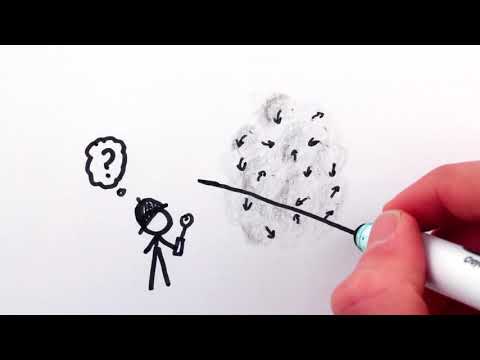 3:12
Why is the Solar System Flat?
9.5M views • 12 years ago
minutephysics
A minutephysics explainer on why the planets orbit in a flat plane. It shows how conserved angular momentum flattens a collapsing cloud of matter into a disk.
Topic match · Fundamental physics 10:24
Why does light slow down in water?
1.3M views • 7 years ago
Fermilab
Fermilab's Don Lincoln explains why light travels slower in water and glass. He knocks down common wrong explanations such as absorption and re-emission, then gives the wave-mechanics reason tied to refractive index.
Topic match · Fundamental physics 20:39
AI Language Models & Transformers - Computerphile
354K views • 7 years ago
Computerphile
Rob Miles explains on Computerphile how language models generate plausible text and how transformers improved on recurrent networks, with a look at what comes next.
Topic match · Computer vision, speech & NLP 16:58
Reynolds Number - Numberphile
560K views • 7 years ago
Numberphile
Numberphile with Tom Crawford of Oxford explains the Reynolds number, the second of three videos on Navier-Stokes and fluid flow, with demonstrations of laminar versus turbulent behavior.
Topic match · Fundamental physics 11:21
How does a whip break the sound barrier? (Slow Motion Shockwave formation) - Smarter Every Day 207
6.5M views • 7 years ago
SmarterEveryDay
Smarter Every Day uses high-speed and Schlieren photography to show how a whip crack is a supersonic shockwave formed at the tip. It references academic papers on whip physics.
Topic match · Fundamental physics 28:35
Magnetohydrodynamics - Propelling Liquid Metal with Magnets!
1.1M views • 8 years ago
Tech Ingredients
Tech Ingredients explains the principles of magnetohydrodynamics and builds several demonstrations, including propelling liquid metal and electrolytes with magnets and a railgun-style setup.
Topic match · Fundamental physics 30:13
What Makes This Song Great? "Into You" MAX MARTIN
456K views • 8 years ago
Rick Beato
Rick Beato analyzes the music and production of Max Martin through Ariana Grande's Into You, breaking down its layering and songwriting craft.
Topic match · Music performance & songs 9:07
The Absurdity of Detecting Gravitational Waves
7.9M views • 9 years ago
Veritasium
Veritasium explains in detail how LIGO detects gravitational waves, with a laser interferometer measuring displacements smaller than a proton. The video focuses on the extreme precision and the techniques needed rather than the general discovery story.
Topic match · Fundamental physics 6:00
Rhyme: Why Eminem is one of the most impressive lyricists ever
3.7M views • 13 years ago
Library of Alexandria
A re-upload of a video breaking down Eminem's rhyme schemes, showing multi-syllable and internal rhymes in songs such as Lose Yourself. It aims to show why he is considered a standout lyricist.
Topic match · Music performance & songs 3:34
Complete Solution To The Twins Paradox
2.3M views • 10 years ago
minutephysics
A minutephysics explainer on the twins paradox in special relativity. It shows why the traveling twin ends up younger and how acceleration resolves the paradox.
Topic match · Fundamental physics 16:07
The Geometry of Causality
1.8M views • 9 years ago
PBS Space Time
PBS Space Time explains how spacetime geometry and light cones determine the order of events and what can cause what. It visualizes causality in special relativity.
Topic match · Fundamental physics 13:41
The Physics of Life (ft. It's Okay to be Smart & PBS Eons!)
771K views • 8 years ago
PBS Space Time
PBS Space Time, together with It's Okay to be Smart and PBS Eons, asks how a universe drifting toward disorder produced something as complex as life. It presents the idea that the laws of physics, through thermodynamics, may actually favor the emergence of life.
Topic match · Fundamental physics 11:48
Superluminal Time Travel + Time Warp Challenge Answer
1M views • 9 years ago
PBS Space Time
A PBS Space Time episode explaining why faster-than-light travel is equivalent to travelling back in time, using relativity and Minkowski diagrams for different observers.
Topic match · Fundamental physics 11:17
The Most Radioactive Places on Earth
24.9M views • 11 years ago
Veritasium
Veritasium visits Chernobyl, Fukushima and other places to find who on Earth is exposed to the most ionizing radiation. The answer turns out to be surprising and puts radiation risk in context.
Topic match · Fundamental physics 11:13
What if you could only see the world in UV?
5.6M views • 8 years ago
Veritasium
Veritasium shows what the world looks like through a UV camera. It covers how pigments absorb UV, how fluorescence works, and how UV imaging reveals sunscreen effectiveness and skin damage.
Topic match · Fundamental physics 11:57
We all move at the Speed of Light
1.4M views • 8 years ago
ScienceClic English
ScienceClic explains why nothing can go faster than light by treating motion through space and time together, so everything moves at the speed of light through spacetime. It uses animated visuals to cover relativity basics in 12 minutes.
Topic match · Fundamental physics 3:57
How Do Bikes Stay Up?
1.7M views • 11 years ago
minutephysics
A short minutephysics video explaining why bicycles stay upright. It looks at gyroscopic precession, head angle and centre of mass, and shows that bikes self-steer toward the direction they lean.
Topic match · Fundamental physics 6:22
The Unreasonable Efficiency of Black Holes
4.5M views • 8 years ago
minutephysics
Minutephysics compares how efficiently different processes convert mass to energy per E=mc^2, from fire and fission to fusion, antimatter and black holes, which can convert a large fraction of mass to energy.
Topic match · Fundamental physics 14:49
The Bizarre Behavior of Rotating Bodies
14M views • 7 years ago
Veritasium
Veritasium explains the Dzhanibekov effect, also called the tennis racket theorem, where a spinning object flips unexpectedly about its intermediate axis. The video gives an intuitive account of the underlying rotational dynamics, drawing on Terry Tao's explanation and the original papers.
Topic match · Fundamental physics 15:48
How to Detect Extra Dimensions
1.6M views • 8 years ago
PBS Space Time
A PBS Space Time episode on how gravitational wave observations of a neutron star merger, GW170817, can limit the number of spacetime dimensions. It is based on a 2018 paper.
Topic match · Fundamental physics 16:30
Why is light slower in glass? - Sixty Symbols
848K views • 13 years ago
Sixty Symbols
Professor Mike Merrifield of Nottingham explains in a mostly uncut conversation why light travels slower in glass. He treats light as a wave and describes how the material's electrons produce secondary waves that combine to slow it.
Topic match · Fundamental physics 15:41
How anti-theft tags work - magnetostriction
886K views • 10 years ago
Applied Science
Applied Science explains how retail anti-theft tags work. A tiny magnetostrictive strip acts as a mechanical oscillator excited by a magnetic field, and magnetizing or demagnetizing it arms or disarms the tag.
Topic match · Fundamental physics 3:13
Hitting the Sun is HARD
3M views • 10 years ago
minutephysics
A three-minute minutephysics video on the orbital mechanics of why crashing into the Sun takes far more energy than leaving the solar system.
Topic match · Fundamental physics 11:07
The music theory of V A P O R W A V E
1.8M views • 10 years ago
Adam Neely
Adam Neely analyzes vaporwave through music theory, timbre and nostalgia, and includes a parody track made for the video. He also touches on the phenomenology of music.
Topic match · Music performance & songs