Why is light slower in glass? - Sixty Symbols
Sixty Symbols1 HN recommender · recommended in 1 month, 2018-2021
848K views · 13 years ago · explainer · evergreen
Professor Mike Merrifield of Nottingham explains in a mostly uncut conversation why light travels slower in glass. He treats light as a wave and describes how the material's electrons produce secondary waves that combine to slow it.
HN cites it whenever the popular absorb-and-re-emit explanation comes up, as a source for the wave-interference account.
 28:34
But why would light "slow down"? | Visualizing Feynman's lecture on the refractive index
3Blue1Brown
2.9M views • 2 years ago
 10:24
Why does light slow down in water?
Fermilab
1.3M views • 7 years ago
 11:57
We all move at the Speed of Light
ScienceClic English
1.4M views • 8 years ago
 7:40
The Original Double Slit Experiment
Veritasium
10.2M views • 13 years ago
 29:48
MOLTEN GLASS VS Prince Rupert's Drop - Smarter Every Day 285
SmarterEveryDay
5.8M views • 3 years ago
 12:46
The Speed of Light is NOT About Light
PBS Space Time
7.1M views • 11 years ago
 11:33
Light Waves Visualized using Photon Sieves.
Huygens Optics
69K views • 6 years ago
 20:34
How big is a visible photon?
Huygens Optics
793K views • 5 years ago
 45:55
Turning Waves Into Particles
Huygens Optics
194K views • 1 year ago
 22:22
Some light quantum mechanics (with minutephysics)
3Blue1Brown
2.2M views • 9 years ago
 33:01
The Strangest Implication of Quantum Mechanics
Veritasium
20.6M views • 1 year ago
 5:55
Richard Feynman talks about light
sdfhsfh
1.8M views • 19 years ago
 17:56
The Case for String Theory - Sixty Symbols
Sixty Symbols
746K views • 9 years ago
 1:02
Single particle creates interference after double slit - Wave particle duality at the workshop
heligone
17K views • 13 years ago
 11:48
Superluminal Time Travel + Time Warp Challenge Answer
PBS Space Time
1M views • 9 years ago
 38:18
Glass engineering - designing and making photochromic glass
Applied Science
517K views • 8 years ago
 3:00
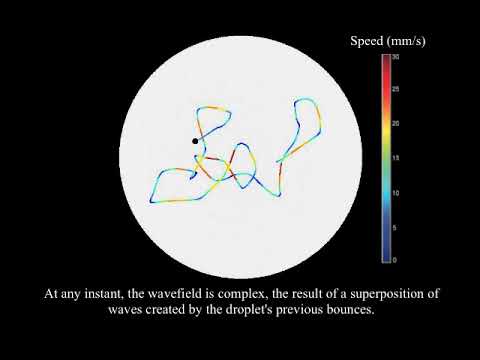
The pilot-wave dynamics of walking droplets
MITMathLab
207K views • 13 years ago
 15:53
Quantum Field Theory visualized
ScienceClic English
2.7M views • 6 years ago
 40:29
What is the Ultraviolet Catastrophe?
Physics Explained
2.7M views • 6 years ago
 52:04
Lecture by Douglas Hofstadter: Albert Einstein on Light; Light on Albert Einstein
Uppsala universitet
23K views • 8 years ago
8 comments from Hacker News
Both ideas are incorrect. Bouncing around would be random and the outgoing light would be scattered (as in matte reflections) in all directions. Absorbtion simply destroys the original light. If photons are mostly absorbed, we call that “a wall” or ”a fog”, not “a transparent medium”, which to be transparent shouldn’t have electrons whose energy level differences correspond to a photon’s wave length. The transparency and slowdown effect is a complex interaction between fields in the medium, which I honestly don’t have enough courage to retell. ▶ this video
> Well, actually, the speed of light is constant, it just takes time to ping-pong around a lattice/gas. Photons hit particles, get absorbed, and re-emitted, which causes an effective slowdown at a larger scale. A gas is just vacuum with particles floating around in it. When photons travel between those particles, they are traveling at c. The effective slowdown is determined by the lattice/gas, and we denote this slowdown with the refractive index... This is wrong. Two sources [0][1]. [0] link [1] ▶ this video
Absorption and re-emission are probabilistic, so you'd expect experiments to show a spread distribution of propagation times, deflection angles, etc that aren't actually observed. The explanation gets into looking at light as a wave. ▶ this video link
downvoted because time traveling through a medium vs traveling through curved space are not anywhere near the same underlying principles[0]. The implication being suggested is - if I was trapped in a block of plastic or... underwater, I would experience time different compared to someone standing on land just because "c" is slower. Clearly not the case. To be specific, when "the speed of light" is discussed like this, it usually means the "speed of causality"[1] which is the underlying meaning of "c" in relativity. The speed of causality through a medium (i.e. water) is the same as a vacuum if spacetime curvature is the same. [0] ▶ this video [1] link
Recently I watched Sixty Symbols video on why light is slower in glass and there are multiple explanations on it. What struck me was what prof. Michael Merrifield said at the end of his explanation: ▶ this video On the question about what is the reality, what explanation is the true one, Merrifield said that the Math works on all of the explanations and what those explanations do is simply to model the behaviour of nature and not necessarily reflect the reality. That's how Newtonian physics and relativistic physics are both correct models, tools to model nature and simply can be used to whenever suitable. Wouldn't that mean that mathematics is just an invented tool to reason about physical models?
This reminds me of this Sixty Symbols video which explains why light is slower in media such as glass than in a vacuum: ▶ this video The incoming light wave causes an avalanche of secondary waves through electromagnetically perturbing the individual atoms, and the superposition of all these results in a wave that seems to travel slower than the speed of light.
thanks! When I wrote that line I think I went with the top result of physics.stackexchange, but I'm now convinced that the phase velocity explanation is better. Here is my updated text: <p>While individual waves of light always move at c, light seems to move slower in dense media. This is because as the light wave propagates through a medium it produces ripples that <a href=" ▶ this video in a way that slows the group velocity of the light wave.</p>
> Light seems like it slows down in dense media, but light always propagates at the fastest possible speed for any physical thing. The slow down occurs when the light gets briefly absorbed by atoms and then re-emitted in the same direction. Someone please correct me if I'm wrong, but Sixty Symbols (aka nottinghamscience) did at least 2 videos on this where they expressly pointed out that this is widely pushed but totally incorrect? ▶ this video