Turning Waves Into Particles
Huygens Optics2 HN recommenders · recommended in 3 months, 2025-2025
194K views · 1 year ago · explainer · evergreen
Huygens Optics explores the idea that space is a non-linear elastic medium, and uses simulations to show how wave energy might be confined locally into particle-like objects. It touches on inertia, the Schwinger limit and the vacuum as a medium.
HN commenters find the hypothesis elegant and the channel consistently thought-provoking, and point to it in threads on light, particles and wave functions.
 1:37:55
Particles, Fields and The Future of Physics - A Lecture by Sean Carroll
Fermilab
1.8M views • 13 years ago
 11:33
Light Waves Visualized using Photon Sieves.
Huygens Optics
69K views • 6 years ago
 1:00:18
Quantum Fields: The Real Building Blocks of the Universe - with David Tong
The Royal Institution
6.9M views • 9 years ago
 14:34
Visualization of Quantum Physics (Quantum Mechanics)
udiprod
2.8M views • 9 years ago
 1:02
Single particle creates interference after double slit - Wave particle duality at the workshop
heligone
17K views • 13 years ago
 20:34
How big is a visible photon?
Huygens Optics
793K views • 5 years ago
 6:33
The Biggest Ideas in the Universe: Introduction
Sean Carroll
384K views • 6 years ago
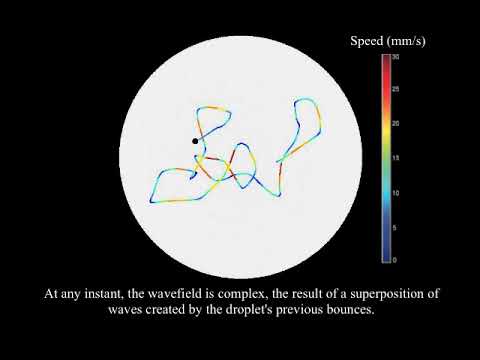 3:00
The pilot-wave dynamics of walking droplets
MITMathLab
207K views • 13 years ago
 7:40
The Original Double Slit Experiment
Veritasium
10.2M views • 13 years ago
 9:32
The Higgs Mechanism Explained | Space Time | PBS Digital Studios
PBS Space Time
2.7M views • 10 years ago
 7:41
Is This What Quantum Mechanics Looks Like?
Veritasium
6.2M views • 10 years ago
 22:22
Some light quantum mechanics (with minutephysics)
3Blue1Brown
2.2M views • 9 years ago
 33:01
The Strangest Implication of Quantum Mechanics
Veritasium
20.6M views • 1 year ago
 18:04
How the Higgs Mechanism Give Things Mass
PBS Space Time
1.9M views • 4 years ago
 20:00
Why Parallel Universes Are Probably Real
Veritasium
25.4M views • 6 years ago
 15:53
Quantum Field Theory visualized
ScienceClic English
2.7M views • 6 years ago
 16:32
Pilot Wave Theory and Quantum Realism | Space Time | PBS Digital Studios
PBS Space Time
1.9M views • 9 years ago
 1:15:08
Demystifying the Higgs Boson with Leonard Susskind
Stanford
1.1M views • 14 years ago
 12:00
Do we have to accept Quantum weirdness? De Broglie Bohm Pilot Wave Theory explained
Looking Glass Universe
125K views • 9 years ago
 1:46:33
Lecture 1 | The Theoretical Minimum
Stanford
969K views • 14 years ago
4 comments from Hacker News
I don't know how fringe this is, but Huygens Optics gives a possible answer here: ▶ this video . TL;DW: if you assume certain non-linear properties of vacuum as a medium, it seems possible for light (EM waves) to self-contain spatially instead of spreading out, and such trapped energy seems, for all intents and purposes, to behave like particles. Again, IANAPhysicist, so I don't know what to think of that video, but the channel seems legit, and the explanation is beautiful in its simplicity .
I don't know how established this is, but I'm partial to the "vacuum is elastic, non-linear medium, and particles are waves trapped in the non-linearity - self-confining energy" hypothesis. IANAPhysicist, but this really seems to make a lot of sense and is quite elegant: ▶ this video And with this, there's no empty space in atoms, as the vacuum perturbations from each particle spread out to infinity, so inside the atom there's more energy in those perturbations than outside - the space is less empty inside than outside.
This is extremely cool! Curious on the story behind this /u/westoncb! It reminds me of Huygens Optics' recent videos about modelling particles as confined light using a particular non-linear medium [0], is it possible to create similar 'light' particles with tweaks to your setup? [0] ▶ this video
There is an interesting video essay by the Huygens Optics channel where some simulations of these field effects are considered. Turning Waves Into Particles ▶ this video And if unfamiliar, that channel constantly delivers high quality thought provoking content on the nature of light.