Light Waves Visualized using Photon Sieves.
Huygens Optics3 HN recommenders · recommended in 3 months, 2020-2022
69K views · 6 years ago · explainer · evergreen
Huygens Optics shows how DIY photon sieves shape a laser's wave front, explaining how they differ from zone plates and how aperture count affects the focal point, with time-resolved visualizations of the diffraction.
HN points to it for a clear explanation of photon sieves versus Fresnel lenses and for showing what interference patterns actually look like.
 45:55
Turning Waves Into Particles
Huygens Optics
194K views • 1 year ago
 20:34
How big is a visible photon?
Huygens Optics
793K views • 5 years ago
 18:31
Fourier Optics used for Optical Pattern Recognition
Huygens Optics
103K views • 6 years ago
 14:40
Etching small patterns in Glass
Huygens Optics
221K views • 5 years ago
 7:40
The Original Double Slit Experiment
Veritasium
10.2M views • 13 years ago
 14:22
Hypercentric optics: A camera lens that can see behind objects
Applied Science
597K views • 6 years ago
 28:34
But why would light "slow down"? | Visualizing Feynman's lecture on the refractive index
3Blue1Brown
2.9M views • 2 years ago
 46:24
How are holograms possible?
3Blue1Brown
7.2M views • 2 years ago
 14:34
Visualization of Quantum Physics (Quantum Mechanics)
udiprod
2.8M views • 9 years ago
 16:30
Why is light slower in glass? - Sixty Symbols
Sixty Symbols
848K views • 13 years ago
 22:22
Some light quantum mechanics (with minutephysics)
3Blue1Brown
2.2M views • 9 years ago
 7:41
Is This What Quantum Mechanics Looks Like?
Veritasium
6.2M views • 10 years ago
 1:02
Single particle creates interference after double slit - Wave particle duality at the workshop
heligone
17K views • 13 years ago
 10:24
Why does light slow down in water?
Fermilab
1.3M views • 7 years ago
 14:57
DIY Scanning Electron Microscope - Overview
Applied Science
632K views • 15 years ago
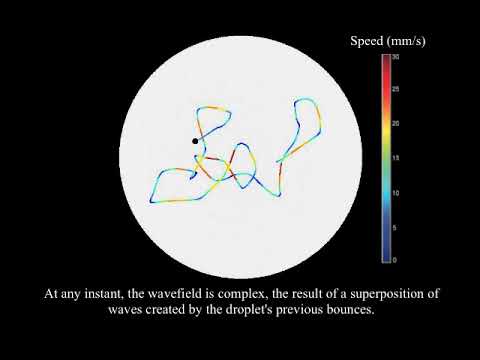 3:00
The pilot-wave dynamics of walking droplets
MITMathLab
207K views • 13 years ago
 3:20
Fairy Lights in Femtoseconds: Tangible Holographic Plasma (SIGGRAPH)
Yoichi Ochiai
1.1M views • 11 years ago
 38:18
Glass engineering - designing and making photochromic glass
Applied Science
517K views • 8 years ago
 19:45
Building a realistic artificial sun (for dark winter days)
DIY Perks
3.3M views • 6 years ago
 12:00
Do we have to accept Quantum weirdness? De Broglie Bohm Pilot Wave Theory explained
Looking Glass Universe
125K views • 9 years ago
4 comments from Hacker News
They are talking about the photon seive micro lenses that make up the whole lens. Each micro lens is the size of a virus. The "camera" is the size of a grain of salt. I don't think this is intentional, but this feels like trigger bait for people dealing with a manic psychotic state. Like there were other things to compare it to other than an HIV virus. I'm sure it's exactly the same size, but you know, might as well say "the same size as a large Coronavirus wrapped in 5G Monkeypox". Also, > The researchers believe their micro camera could be dusted on a surface, making anything a camera. (Perhaps not the most comforting thought, as Nerdist points out.) I think this is really interesting technology. I was suspecting something similar would arrive after learning about making optical tensors that you print in 3D space and learning more about "photon sieves". This is a weird part of our future. There are really interesting new on a chip photonics methods to generate targetable full spectrum light out of a single laser light source. 2025 we'll see some really really crazy light processing products. - ▶ this video - link - link - link
Regarding waves and interference, have a look at this video: ▶ this video . It shows how the interference patterns actually look. Yes, the wave is 3D and the interference patterns can be kind of like checker board. We are usually considering a 2D example because it is simpler to visualize and analize. > how do we know that entanglement is the result of 'spooky action at a distance' and not the result of creating two entangled particles? A very high-level explanation is that we know this because quantum computers work (even though right now we can't build them big enough to be useful) and it can't be explained by any classical effects.
The Huygens Optics channel has a fascinating video abut a photon sieve created using a home-made litography setup: ▶ this video
Here is a video explaining the difference between a Fresnel lens and a photon sieve: Photon sieves used to visualise optical wave front propagation ▶ this video