computation
 10:44
P vs. NP and the Computational Complexity Zoo
3.7M views • 12 years ago
hackerdashery
An 11-minute animated introduction to P vs. NP and the wider landscape of complexity classes, inspired by the Complexity Zoo wiki. It assumes no background in computer science.
 12:04
Anagrams, but where you can break apart letters: "Anagraphs"
256K views • 8 years ago
suckerpinch
Tom Scott-style exploration by suckerpinch (Tom7) of generalized anagrams where letters can be broken into pieces, called anagraphs, with a whimsical computational approach.
Topic match · Creative coding & generative art 17:58
What P vs NP is actually about
253K views • 2 years ago
Polylog
Polylog explains how algorithms can be turned into circuits and encoded as satisfiability problems, which lets you effectively run them backwards. It uses this to motivate breaking RSA, general reductions to SAT, and what P vs NP is really asking.
Topic match · Computability & complexity theory 34:00
Math's Fundamental Flaw
30.8M views • 5 years ago
Veritasium
Veritasium's explainer on Godel's incompleteness theorems and the limits of mathematical proof, tracing set theory, Hilbert's program and the road to Turing and modern computing.
Topic match · Computability & complexity theory 14:27
All the Numbers - Numberphile
1.8M views • 7 years ago
Numberphile
Matt Parker talks Numberphile through the different kinds of numbers: algebraic, transcendental, computable, normal, and beyond. It shows how few numbers we can actually name or describe.
Topic match · Computability & complexity theory 21:46
Surface-Stable Fractal Dithering Explained
646K views • 1 year ago
runevision
Rune Skovbo Johansen explains Surface-Stable Fractal Dithering, a technique he invented and released as open source. It makes dithering stick to 3D surfaces and covers the experiments and shortcomings along the way, inspired by Return of the Obra Dinn.
Topic match · Creative coding & generative art 7:42
Extremely Large Numbers 1 - Introduction
20K views • 11 years ago
Giroux Studios
The first video in a series on extremely large numbers, introducing the topic with examples. Later parts go deep into the fast-growing hierarchy.
Topic match · Computability & complexity theory 6:14
Turing & The Halting Problem - Computerphile
919K views • 12 years ago
Computerphile
A Computerphile video in which Mark Jago of the University of Nottingham explains Turing's halting problem and how it led to the blueprint for the modern computer.
Topic match · Computability & complexity theory 28:28
What is PLUS times PLUS?
2.2M views • 1 year ago
2swap
2swap explores lambda calculus using John Tromp's lambda diagrams, with animated beta-reductions, asking what PLUS times PLUS gives. It touches on Church encodings and the equivalence of Turing machines and lambda calculus.
Topic match · Computability & complexity theory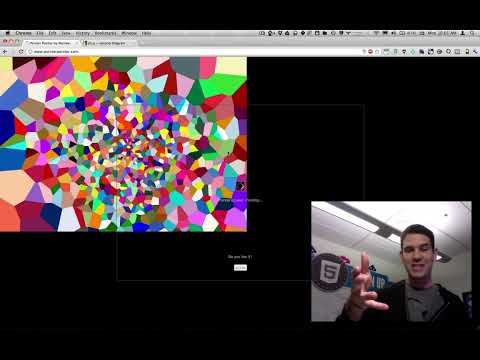 3:45
pointerpointer.com's use of voronoi, canvas, and javascript
40K views • 14 years ago
Paul Irish
Paul Irish explains how pointerpointer.com works. It uses a hidden canvas of colored Voronoi regions to look up which photo matches the cursor position.
Topic match · Creative coding & generative art 12:35
The Mathematics of Quantum Computers | Infinite Series
718K views • 9 years ago
PBS Infinite Series
A PBS Infinite Series episode explaining the mathematics of quantum computers, including how qubits store complex numbers and how quantum computation differs from classical computation. Hosted by Kelsey Houston-Edwards.
 26:48
Algorithmic Redistricting: Elections made-to-order
584K views • 5 years ago
AlphaPhoenix
AlphaPhoenix uses Monte Carlo simulation and annealing-style methods to draw North Carolina congressional district maps, both gerrymandered and fair. He focuses on the fascinating computational problem rather than the politics.
 26:41
Finding the BEST sine function for Nintendo 64
418K views • 3 years ago
Kaze Emanuar
Kaze Emanuar searches for the best sine approximation for the Nintendo 64, comparing the lookup tables in Mario 64 and Ocarina of Time with polynomial alternatives. It walks through numerics and 3rd, 4th and 5th order approximations.
 23:55
Matrioshka Brains: Star-Powered Computers
505K views • 10 years ago
Isaac Arthur
Isaac Arthur explains the Matrioshka Brain, a hypothetical computer or artificial mind powered by an entire star using nested shells. It covers how such megastructures relate to Dyson spheres and superintelligence.