cpu industry
 1:26:50
The Mill CPU Architecture - the Belt (2 of 13)
38K views • 13 years ago
Mill Computing, Inc.
The second talk in the Mill CPU series by Mill Computing, covering the Belt, the Mill's operand-passing model that replaces general registers. It explains the cost of register renaming in conventional wide CPUs and how the Belt reaches high instruction-level parallelism.
 2:18
What happens when the CPU cooler is removed?
388K views • 19 years ago
AdDiCt Zorz
A short 2001 Tom's Hardware clip that runs Quake 3 on several popular CPU and motherboard combinations of the era, then removes the CPU cooler to see which chips survive. It shows how different processors handle losing their heatsink or fan.
 2:02:18
The Mill CPU Architecture – The Compiler (10 of 13)
12K views • 11 years ago
Mill Computing, Inc.
A long Mill Computing lecture on the Mill CPU's compiler toolchain, covering the specializer that targets family members, scheduling and latency passes, and the belt. It explains how the compiler handles a wide-issue, exposed-pipeline design.
 24:46
Building a 6800 CPU on an FPGA with nMigen (part 1)
27K views • 6 years ago
Robert Baruch
The first part of Robert Baruch's series on building a 6800 CPU on an FPGA with nMigen, a Python-based hardware description language. It introduces the HDL while implementing a simpler 6800 core.
 18:58
How The Auto Industry Carjacked The American Dream | Climate Town
922K views • 5 years ago
Climate Town
A Climate Town video on how the auto industry reshaped American cities and culture through advertising, lobbying and campaigns like the 1939 World's Fair. It is snarky in tone but backed by a published source document.
 1:16:58
code::dive conference 2014 - Scott Meyers: Cpu Caches and Why You Care
231K views • 11 years ago
NOKIA Technology Center Wrocław
Scott Meyers explains how CPU caches work and why they matter for performance, covering cache levels, access speeds, associativity, and effects in multithreaded code. The focus is C++ and cache-aware, data-oriented programming.
 27:52
8-bit CPU control logic: Part 1
1.5M views • 9 years ago
Ben Eater
Ben Eater writes a program in a made-up machine language and walks through the control logic an 8-bit breadboard CPU needs to execute it. It is part of his build-an-8-bit-computer series.
 1:29:54
CppCon 2015: Chandler Carruth "Tuning C++: Benchmarks, and CPUs, and Compilers! Oh My!"
188K views • 11 years ago
CppCon
Chandler Carruth walks through tuning C++ performance, from writing benchmarks to analyzing results on real CPUs and compilers. It focuses on small-scale problems such as loop kernels, data structures and algorithms, and on keeping compilers from optimizing benchmarks away.
 26:13
The Smartphone CPU Review You NEED to Watch!
345K views • 4 years ago
Geekerwan
Geekerwan reviews smartphone CPUs by power efficiency rather than benchmark scores, with test methodology and chapters on Qualcomm, Apple, Samsung and Google chips. It explains why high benchmark scores can coexist with heat and poor battery life.
 19:37
Why is Japan So Weak in Software?
968K views • 2 years ago
Asianometry
Asianometry examines why Japan's software industry has lagged despite its hardware strengths. It looks at dependence on US software and the low prestige of programming.
 1:28:31
FoodGate: The Break-in, the Cover-up, & the Aftermath
2.1M views • 8 years ago
University of California Television (UCTV)
A UCTV panel with endocrinologist Robert Lustig, dentist Cristen Kearns and health policy expert Laura Schmidt on how the US food system and sugar industry influence diet and health, including industry efforts to shape the science.
 19:42
Using AI To Detect AI Music (and other music industry data-porn)
452K views • 1 year ago
Benn Jordan
Musician Benn Jordan uses AI to detect AI-generated music and digs into music industry data, including streaming payouts and sample library copyright problems. He covers ways to tell whether a track is human-made.
 51:57
27c3: Reverse Engineering the MOS 6502 CPU (en)
477K views • 15 years ago
Christiaan008
Michael Steil's 27c3 talk on reverse engineering the MOS 6502 from die shots into a transistor-level simulation, as in the Visual6502 project. It covers going from chip package to a digital model.
 19:25
New computers don't speed up old code
187K views • 1 year ago
Matthias random stuff
Matthias Wandel tests old and new code on a range of PCs, including a new mini PC, to measure how much faster modern hardware really is. He also shows optimization techniques such as branchless code, with benchmark programs on GitHub.
 59:21
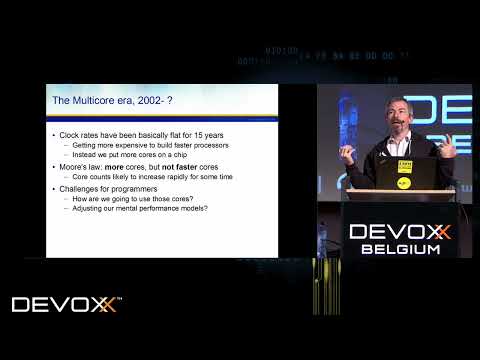
A Crash Course in Modern Hardware by Cliff Click
21K views • 9 years ago
Devoxx
Cliff Click walks through a small performance example on a modern out-of-order CPU. He covers pipelining, ILP, CISC vs RISC, multicore, and why cache misses and the memory subsystem dominate performance.
 40:43
Birth of The Transistor: A video history of Japan's electronic industry. (Part 1)
1.2M views • 12 years ago
RC286
First part of a four-part video history of Japan's electronics industry, covering the birth of the transistor and the rise of Japanese semiconductors. It appears to draw on NHK documentary material.
 27:48
How are Microchips Made? 🖥️🛠️ CPU Manufacturing Process Steps
11.9M views • 2 years ago
Branch Education
Branch Education walks through a semiconductor fab and the dozens of steps used to turn silicon wafers into microchips, with 3D animation. It covers lithography, deposition and etching at a high level.
 51:50
[11] Mike Clark, AMD Zen Chief Architect
27K views • 5 years ago
TechTechPotato
Ian Cutress interviews Mike Clark, AMD's chief architect of Zen, about his career since the K5, how Zen began and how CPUs are designed. It also covers the future of AMD.
 8:45
Plastic Recycling is an Actual Scam | Climate Town
1.9M views • 5 years ago
Climate Town
Climate Town gives a comedic, fast-paced account of how the plastics industry promoted recycling, including the resin-code recycling symbol, while knowing most plastic could not be economically recycled. It points viewers to the Frontline documentary Plastic Wars for a deeper treatment.
 46:04
DEF CON 26 - Christopher Domas - GOD MODE UNLOCKED Hardware Backdoors in redacted x86
86K views • 8 years ago
DEFCONConference
Christopher Domas presents research at DEF CON 26 showing a hidden alternate instruction set and undocumented hardware backdoor in some x86 processors, found on a third-party CPU. He uses it to ask how feasible wider hardware backdoors are.
 1:00:58
CppCon 2017: Chandler Carruth “Going Nowhere Faster”
113K views • 9 years ago
CppCon
Chandler Carruth shows how to squeeze more performance out of already-optimized C++ code, covering how the CPU executes it. The talk goes into pipelining, branch prediction and speculative execution using benchmarks.
 2:39:15
Jim Keller: The Future of Computing, AI, Life, and Consciousness | Lex Fridman Podcast #162
1.3M views • 5 years ago
Lex Fridman
Lex Fridman interviews chip architect Jim Keller about the future of computing, AI, life and consciousness. Topics include CPU design, branch prediction and why imperfect designs often win.
 1:03:44
CppCon 2015: Timur Doumler “C++ in the Audio Industry”
131K views • 11 years ago
CppCon
Timur Doumler's CppCon 2015 talk on how C++ is used in the audio industry. It covers the patterns and tools audio developers rely on, including handling real-time constraints.
 34:51
Intel - Anti-Competitive, Anti-Consumer, Anti-Technology.
257K views • 9 years ago
AdoredTV
AdoredTV's history of Intel's monopolistic behavior over three decades, covering its dealings with AMD and its anti-consumer practices.
 5:12
The $8 billion iPod | Rob Reid
954K views • 14 years ago
TED
A five-minute TED talk by Rob Reid, who introduces Copyright Math, applying entertainment-industry piracy loss claims to produce absurd totals such as an $8 billion iPod.
 38:26
Racing the Beam Explained - Atari 2600 CPU vs. CRT Television
400K views • 5 years ago
Retro Game Mechanics Explained
Retro Game Mechanics Explained shows how the Atari 2600 draws images with almost no video memory, by having the CPU race the CRT beam line by line. It walks through the techniques in detail.
 4:18
Frank Zappa explains the decline of the music business
828K views • 19 years ago
budagum
A short Frank Zappa interview clip on the decline of the music business, contrasting old cigar-chomping executives with younger industry people.
 56:37
36C3 - Uncover, Understand, Own - Regaining Control Over Your AMD CPU
23K views • 6 years ago
media.ccc.de
A 36C3 talk on the AMD Platform Security Processor, an undocumented ARM core inside AMD CPUs that runs before the main processor. The speakers present their reverse engineering of its internals.
 16:26
Dr. Oz and Nutritional Supplements: Last Week Tonight with John Oliver (HBO)
19.2M views • 12 years ago
LastWeekTonight
John Oliver's Last Week Tonight segment takes on Dr. Oz and the dietary supplement industry. It explains what is problematic about both, with a comedic wrap-up.
 20:11
Inside Intel
62K views • 6 years ago
AdoredTV
AdoredTV relays leaks and insider accounts of what it is like inside Intel, including staffing changes and morale. It is a commentary video from 2020.
 30:48
Scumbag ASUS: Overvolting CPUs & Screwing the Customer
1.5M views • 3 years ago
Gamers Nexus
Gamers Nexus criticizes ASUS over its handling of exploding Ryzen CPUs, overvolting BIOS settings and warranty and support behavior. It re-benchmarks the chips at defaults and argues ASUS eroded customer trust.
 6:53
8-bit computer update
2.8M views • 10 years ago
Ben Eater
Ben Eater's short update announcing his plan to build another 8-bit computer from scratch on camera. It kicks off the breadboard computer series that became widely known.
 1:34:44
Jim Keller: Moore's Law, Microprocessors, and First Principles | Lex Fridman Podcast #70
742K views • 6 years ago
Lex Fridman
Lex Fridman interviews legendary chip architect Jim Keller about Moore's Law, microprocessor design, and first-principles thinking. Keller draws on his work at AMD, Apple, Tesla and Intel, discussing instruction sets, transistor budgets, and self-driving.
 1:04:53
Jim Keller: Moore’s Law is Not Dead
77K views • 7 years ago
UC Berkeley EECS
Jim Keller gives a UC Berkeley EECS colloquium arguing that Moore's Law is not dead. He surveys upcoming technologies and the multiple innovation curves that can keep transistor density and performance scaling.
 2:50:14
Simple Code, High Performance
463K views • 5 years ago
Molly Rocket
Casey Muratori's University of Twente guest lecture is a case study in how straightforward code can cut thousands of lines and tens of seconds of runtime down to a few dozen lines running in under a second. It uses concrete examples to show why software is often an order of magnitude slower than it should be.
 5:41
DAIRY IS SCARY!
6.9M views • 10 years ago
Erin Janus
Vegan advocate Erin Janus explains the dairy industry in about five minutes, covering how milk is produced and the treatment of cows and calves. It is an advocacy piece and includes graphic material.
 2:01:18
Half-Life 2: 20th Anniversary Documentary
9.3M views • 1 year ago
Valve
Valve's two-hour documentary for Half-Life 2's 20th anniversary, with team members discussing development, nearly running out of money, being hacked, the publisher lawsuit and the birth of Steam.
 1:12:52
SHIPBREAKERS | Would you risk your life dismantling the world’s largest ships just to survive? | NFB
5.8M views • 9 years ago
NFB
An NFB documentary about the shipbreaking yards of Alang, India, where about 40,000 people dismantle huge ships by hand in dangerous conditions.
 1:05:24
Susan Crawford on Captive Audience: The Telecom Industry & Monopoly Power in the New Gilded Age
11K views • 13 years ago
Berkman Klein Center for Internet & Society
Susan Crawford talks at Harvard's Berkman Klein Center about her book Captive Audience. She argues that deregulation and consolidation left a few telecom companies in control of American internet access, so people pay too much for slow service.
 21:28
DEF CON 26 - Christopher Domas - The Ring 0 Facade Awakening the Processors Inner Demons
24K views • 8 years ago
DEFCONConference
Christopher Domas's DEF CON 26 talk on secret processor registers that vendors reserve for third parties holding trusted keys. He examines how users are locked out of parts of their own CPUs.