due process
 36:06
Civilizations at the End of Time: Black Hole Farming
934K views • 10 years ago
Isaac Arthur
An Isaac Arthur episode on civilizations in the dark, post-stellar universe, including black hole farming, accretion disks and the Penrose process as energy sources.
 12:31
The Superheterodyne Radio: No really, that's its name
987K views • 7 years ago
Technology Connections
Technology Connections explains why the superheterodyne radio has its name and how mixing frequencies lets it tune stations well. It walks through the underlying wave phenomena and algebra and why the design solved a hard tuning problem.
 27:48
How are Microchips Made? 🖥️🛠️ CPU Manufacturing Process Steps
11.9M views • 2 years ago
Branch Education
Branch Education walks through a semiconductor fab and the dozens of steps used to turn silicon wafers into microchips, with 3D animation. It covers lithography, deposition and etching at a high level.
 19:42
But what is the Fourier Transform? A visual introduction.
12.6M views • 8 years ago
3Blue1Brown
3Blue1Brown's animated visual introduction to the Fourier Transform, showing how a signal breaks into frequency components.
 28:23
The Fast Fourier Transform (FFT): Most Ingenious Algorithm Ever?
2.3M views • 5 years ago
Reducible
Reducible's visual walkthrough of the Fast Fourier Transform, motivated by polynomial multiplication. It shows how the FFT's key ideas can be discovered by asking the right questions.
 18:07
The more general uncertainty principle, regarding Fourier transforms
2.3M views • 8 years ago
3Blue1Brown
3Blue1Brown shows how the uncertainty principle arises from Fourier transforms. A wave packet cannot be narrow in both position and frequency, so the principle is a property of waves rather than of measurement.
 4:14
Computer Color is Broken
4.3M views • 11 years ago
minutephysics
MinutePhysics explains that computers store brightness nonlinearly, so blurring and blending colors in raw RGB gives wrong, dark results. It shows why mixed colors, such as in gradients, look off.
 26:33
The Most Underrated Algorithm
10.8M views • 4 years ago
Veritasium
Veritasium tells the story of the Fast Fourier Transform, from its use in detecting nuclear tests to Cold War politics, and how it could have changed the arms race. It includes a short, intuitive explanation of what the Fourier transform does.
 20:47
Decaf Explained
2.1M views • 2 years ago
James Hoffmann
James Hoffmann explains how decaf coffee is made, how the decaffeination processes differ, and why decaf is roasted and stales differently. He also discusses decaf quality and health questions.
 11:15
The hardest problem on the hardest test
16.5M views • 8 years ago
3Blue1Brown
3Blue1Brown walks through a very hard Putnam competition problem and its elegant solution, emphasizing the visual intuition and the thought process behind solving it.
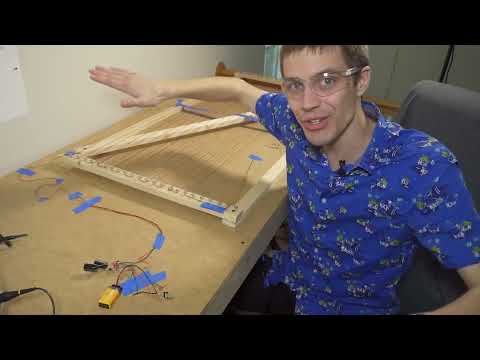 26:29
Watch electricity hit a fork in the road at half a billion frames per second
3M views • 2 years ago
AlphaPhoenix
AlphaPhoenix uses a custom high-speed measurement setup to watch voltage waves travel down wires and split at a fork. It answers how electricity knows where to go and how quickly that process happens.
 35:33
How does Computer Memory Work? 💻🛠
5.5M views • 4 years ago
Branch Education
A 36-minute animated deep dive from Branch Education into how DRAM works. It shows how memory connects to the CPU and how billions of bits are stored in nanoscale capacitor cells. It also covers why DRAM sits between SSDs and the processor.
 13:36
Chinese Invisibility Cloak Hoax DESTROYED!!!
6.8M views • 8 years ago
Captain Disillusion
Captain Disillusion debunks a viral Chinese invisibility cloak video while parodying popular educational channels. Along the way he explains chroma keying and green screen techniques.
 23:29
How Imaginary Numbers Were Invented
22.7M views • 5 years ago
Veritasium
Veritasium tells the history of how imaginary numbers arose from the quest for a general solution to the cubic equation, including the duels and secrecy among Renaissance mathematicians. It argues math had to give up the requirement that it mirror reality.
 38:31
The $200M Machine that Prints Microchips: The EUV Photolithography System
2.4M views • 1 year ago
Branch Education
Branch Education's animated deep dive into ASML's EUV photolithography machine and how it prints nanometer-scale transistors onto chips. It covers the system's components and the process of chip manufacturing.
 12:25
This Invention Made Disney MILLIONS, but Then They LOST It!
7.3M views • 2 years ago
Corridor Crew
Corridor Crew tracks down Disney's lost sodium vapor prism process, used for Mary Poppins-era transparency mattes. They explain how a narrow sodium wavelength and a beam splitter enabled better compositing than green screen.
 29:48
MOLTEN GLASS VS Prince Rupert's Drop - Smarter Every Day 285
5.8M views • 3 years ago
SmarterEveryDay
Destin Sandlin of Smarter Every Day explores molten glass and Prince Rupert's drops with a glass artist, including a process that freezes the moment glass shatters and an artisan who makes the drops.
 11:53
Where The Real Chip Shortage Is
624K views • 4 years ago
Asianometry
Asianometry explains that the worst of the 2021-22 chip shortage sits in trailing-edge semiconductors, not the leading-edge chips usually covered. It covers why those older-node fabs are so hard to expand and fix.
 15:00
The Material Science of Metal 3D Printing
2.7M views • 7 years ago
Real Engineering
Real Engineering explains the materials science behind metal 3D printing, including crystal structure, laser sintering, and why printed parts develop fatigue cracks. It shows how process imperfections limit the strength of printed metal.
 7:04
What *Really* happens to used Electric Car Batteries? - (you might be surprised)
5.6M views • 3 years ago
JerryRigEverything
JerryRigEverything tours Li-Cycle to show how lithium-ion batteries from EVs, phones and tools are recycled. It walks through the process of shredding batteries and extracting materials.
 6:22
The Unreasonable Efficiency of Black Holes
4.5M views • 8 years ago
minutephysics
Minutephysics compares how efficiently different processes convert mass to energy per E=mc^2, from fire and fission to fusion, antimatter and black holes, which can convert a large fraction of mass to energy.
 19:19
Was Penrose Right? NEW EVIDENCE For Quantum Effects In The Brain
1.1M views • 2 years ago
PBS Space Time
PBS Space Time examines Roger Penrose's idea that consciousness arises from quantum processes in the brain, and reviews new evidence about microtubules. It ends with an estimate of what replicating consciousness would demand.
 4:42
Why Your Webcam Still SUCKS!
552K views • 6 years ago
Techquickie
A short Techquickie explainer on why laptop webcams are much worse than phone cameras. It covers sensor size, image processing, and the interface differences between laptops and phones, with input from a Logitech engineer.
 43:00
The step-by-step, mechanical logic of old pinball machines
1.1M views • 2 years ago
Technology Connections
Technology Connections takes apart the step-by-step electromechanical logic of a 1970s pinball machine. He shows how relays, steppers and switches track state and score without electronics.
 14:24
DNA Testing and Privacy (Behind the scenes at the 23andMe Lab) - Smarter Every Day 176
1.5M views • 9 years ago
SmarterEveryDay
Destin of Smarter Every Day goes behind the scenes at the 23andMe lab to show how genotyping works. He also discusses DNA testing and privacy.
 4:21
The Disaster That Changed Engineering: The Hyatt Regency Collapse
2.7M views • 9 years ago
Tom Scott
A Tom Scott guest video by Grady Hillhouse of Practical Engineering on the 1981 Hyatt Regency walkway collapse. A seemingly minor change to the support design led to catastrophic failure, which is why the case is taught as a lesson to check and double-check everything.