error correction
 20:05
But what are Hamming codes? The origin of error correction
3.1M views • 6 years ago
3Blue1Brown
3Blue1Brown's discovery-oriented introduction to error correction codes, building up Hamming codes from the puzzle of locating a flipped bit. It explains the parity-check idea and why it is so efficient.
 45:31
The Do's and Don'ts of Error Handling • Joe Armstrong • GOTO 2018
74K views • 8 years ago
GOTO Conferences
Joe Armstrong, inventor of Erlang, gives a GOTO Chicago 2018 talk on building fault-tolerant systems. He covers what to do and avoid when handling errors, arguing for letting processes fail and recover.
 31:18
Quantum Expert Insight: Peter Shor
607K views • 5 years ago
Qiskit
Peter Shor tells the story of how he discovered Shor's Algorithm, from his early mathematics days to the quantum factoring breakthrough. It was recorded at MIT at the Physics of Computation conference.
Topic match · Quantum computing 35:13
I built a QR code with my bare hands to see how it works
9.7M views • 2 years ago
Veritasium
Veritasium builds a QR code by hand to explain how it works. It covers the history of Morse code and barcodes, how QR codes encode data, why damaged codes still scan, and how safe they are.
 33:32
Condition Systems in an Exceptional Language - Chris Houser
16K views • 10 years ago
ClojureTV
Chris Houser's Clojure/conj talk on why Clojure's exceptions destroy information as the stack unwinds, unlike Common Lisp's condition system, which can resume from the error site. He surveys the existing libraries that approximate conditions, explains why they don't compose with each other, and considers what a better design would look like.
 48:36
Matt Might - Winning the War on Error Solving the Halting Problem and Curing Cancer
9K views • 9 years ago
Curry On!
Matt Might's Curry On talk on ending errors in code, both software and the human genome. He covers conservative approximation of the halting problem via static analysis and a computational approach to precision medicine.
 23:03
The Universe is Hostile to Computers
26.5M views • 5 years ago
Veritasium
Veritasium explains how cosmic rays and other particles flip bits in computer memory, with examples including a Belgian election count error, plane incidents and game glitches. It is inspired by a RadioLab episode on bit flips.
 37:07
Who Destroyed Three Mile Island? - Nickolas Means | The Lead Developer Austin 2018
762K views • 8 years ago
LeadDev
Nickolas Means recounts the 1979 Three Mile Island accident minute by minute, from the control rod insertion to the operator's decision to switch off emergency cooling. He argues that finding systemic causes is more useful than blaming individuals.
 38:38
"Tree-sitter - a new parsing system for programming tools" by Max Brunsfeld
63K views • 8 years ago
Strange Loop Conference
Max Brunsfeld introduces Tree-sitter, a parsing system for developer tools that offers incremental parsing and robust error recovery through a uniform C API. The talk explains the design, based on LR extended to GLR parsing.
 44:19
Unconditional Code • Michael Feathers • GOTO 2018
61K views • 8 years ago
GOTO Conferences
Michael Feathers' GOTO Chicago 2018 talk on reducing error checks and conditional logic in code. He offers a framework for handling errors and decisions at the level of code and architecture.
 21:24
The CIA is a Terrorist Organization
794K views • 5 years ago
Second Thought
A Second Thought video arguing that the CIA is responsible for serious crimes, coups and unrest around the world, with historical examples and further reading.
 30:12
Casey Muratori | Smart-Pointers, RAII, ZII? Becoming an N+2 programmer
162K views • 2 years ago
xDahl
Casey Muratori argues against smart pointers and RAII, advocating grouped-element thinking, zero-is-initialization and stubs as better ways to structure memory and handle errors.
 34:10
Anders Hejlsberg on Modern Compiler Construction
25K views • 9 years ago
Kasper
Anders Hejlsberg whiteboards how compilers are taught versus how modern ones are actually built. He explains the shift to compilers as services with incremental, error-tolerant, IDE-oriented design, as in Roslyn and TypeScript.
 20:33
Gradient descent, how neural networks learn | Deep Learning Chapter 2
9.7M views • 9 years ago
3Blue1Brown
3Blue1Brown's second neural network chapter explains cost functions and gradient descent, showing how a network learns by minimizing error during training.
 54:24
26. Chernobyl — How It Happened
3.6M views • 7 years ago
MIT OpenCourseWare
MIT 22.01 lecture by Michael Short explaining the Chernobyl accident technically, including RBMK reactor positive feedback, xenon poisoning and the cascade of human errors during the test.
 23:39
I sent robot forgeries to a handwriting expert
11.5M views • 3 years ago
Stuff Made Here
Stuff Made Here builds a handwriting robot and sends its output to a handwriting expert to see whether it can pass as forgery. It walks through the engineering trials and errors along the way.
 27:18
Vocal Fry: what it is, who does it, and why people hate it!
4.1M views • 3 years ago
Dr Geoff Lindsey
Linguist Geoff Lindsey explores vocal fry: what it is, who uses it, how it relates to glottal stops and accents, and why some people dislike it.
 29:28
Defeating Microwave Weapons! - Part 1
2.4M views • 4 years ago
Tech Ingredients
Tech Ingredients demonstrates how microwaves work and how they affect objects at range, then shows ways to defend against them. It includes a correction about rectifier output frequency.
 52:22
Power is not energy: why the difference matters
2.3M views • 1 year ago
Technology Connections
Technology Connections explains the difference between power (watts) and energy (watt-hours) and why confusing them leads to errors. It runs about 52 minutes and uses everyday examples.
 43:00
Tree-sitter: a new parsing system for programming tools - GitHub Universe 2017
24K views • 8 years ago
GitHub
Max Brunsfeld of GitHub presents Tree-sitter, a parsing system for programming tools that supports incremental, error-tolerant parsing. He demos its integration into GitHub.com and Atom for syntax highlighting and code navigation.
 45:14
DEFCON 19: Bit-squatting: DNS Hijacking Without Exploitation (w speaker)
24K views • 14 years ago
Christiaan008
Artem Dinaburg's DEF CON 19 talk on bit-squatting, where flipped bits in DRAM cause devices to contact domains that differ by one bit from legitimate ones. He shows how registering such domains can hijack traffic without exploiting any software bug.
 40:57
"Hedy: A Gradual programming language" by Felienne Hermans (Strange Loop 2022)
17K views • 4 years ago
Strange Loop Conference
Felienne Hermans presents Hedy, a gradual programming language for teaching kids that moves through levels from almost no syntax toward full Python. The talk covers why error messages and syntax are scary for beginners.
 55:02
GradIEEEnt half decent: The hidden power of imprecise lines
391K views • 3 years ago
suckerpinch
Tom 7 (suckerpinch) delivers a long, comedic digression on gradient descent and floating-point imprecision. He shows how rounding behavior can supply the nonlinearity needed to build a neural network.
 57:53
Larry Wall Speaks at Google
81K views • 18 years ago
Google TechTalks
Larry Wall speaks at Google's Chicago office in 2008 about the Perl community, the language, and Perl 6. The talk touches on grammars, macros and error messages.
 37:02
DEFCON 21 - DNS May Be Hazardous to Your Health - Robert Stucke
20K views • 13 years ago
Robert Stucke (bobhex)
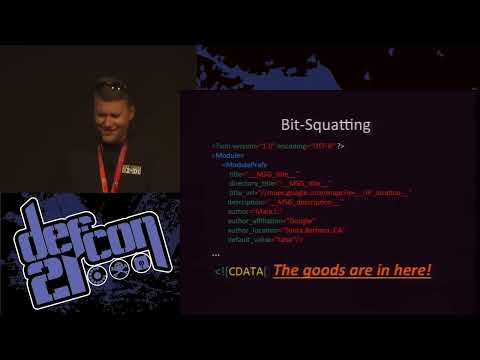
A DEFCON 21 talk by Robert Stucke on DNS errors caused by single-bit flips, which lead to requests for misspelled domains. It shows real-world data on bitsquatting.
 24:05
Edsger Dijkstra interview
35K views • 8 years ago
Hans Otten
A 24-minute interview with Edsger Dijkstra, the Dutch computer scientist, including his views on writing programs by hand and keeping errors out of them. It is part of a longer Dutch TV interview.
 36:41
TASBot plays Brain Age by micro500, xy2_ in 20:06 - Awesome Games Done Quick 2016 - Part 154
6M views • 10 years ago
Games Done Quick
A tool-assisted run of Brain Age by TASBot, shown at Awesome Games Done Quick 2016. The bot gives deliberately deranged answers while exploiting the game's error-prone recognition.