free play
 13:55
Segmented Displays
7.2M views • 4 years ago
Posy
Posy explores segmented displays, from the seven-segment display to alternative designs with fewer or more segments, with patents and history.
 3:38
The Electrowetting Display
118K views • 13 years ago
IEEE Spectrum
IEEE Spectrum interviews Samsung display researcher Johan Feenstra on how electrowetting displays work. He explains why they can match LCD capability while being about three times more efficient.
 14:18
The Only* Car-Free Neighbourhood in Canada (and why you can't live there)
1.1M views • 4 years ago
Not Just Bikes
Not Just Bikes visits the Toronto Islands, home to Canada's only car-free neighbourhood. He explains the waiting list and strict ownership rules and asks why more such places aren't built.
 26:54
Chest Freezers; What they tell us about designing for X
2.9M views • 6 years ago
Technology Connections
Technology Connections explains how refrigerator and freezer design affects energy use, using chest freezers to show why top-opening designs and layout choices matter. It includes thermal-camera footage of cold air spilling out of upright units.
 14:05
The Five Freedoms of Aviation
3.7M views • 9 years ago
Wendover Productions
A Wendover Productions explainer on the political agreements, from the Chicago Convention onward, that determine which airlines can fly where. It lays out the five freedoms of the air.
 6:04
Car-free Streets are Amazing (and we need more of them)
484K views • 6 years ago
Not Just Bikes
Not Just Bikes explains the Dutch concept of autoluw, or nearly car-free, streets and how it is applied across the Netherlands, with examples from Toronto and Copenhagen. It also covers Amsterdam's move toward a nearly car-free city.
 20:30
Does Superdeterminism save Quantum Mechanics? Or does it kill free will and destroy science?
989K views • 4 years ago
Sabine Hossenfelder
Sabine Hossenfelder explains superdeterminism as an interpretation of quantum mechanics, addressing common objections and misconceptions, including the worry that it kills free will or science. She ties it to Bell's theorem and hidden variables.
 12:36
Why PlayStation 1 Graphics Warped and Wobbled so much | MVG
2.3M views • 6 years ago
Modern Vintage Gamer
Modern Vintage Gamer explains why PlayStation 1 graphics warped and jittered, comparing it with the Nintendo 64. The causes are affine texture mapping and the lack of sub-pixel vertex precision.
 7:38
Does Hot Water Freeze Faster Than Cold Water?
5M views • 9 years ago
Sciencium
Sciencium examines the Mpemba effect, the claim that hot water freezes faster than cold water. It walks through experiments and a published paper questioning the effect.
 2:42
Power of the Market - The Pencil
551K views • 18 years ago
LibertyPen
A three-minute excerpt from Milton Friedman's Free to Choose in which he uses a pencil to show that no single person knows how to make it. He argues that the free market coordinates countless strangers peacefully.
 9:48
Why do YouTube views freeze at 301?
301 views • 14 years ago
Numberphile
Numberphile visits YouTube to learn why view counts on new videos used to freeze at 301. It explains that YouTube holds counts while it verifies views aren't from bots or fakes.
 6:43
The high cost of free parking
4.6M views • 9 years ago
Vox
A Vox explainer on how mandatory parking minimums and free parking impose hidden costs on cities. It draws on Donald Shoup's work and gives the history of parking requirements.
 2:26
Milton Friedman - I, Pencil
802K views • 14 years ago
Free To Choose Network
A two-minute clip in which Milton Friedman uses a humble pencil to show how thousands of strangers across many countries cooperate, without central direction, to make a simple product. It is a short visual version of the 'I, Pencil' essay's argument about free markets and dispersed knowledge.
 23:16
The Machinery Of Freedom: Illustrated summary
164K views • 14 years ago
bitbutter
An illustrated 23-minute summary of David Friedman's talk based on The Machinery of Freedom. It describes how law, police and courts could work as market services in a stateless society, covering private law, polycentric law and objections.
 14:34
Visualization of Quantum Physics (Quantum Mechanics)
2.8M views • 9 years ago
udiprod
An animated visualization of basic quantum mechanics using a free particle, with simulations based on the actual equations. It covers waves, particles, and how measurement collapses the wavefunction.
 19:40
How I Designed a Free Music Font for 5 Million Musicians (MuseScore 3.6)
608K views • 5 years ago
Tantacrul
Tantacrul explains how he and engraver Simon Smith designed the free music notation font for MuseScore 3.6. It draws on the history of the SCORE notation application by Leland Smith.
 12:02
Nintendo - Putting Play First
997K views • 10 years ago
Game Maker's Toolkit
Game Maker's Toolkit examines Nintendo's design approach of starting from a core play mechanic, making it fun, and building around it. Examples include Mario's jump and Luigi's Mansion's vacuum.
 41:35
The Alt-Right Playbook: How to Radicalize a Normie
4.5M views • 7 years ago
Innuendo Studios
A video essay from the Alt-Right Playbook series that explains how extremist movements draw ordinary people in, using deniable rhetoric, bad-faith games, and gradual escalation. It draws on books about the alt-right, male radicalization, and cult-style brainwashing.
 6:58
The Skinner Box - How Games Condition People to Play More - Extra Credits
1.2M views • 14 years ago
Extra Credits
An Extra Credits episode on how games use Skinner box operant conditioning and reward schedules to keep players playing and spending. It argues for more immersive design mechanics than simple reward loops.
 4:45
How playing an instrument benefits your brain - Anita Collins
15.2M views • 12 years ago
TED-Ed
A short TED-Ed animated lesson by Anita Collins on what happens in the brain when people play a musical instrument. It argues that playing engages many brain areas at once, like a full-body workout, with long-term benefits.
 17:34
What Everyone Gets Wrong About Gravity
15.6M views • 6 years ago
Veritasium
Veritasium explains, with expert input, that in general relativity gravity is not a force and objects follow straight paths through curved spacetime, including why standing on the ground means you are accelerating.
 9:06
Vancouver Never Plays Itself
2.2M views • 11 years ago
Every Frame a Painting
A video essay from Every Frame a Painting about Vancouver, a major film production city that almost never appears onscreen as itself. It shows clips of films and TV shot there that pass the city off as somewhere else.
 7:00
CD / Color
2.9M views • 6 years ago
Captain Disillusion
Captain Disillusion's comedic, fast-paced explainer on how color works in cameras, displays and video. It covers the biology of color perception and what it means for screens.
 12:04
Anagrams, but where you can break apart letters: "Anagraphs"
256K views • 8 years ago
suckerpinch
Tom Scott-style exploration by suckerpinch (Tom7) of generalized anagrams where letters can be broken into pieces, called anagraphs, with a whimsical computational approach.
 22:13
what did you do
1.5M views • 11 months ago
Noodle
Noodle explores how retro pixel art was designed for CRT displays and why games look different on LCDs, with input from pixel artists and CRT researchers.
 45:13
You've (Likely) Been Playing The Game Of Life Wrong
11.6M views • 11 months ago
Veritasium
Veritasium explains why many real-world systems follow power laws rather than normal distributions. It covers self-organized criticality, with simulations of sandpiles, magnetism and forest fires.
 14:54
Induced Demand & Roadway Widening: Everything You Always Wanted to Know (and Weren't Afraid to Ask)
120K views • 4 years ago
Ray Delahanty | CityNerd
CityNerd Ray Delahanty explains induced demand and what happens when freeways are widened. He walks through the economics of supply and demand applied to traffic and asks how much new traffic appears and whether congestion returns.
 23:04
The Computer-free Automation of a Jukebox (Electromechanics)
1.3M views • 6 years ago
Technology Connections
Technology Connections takes apart a 1970 Wurlitzer 3400 jukebox to show how electromechanical relays and switches automated its behavior without a computer.
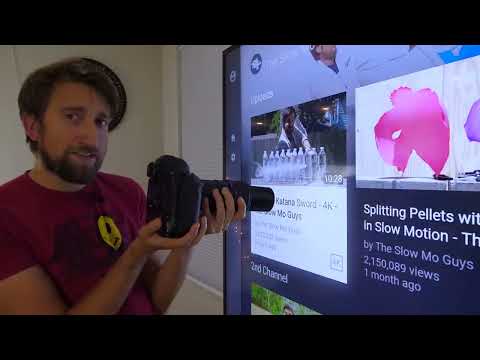 11:39
How a TV Works in Slow Motion - The Slow Mo Guys
45.7M views • 8 years ago
The Slow Mo Guys
The Slow Mo Guys film a TV and screens with a high-speed camera to show how displays build an image. The footage includes CRT-style scanning and how pixels light up over time.
 6:02
OpenAI Plays Hide and Seek…and Breaks The Game! 🤖
11M views • 7 years ago
Two Minute Papers
Two Minute Papers covers OpenAI's multi-agent hide-and-seek experiment, in which agents learned emergent tool use and found ways to break the game's rules. It summarizes the 'Emergent Tool Use from Multi-Agent Interaction' paper.
 25:05
The Best-Designed Town in the Netherlands (and therefore, the world)
1.2M views • 1 year ago
Not Just Bikes
Not Just Bikes tours Houten, a Dutch town designed around cycling, explaining how its layout makes most trips by bike safe and easy. It also promotes a book about the town.
 12:16
LCCS: The LCD / CRT Hybrid from JVC
2.3M views • 7 years ago
Technology Connections
A Technology Connections video on JVC's LCCS, a display hybrid that cycles a color LCD shutter over a monochrome CRT to produce field-sequential color without dots or stripes. It builds on his earlier videos about analog TV and compatible color.
 5:21
The Best Kind of Dutch Cycling Infrastructure
355K views • 6 years ago
Not Just Bikes
Not Just Bikes explains Dutch bicycle-only roads, which let people travel long distances in and out of cities with almost no car interaction. It shows how this changes cycling from a chore into something enjoyable.
 4:21
An elevator that actually goes sideways
4.3M views • 9 years ago
Tom Scott
Tom Scott visits ThyssenKrupp's test tower in Rottweil to see the Multi, a rope-free elevator that uses linear motors to move cabins sideways as well as vertically.
 11:28
Here's What's Preventing You From Finishing Projects
147K views • 5 years ago
Zack Freedman
Zack Freedman gives advice on why makers fail to finish projects, including scrapping bad ideas, showing work publicly and writing a plan that keeps projects fun. It is aimed at hardware DIY but generalizes.
 6:33
I, Pencil: The Movie
1.4M views • 13 years ago
I, Pencil
A short film from the Competitive Enterprise Institute adapting Leonard Read's 1958 essay I, Pencil, showing how no one person knows how to make a pencil and how many people cooperate without central planning.
 10:45
The Car-Replacement Bicycle (the bakfiets)
1.6M views • 4 years ago
Not Just Bikes
Not Just Bikes explains how an electric bakfiets (Dutch cargo bike) replaced the family car after a move back to Canada, saving thousands of dollars. It shows how much it can carry, including kids and groceries.
 17:04
These Are Not Pixels: Revisited
611K views • 8 years ago
Technology Connections
Technology Connections follows up on his analog TV video to clear up the debate over whether CRT phosphor dots are pixels. He explains the shadow mask, color triads and how they relate to the scanned picture.
 37:20
But how do AI images and videos actually work? | Guest video by Welch Labs
2.2M views • 1 year ago
3Blue1Brown
A guest video by Welch Labs on 3Blue1Brown explaining how text-to-image and video models work. It covers CLIP, shared embedding spaces, diffusion models (DDPM, DDIM), conditioning, guidance and negative prompts.
 13:00
How to (Quickly) Build a Cycling City - Paris
1.4M views • 4 years ago
Not Just Bikes
Not Just Bikes visits Paris to see how Mayor Anne Hidalgo's policies are turning it into a '100% cyclable' city. It looks at the changes that took space from cars for bikes and people.