shor's algorithm
 31:18
Quantum Expert Insight: Peter Shor
607K views • 5 years ago
Qiskit
Peter Shor tells the story of how he discovered Shor's Algorithm, from his early mathematics days to the quantum factoring breakthrough. It was recorded at MIT at the Physics of Computation conference.
 27:42
Mark DiMarco: User Interface Algorithms [JSConf2014]
52K views • 12 years ago
JSConf
A JSConf 2014 talk visually breaking down algorithms behind everyday UI patterns, such as dropdown menus that vanish when the mouse drifts and picking the nearest target to the cursor. It shows how these are implemented in JavaScript.
 59:34
There is No Algorithm for Truth - with Tom Scott
2.7M views • 7 years ago
The Royal Institution
Tom Scott's Royal Institution discourse on science communication in the age of social media, how recommendation algorithms shape popularity, and why view counts can matter more than truth. It includes a segment on parasocial relationships.
 42:25
Glenn Vanderburg - Cló: The Algorithms of TeX in Clojure
9K views • 11 years ago
ClojureTV
Glenn Vanderburg presents Cló, a Clojure library that reimplements TeX's core typesetting algorithms as composable functions. He shows what translating procedural, literate-programming code into functional form teaches.
 1:29:55
Sorting Algorithms: Speed Is Found In The Minds of People - Andrei Alexandrescu - CppCon 2019
184K views • 7 years ago
CppCon
Andrei Alexandrescu's CppCon 2019 talk revisits sorting, showing how branchless tricks, hybrid strategies and a cost metric can speed up std::sort-style algorithms on modern hardware.
 22:56
We're building a dystopia just to make people click on ads | Zeynep Tufekci
771K views • 8 years ago
TED
Technosociologist Zeynep Tufekci argues that the machine-learning systems used to serve ads also decide what political and social information people see. She explains how opaque algorithms can nudge, segment and manipulate users, and warns that the real danger is powerful people using AI to control populations.
 1:23:56
Stanford Seminar - Unethical Algorithms of Massive Scale
15K views • 9 years ago
Stanford Online
Psychologist Robert Epstein presents a Stanford EE380 colloquium on how internet algorithms such as search rankings can manipulate opinions, purchases and votes at massive scale. He also describes a new monitoring system for tracking such influence.
 31:07
Crafting A Tiny Open World: A Short Hike Postmortem
521K views • 6 years ago
GDC Festival of Gaming
Adam Robinson-Yu's GDC 2020 talk on how he shelved a big project to prototype what became A Short Hike. He covers the solo development process and technical choices like a pixel shader over low-poly models.
 1:13:41
CppCon 2014: Chandler Carruth "Efficiency with Algorithms, Performance with Data Structures"
235K views • 12 years ago
CppCon
Chandler Carruth's CppCon 2014 talk on writing fast C++, explaining why data structure choice and memory layout matter more than clever algorithms. It covers why standard containers like unordered_map perform poorly on modern CPUs.
 1:01:47
Four Solutions to a Trivial Problem - Guy Steele Jr.
36K views • 10 years ago
Google TechTalks
Guy Steele presents a small geometric problem and compares four computational approaches: a classic sequential solution and three parallel-friendly ones. Each is illustrated pictorially and with working code, weighing total work against time to solution.
 1:17:12
C++ Seasoning
58K views • 13 years ago
aghuttun
Sean Parent's GoingNative 2013 talk surveys new and overlooked C++ features and shows how to use them for simple, correct, clear code. It stresses using standard algorithms rather than raw loops.
 43:23
AI Ethics, Impossibility Theorems and Tradeoffs - Chris Stucchio | Crunch 2018
2K views • 7 years ago
CraftHub Events
Chris Stucchio presents the ethical principles behind algorithmic decision making and shows with examples from lending, criminology and education that they cannot all be satisfied at once. The talk frames AI fairness as a set of quantitative tradeoffs.
 16:33
The nightmare videos of childrens' YouTube — and what's wrong with the internet today | James Bridle
6M views • 8 years ago
TED
Writer and artist James Bridle shows how strange and disturbing children's videos on YouTube, from surprise eggs to algorithmic mashups, are produced for ad revenue. He argues they reveal problems in a data-driven internet.
 11:47
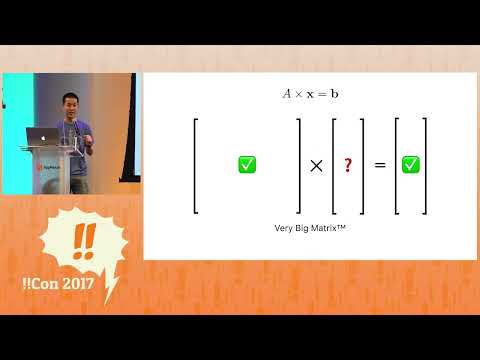
!!Con 2017: HDR Photography in Microsoft Excel?! by Kevin Chen
119K views • 9 years ago
Confreaks
A short conference talk from !!Con 2017 in which Kevin Chen explains the HDR imaging algorithm from a foundational paper, framing it as a system of linear equations, and implements it in a Microsoft Excel spreadsheet. No prior image processing knowledge is needed.
 3:21
A real person, a lot like you
467K views • 15 years ago
Derek Sivers
A three-minute video from Derek Sivers, based on his book Anything You Want, about remembering that the people you deal with online are real people. It contrasts how we treat people face to face with how we treat them online.
 1:47:35
Bryan Cantrill on ARC: A Self-Tuning, Low Overhead Replacement Cache [PWL SF] 10/2017
13K views • 9 years ago
PapersWeLove
Bryan Cantrill presents the ARC (Adaptive Replacement Cache) paper by Megiddo and Modha at Papers We Love. He opens with a survey of caching strategies before digging into the self-tuning LRU/MFU design.
 50:31
How Modern SQL Databases Come up with Algorithms that You Would Have Never Dreamed Of by Lukas Eder
55K views • 9 years ago
Devoxx
Lukas Eder's Devoxx talk on how modern cost-based SQL optimizers rewrite and plan queries in ways developers would not expect. It argues that declarative SQL, used well, can run complex queries very fast.
 9:05
Beware online "filter bubbles" | Eli Pariser
1.7M views • 15 years ago
TED
Eli Pariser's TED talk argues that personalized web services trap users in filter bubbles, limiting exposure to challenging information. He says this is bad for individuals and for democracy.
 16:09
The astounding athletic power of quadcopters | Raffaello D'Andrea
10.8M views • 13 years ago
TED
In a TEDGlobal talk, Raffaello D'Andrea demonstrates quadcopters that play catch, balance, learn and coordinate, using algorithms that treat them like athletes. It includes Kinect-controlled quads.
 1:28:23
Quantum Computing for Computer Scientists
2.2M views • 8 years ago
Microsoft Research
An 88-minute Microsoft Research talk that explains how quantum computers beat classical ones using basic linear algebra, qubits, superposition and gates. It works through the Deutsch oracle problem and ends with entanglement, teleportation and a live demo.
Topic match · Quantum computing 1:10:01
35C3 - The year in post-quantum crypto
8K views • 7 years ago
media.ccc.de
Daniel J. Bernstein and Tanja Lange survey recent highlights in post-quantum cryptography at 35C3, covering the NIST competition, network protocol experiments, and broken candidates.
Topic match · Quantum computing 1:14:51
Lisp at the Frontier of Computation, by Robert Smith at Rigetti Computing
16K views • 8 years ago
Arthur Gleckler
Robert Smith of Rigetti Computing talks at a Bay Area Lisp and Scheme meetup about using Common Lisp for quantum computing. He covers the technical, sociological and psychological sides of working across disciplines.
Topic match · Quantum computing 4:23
The User is Drunk
275K views • 13 years ago
squareweave
A short talk by Will Dayble of Squareweave arguing that you should design software as if the user were drunk: distracted, impaired in attention and vision, and prone to misreading. It is a user experience talk built around that framing.
 6:15
Find your primal posture and sit without back pain: Esther Gokhale at TEDxStanford
1.1M views • 14 years ago
TEDx Talks
Esther Gokhale's short TEDx talk argues that the natural human spine is curved rather than straight and teaches a 'primal posture' for sitting without back pain.
 53:56
Three Beautiful Quicksorts
45K views • 19 years ago
Google TechTalks
Jon Bentley walks through three implementations of Hoare's Quicksort, from a dozen-line C function to a series of systematic code transformations that make the program ever simpler and more powerful. It is a Google Tech Talk on code elegance and program derivation.
 1:26:11
Succinct Data Structures
9K views • 12 years ago
Edward Kmett
Edward Kmett's 2013 talk at Prezi in Budapest on succinct data structures, which store data in close to the information-theoretic minimum space while supporting fast queries. It ties together the research and walks through his Haskell succinct library.
 1:09:20
Don Knuth - Constraint Based Composition
9K views • 11 years ago
ccrmalite1
Donald Knuth explains at Stanford's CCRMA the constraint-based methods he is using to compose a major work for pipe organ.
 17:58
Copyrighting all the melodies to avoid accidental infringement | Damien Riehl | TEDxMinneapolis
346K views • 6 years ago
TEDx Talks
Lawyer and musician Damien Riehl argues that music is math with a finite number of melodies, and describes how he and programmer Noah Rubin generated every possible melody and released them under CC0 to avoid accidental infringement claims.
 1:06:40
Polyworld: Using Evolution to Design Artificial Intelligence
220K views • 18 years ago
Google TechTalks
A 2007 Google Tech Talk introducing Polyworld, an artificial life simulator used to evolve artificial intelligence by designing worlds rather than minds. It presents results from ongoing attempts to evolve intelligent behavior.
 19:10
Velocity NY 2013: Richard Cook, "Resilience In Complex Adaptive Systems"
47K views • 13 years ago
O'Reilly
Richard Cook's short Velocity 2013 talk on resilience in complex adaptive systems, arguing systems operate near the edge of failure and that the surprise is how rarely they fail. He presents a model of how pressures push systems toward failure boundaries.
 48:10
Bay Area Vision Meeting: Unsupervised Feature Learning and Deep Learning
123K views • 15 years ago
Google TechTalks
Andrew Ng presents unsupervised feature learning and deep learning, showing how algorithms can learn representations from unlabeled data instead of hand-designed features. He gives examples in vision and audio, including visualizations of features learned by successive layers.
 36:31
Hey Underscore, You're Doing It Wrong!
141K views • 13 years ago
InfoQ
Brian Lonsdorf explains why Underscore.js falls short as a functional programming library, then introduces currying, composition and point-free style in JavaScript. He argues for data-last argument ordering.
 1:27:37
DOUGLAS ADAMS: Parrots, the Universe and Everything
1.3M views • 18 years ago
University of California Television (UCTV)
Douglas Adams gives a talk at UCSB, recorded shortly before his death, about the odd lives of animals and what they suggest about humanity's future. It draws on his Last Chance to See work and is funny and wide-ranging.
 5:21
Ira Glass on Storytelling 3
146K views • 17 years ago
warphotography
A five-minute clip of Ira Glass on the gap between good taste and early creative work. He says beginners know their work falls short and must keep producing to close the gap.
 5:34
On The Turing Completeness of PowerPoint (SIGBOVIK)
1.2M views • 9 years ago
Tom Wildenhain
A short SIGBOVIK 2017 presentation by Tom Wildenhain showing that PowerPoint animations are Turing complete, with a working Turing machine built in slides. The talk is delivered deadpan as a serious research result.
 15:29
Dr Shashi Tharoor MP - Britain Does Owe Reparations
12.1M views • 11 years ago
OxfordUnion
Shashi Tharoor's Oxford Union speech arguing that Britain owes reparations to its former colonies, focused on the effects of British rule in India. It lists economic and political damage done by colonialism.
 13:29
!!Con 2016 - How I Code and Use a Computer at 1,000 WPM!! By Sina Bahram
11K views • 10 years ago
Confreaks
A short !!Con 2016 talk by blind developer Sina Bahram on how he uses a computer and writes code with a screen reader at about 1,000 words per minute. He plays how common interfaces sound and challenges the audience to go a day using only the keyboard.
 4:26
Dr. Robert Zubrin with a brilliant answer to "Why Should We Go To Mars?"
470K views • 10 years ago
Jamin Gray
A short clip of Dr. Robert Zubrin, author of The Case for Mars, answering why humanity should go to Mars. He argues that societies grow by challenging themselves and that exploration inspires young people.
 45:00
"Transducers" by Rich Hickey
116K views • 12 years ago
Strange Loop Conference
Rich Hickey introduces transducers in Clojure, a way to make map, filter and similar algorithms composable independent of the data source. This avoids duplicated implementations and intermediate collections across sequences, channels and streams.
 35:24
The Unreasonable Effectiveness of Multiple Dispatch | Stefan Karpinski | JuliaCon 2019
79K views • 7 years ago
The Julia Programming Language
Julia co-creator Stefan Karpinski explains why multiple dispatch makes Julia code and types reusable across packages with so little friction. He covers sharing basic types and sharing generic algorithms.