software security
 1:06:36
Computer Security 161 Cryptocurrency Lecture
128K views • 4 years ago
Nicholas C Weaver
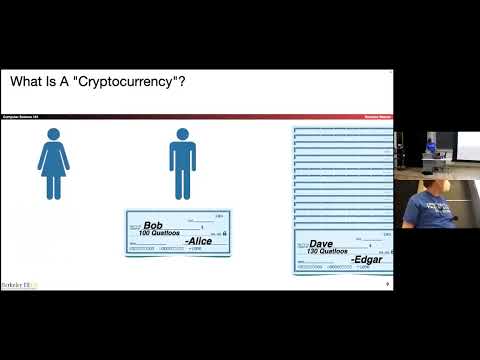
A UC Berkeley CS 161 lecture by Nicholas Weaver on cryptocurrency and blockchains, covering how they work and the case against them. It is aimed at a computer security course audience.
 48:40
Capt. Grace Hopper on Future Possibilities: Data, Hardware, Software, and People (Part One, 1982)
179K views • 2 years ago
National Security Agency
Part one of Capt. Grace Hopper's 1982 NSA lecture on the future of data, hardware, software and people. It includes her humor, her nanosecond demonstration and views on scaling and resisting old ways of doing things.
 1:21:22
Light Years Ahead | The 1969 Apollo Guidance Computer
2.8M views • 6 years ago
TNMoC
Robert Wills of TNMoC explains the Apollo Guidance Computer hardware and software, then walks through the Apollo 11 landing procedure step by step, including the 1202 alarms.
 53:25
The Only Unbreakable Law
487K views • 4 years ago
Molly Rocket
Casey Muratori's lecture, originally given at the Technical University of Madrid, arguing that Conway's Law is the only viable candidate for a true law of software architecture. He explains how software mimics the organization over time, using examples like Windows' multiple volume controls.
 1:16:22
If Brains are Computers, Who Designs the Software? - with Daniel Dennett
873K views • 9 years ago
The Royal Institution
Daniel Dennett's Royal Institution lecture on whether the brain is a computer and where its software comes from. He argues that minds are built by evolution and culture, with competence arising without comprehension.
 1:22:45
Building Software Systems At Google and Lessons Learned
257K views • 15 years ago
Stanford
Jeff Dean of Google describes his experiences building Google's systems and how its infrastructure evolved over time. The Stanford talk covers search, scaling tipping points and lessons from building large-scale software.
 42:21
Where Does Bad Code Come From?
282K views • 5 years ago
Molly Rocket
Casey Muratori's invited lecture on where bad code comes from, rebroadcast from a Twitch stream. He critiques conventional wisdom such as SOLID and Clean Code and argues about how those habits lead to slow, poorly structured software.
 18:41
Refterm Lecture Part 1 - Philosophies of Optimization
93K views • 5 years ago
Molly Rocket
Casey Muratori's first refterm lecture lays out philosophies of optimization, distinguishing optimization from non-pessimization, which means avoiding needless work. It uses his fast terminal renderer project to show how fast computers really are.
 1:48:42
Clean Code - Uncle Bob / Lesson 1
2.2M views • 7 years ago
UnityCoin
The first lesson of Uncle Bob (Robert C. Martin)'s "Coding Better World Together" series. It makes the case for clean code and for treating software craftsmanship as an ethical and professional responsibility. It runs about 109 minutes.
 1:15:47
Richard Feynman Computer Science Lecture - Hardware, Software and Heuristics
978K views • 14 years ago
Muon Ray
A lecture by Richard Feynman on how computers work, using the analogy of a filing clerk that becomes progressively dumber and faster. It also covers heuristics and how computers handle data and solve problems in finite time.
 2:50:14
Simple Code, High Performance
463K views • 5 years ago
Molly Rocket
Casey Muratori's University of Twente guest lecture is a case study in how straightforward code can cut thousands of lines and tens of seconds of runtime down to a few dozen lines running in under a second. It uses concrete examples to show why software is often an order of magnitude slower than it should be.
 49:47
Lecture 1 | Programming Methodology (Stanford)
2.6M views • 18 years ago
Stanford
First lecture of Stanford's CS106A Programming Methodology by Mehran Sahami, giving a course overview and starting on programming. The course teaches software engineering principles using Java.
 1:06:49
Special Lecture: F-22 Flight Controls
6.8M views • 5 years ago
MIT OpenCourseWare
A special lecture from MIT's Private Pilot Ground School in which Lt. Col. Randy Gordon, a fighter and test pilot, describes F-22 flight controls. Topics include thrust vectoring, the pilot command system and how software handles failures.
 52:48
Object-Oriented Programming is Garbage: 3800 SLOC example
258K views • 10 years ago
Brian Will
Brian Will critiques object-oriented programming and rewrites a roughly 3800-line OO program in a procedural style, cutting code and complexity. It is part of a series of OOP critiques.
 2:05:23
Richard Stallman: Copyright vs. Community
51K views • 13 years ago
RU Computer Science
A 2012 lecture by Richard Stallman at Reykjavik University arguing that copyright, built for the printing press, fits poorly with computer networks. He criticizes draconian enforcement and corporate lobbying.
 44:19
Hamming, "You and Your Research" (June 6, 1995)
368K views • 14 years ago
securitylectures
Richard Hamming's 1995 recording of his talk 'You and Your Research', drawn from his graduate engineering course. He discusses how great scientists pick important problems and build careers, drawing on his years at Bell Labs.
 47:20
Hamming, Intro to The Art of Doing Science and Engineering: Learning to Learn (March 28, 1995)
171K views • 14 years ago
securitylectures
The introductory lecture of Richard Hamming's capstone course, The Art of Doing Science and Engineering: Learning to Learn. It focuses on style of thinking and on educating rather than training, using technical material only as illustration.
 50:27
Hamming, "n-Dimensional Space" (April 14, 1995)
14K views • 14 years ago
securitylectures
Richard Hamming's 1995 lecture on n-dimensional space, showing how geometric intuition about spheres and cubes breaks down in high dimensions. It is part of his course on learning to learn.
 1:19:38
John Hennessy and David Patterson 2017 ACM A.M. Turing Award Lecture
150K views • 8 years ago
Association for Computing Machinery (ACM)
Hennessy and Patterson's 2018 Turing Award lecture at ISCA, A New Golden Age for Computer Architecture. It covers domain-specific hardware, security, open instruction sets and agile chip development.
 1:05:45
Donald B. Gillies Lecture: Dr. Michael Stonebraker
14K views • 8 years ago
Siebel School of Computing and Data Science
Turing Award winner Michael Stonebraker gives the 2018 Donald B. Gillies Memorial Lecture at Illinois. He discusses the gap between academic research and industry problems, publishing incentives, and the influence of large industry users on research.
 47:26
Have the Boomers Pinched Their Children’s Futures? - with Lord David Willetts
1M views • 6 years ago
The Royal Institution
Lord David Willetts argues at the Royal Institution that the post-war baby boomers gained wealth and security at the expense of younger generations. He draws on his book The Pinch, covering housing, wealth and social policy in the UK.
 1:28:09
Jacob Appelbaum (Part 2/2) Digital Anti-Repression Workshop - April 26 2012
19K views • 14 years ago
NewYorkRawVideos
Part 2 of a Q&A workshop with security researcher Jacob Appelbaum from April 2012, covering mobile phone security, cellphone forensics, state repression and surveillance. Topics include booting Tails from USB and surveillance self-defense resources.
 1:27:14
Mark Blyth - A Brief History of How We Got Here and Why
248K views • 7 years ago
McMaster Humanities
Political economist Mark Blyth gives a lecture tracing two versions of capitalist 'software': the postwar Great Compression era and the neoliberal era from 1980 to 2008. He explains the bug that crashed the first and the design of the second.
 1:10:58
Trends in Deep Learning Hardware: Bill Dally (NVIDIA)
32K views • 2 years ago
Paul G. Allen School
Bill Dally of NVIDIA gives a University of Washington lecture on trends in deep learning hardware. It covers numeric formats, specialized instructions, energy per operation and co-design of hardware and software.