spin gravity
 6:18
The artificial gravity lab
7.2M views • 7 years ago
Tom Scott
Tom Scott tours the rotating room artificial gravity facility at Brandeis University's Graybiel lab. It shows how humans cope with rotation-based gravity and the odd effects such as Coriolis forces.
 11:08
Can Spinlaunch Throw Rockets Into Space?
3.2M views • 4 years ago
Scott Manley
Scott Manley looks at SpinLaunch, which aims to throw launch vehicles out of a spinning launcher at hypersonic speed. He covers its recent Mach 1 test of a one-third scale launcher and the engineering problems that remain.
 17:34
What Everyone Gets Wrong About Gravity
15.6M views • 6 years ago
Veritasium
Veritasium explains, with expert input, that in general relativity gravity is not a force and objects follow straight paths through curved spacetime, including why standing on the ground means you are accelerating.
 15:27
Can The Human Body Handle Rotating Artificial Gravity?
3M views • 5 years ago
Scott Manley
Scott Manley surveys the research on whether people can adapt to rotating artificial gravity, from early Soviet centrifuge tests to modern studies. He concludes it is an engineering problem and discusses Coriolis effects and station radius.
 11:51
Does Time Cause Gravity?
3M views • 5 years ago
PBS Space Time
PBS Space Time explores whether time causes gravity, explaining that gravity does not truly warp the flow of time but arises from time gradients. It revisits how gravitational time dilation works in general relativity.
 11:33
A new way to visualize General Relativity
3.6M views • 6 years ago
ScienceClic English
ScienceClic explains why the rubber sheet analogy for general relativity is misleading and offers a new visualization that includes the curvature of time and shows gravity as motion through curved spacetime.
 9:41
Spinning Levers - How A Transmission Works (1936)
11.5M views • 14 years ago
US Auto Industry
A 1936 Chevrolet-sponsored film that explains how a car transmission works by treating gears as spinning levers. It uses physical models to make the mechanism clear.
 43:48
dark matter is not a theory
750K views • 3 years ago
Angela Collier
Physicist Angela Collier argues that dark matter is not a theory but a set of observations, covering rotation curves, the CMB and why modified gravity struggles to explain them.
 11:50
Dark Matter: The Situation has Changed
830K views • 5 years ago
Sabine Hossenfelder
Sabine Hossenfelder explains how her opinion on dark matter has shifted, weighing the evidence for and against it and the case for modified gravity. It runs through what dark matter is and why it has not been detected.
 15:53
Quantum Field Theory visualized
2.7M views • 6 years ago
ScienceClic English
ScienceClic gives a 15-minute animated introduction to quantum field theory, covering fields, spin, conserved quantities, the standard model and interactions.
 19:22
Mechanical circuits: electronics without electricity
8.7M views • 4 years ago
Steve Mould
Steve Mould shows Spintronics, a set of mechanical components such as resistors, capacitors and transistors linked by chains, that give an intuitive feel for how electrical circuits work.
 5:30
The Moon's Orbit is WEIRD
1.9M views • 2 years ago
minutephysics
A minutephysics explainer showing that the Moon's path around the Sun is not a spiral but closer to a 12-sided polygon with curved corners. It argues the Moon arguably orbits the Sun rather than the Earth.
 14:49
The Bizarre Behavior of Rotating Bodies
14M views • 7 years ago
Veritasium
Veritasium explains the Dzhanibekov effect, also called the tennis racket theorem, where a spinning object flips unexpectedly about its intermediate axis. The video gives an intuitive account of the underlying rotational dynamics, drawing on Terry Tao's explanation and the original papers.
 16:29
Are Black Holes Actually Fuzzballs?
1.3M views • 4 years ago
PBS Space Time
A PBS Space Time episode on fuzzballs, the string-theory proposal for black holes that replaces the singularity with a tangle of strings. It explains why black holes seem to both have to exist and break known physics.
 21:15
The REAL Possibility of Mapping Alien Planets!
778K views • 4 years ago
PBS Space Time
PBS Space Time explains the proposal to use the Sun's gravity as a giant lens, sending a train of small light-sail spacecraft to the focal point roughly 550 AU out. It covers how such a telescope could image exoplanets in surprising detail and the engineering challenges involved.
 29:52
Turning Earth Into a Telescope | The Terrascope
613K views • 7 years ago
Cool Worlds
David Kipping presents his proposed Terrascope, a telescope that uses Earth's atmosphere as a lens to achieve enormous magnification. He covers the history of telescopes and his path to the idea, plus Sol-scope and Jupiter-scope variants.
 16:01
Mars Helicopter (before it went to Mars)
6.2M views • 7 years ago
Veritasium
Veritasium's Derek Muller visits NASA JPL to see the Mars helicopter Ingenuity before it was mounted on the rover. He explains how it can fly in Mars's thin atmosphere with large, fast-spinning contra-rotating rotors and low mass, and covers power and cold.
 3:12
Why is the Solar System Flat?
9.5M views • 12 years ago
minutephysics
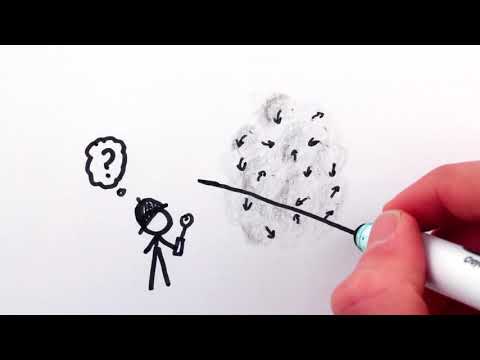
A minutephysics explainer on why the planets orbit in a flat plane. It shows how conserved angular momentum flattens a collapsing cloud of matter into a disk.
 1:19:08
A Million Dollars vs A Billion Dollars, Visualized: A Road Trip
8.3M views • 6 years ago
Tom Scott
Tom Scott makes the difference between a million and a billion dollars tangible by using distance on a road trip instead of volume. The drive makes the scale of a billion intuitively felt.
 1:00:26
Why Starting A Rocket Engine Is So Hard!
2.3M views • 3 years ago
Everyday Astronaut
Tim Dodd's hour-long deep dive on how rocket engines start, from solid motors to liquid engines. It covers thermal conditioning, spin-up, ignition methods, starting in space, and a step-by-step RS-25 startup.
 8:08
The Black Hole Bomb and Black Hole Civilizations
29.5M views • 8 years ago
Kurzgesagt – In a Nutshell
Kurzgesagt explains the black hole bomb and how far-future civilizations might extract energy from spinning black holes, including Dyson-sphere-style ideas.
 15:48
How to Detect Extra Dimensions
1.6M views • 8 years ago
PBS Space Time
A PBS Space Time episode on how gravitational wave observations of a neutron star merger, GW170817, can limit the number of spacetime dimensions. It is based on a 2018 paper.