sync
 48:46
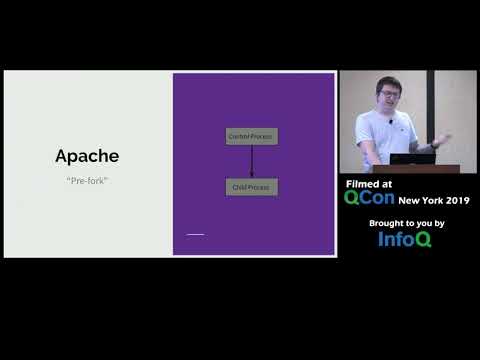
Rust's Journey to Async/Await
90K views • 6 years ago
InfoQ
Steve Klabnik walks through the history of Rust and how its design evolved toward async/await, including the alternatives tried and dropped. He also discusses the difficulty of adding a major feature to a language.
 32:24
RustLatam 2019 - Without Boats: Zero-Cost Async IO
55K views • 7 years ago
Rust Programming Language
Without Boats, a Rust language team member, explains the design of Rust's async/await at RustLatam 2019. He covers the history and constraints behind zero-cost, allocation-free async state machines.
 49:20
Modeling Data Concurrency w/ Asynchronous I/O in Zig - RedisConf 2020
11K views • 6 years ago
Redis
Zig creator Andrew Kelley's RedisConf 2020 talk on modeling data flow with asynchronous I/O in Zig. It explains how Zig's async/await avoids function coloring, and Loris Cro demonstrates OkRedis, a zero-allocation Redis client.
 32:17
Nathaniel J. Smith - Trio: Async concurrency for mere mortals - PyCon 2018
30K views • 8 years ago
PyCon 2018
Nathaniel J. Smith's PyCon 2018 talk introducing Trio, a Python concurrency library designed around usability and structured concurrency. He live-codes a problem and analyzes pitfalls in other async libraries.
 1:06:08
Scaling the Linear Sync Engine
37K views • 3 years ago
Linear
A Linear engineer talks about scaling the company's sync engine, which keeps client data local and synchronized. It follows an earlier talk on the same system.
 28:39
Netflix JavaScript Talks - Async JavaScript with Reactive Extensions
69K views • 12 years ago
Matt Marenghi
A Netflix JavaScript talk on using Reactive Extensions (Rx) for asynchronous UI code. It covers Observables, composing events such as drag and drop, and sequencing Ajax requests.
 54:44
Differential Synchronization
52K views • 17 years ago
Google TechTalks
Neil Fraser of Google presents Differential Synchronization, the algorithm behind MobWrite, for keeping multiple copies of a document in sync in real time. The talk argues the approach is robust, convergent and efficient.
 58:08
Parallelism, Concurrency, and Asynchrony in Perl 6 / Jonathan Worthington
6K views • 11 years ago
yapcasia
Jonathan Worthington's YAPC Asia 2015 talk on parallelism, concurrency and asynchrony in Perl 6. It covers the language's concurrency features.
 1:10:00
The Mental Game of Python - Raymond Hettinger [synced version]
24K views • 6 years ago
Tech Ma
Raymond Hettinger's PyBay 2019 talk on the mental strategies he uses when programming in Python, such as chunking, solving a simpler related problem, and repeating tasks manually until patterns emerge. This version is re-synced with the slides.
 1:16:07
React Helsinki February 2020
42K views • 6 years ago
Fraktio
React Helsinki meetup recording featuring a talk on lessons with Apollo GraphQL and Linear co-founder Tuomas Artman on real-time sync for web apps. The sync talk explains Linear's local-first architecture.
 19:36
Your web app but good: Aaron Boodman (Local-First Conf)
8K views • 2 years ago
Local-First Conf
Aaron Boodman of Replicache asks why sync engines have not yet fixed web app complexity and what is missing for them to go mainstream. The talk lays out the ideas that led to the Zero sync engine.
 26:53
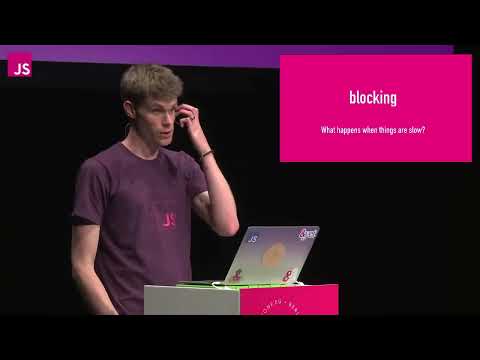
What the heck is the event loop anyway? | Philip Roberts | JSConf EU
3.8M views • 12 years ago
JSConf
Philip Roberts explains the JavaScript event loop, call stack, callbacks and asynchronous behavior with live visualizations using a tool he built. It demystifies terms like non-blocking and single-threaded.
 48:32
Ryan Dahl: Node JS
35K views • 14 years ago
JSConf
Ryan Dahl's JSConf EU talk introducing Node.js to the world. He explains the motivation for event-driven, non-blocking I/O, with JavaScript chosen mainly for its asynchronous nature.
 48:45
Matrix 2.0 — How we're making Matrix go voom!
16K views • 3 years ago
Matrixdotorg
A FOSDEM 2023 talk from the Matrix team on Matrix 2.0, covering sliding sync, the Element X client rewrite and next-generation calling. It explains how Matrix aims to match the speed of proprietary messengers.
 1:00:23
[#36] Zig Roadmap 2024 - Andrew Kelley
66K views • 2 years ago
Zig SHOWTIME
Andrew Kelley's 2024 Zig roadmap talk, followed by a Q&A, covers the language's priorities and the state of the project. Topics include compilation speed, moving off LLVM toward a self-hosted toolchain, async, and the path to 1.0.
 29:46
The past, present, and future of local-first - Martin Kleppmann (Local-First Conf)
17K views • 2 years ago
Local-First Conf
Martin Kleppmann's Local-First Conf talk reviewing where the local-first idea came from, where it stands five years after the essay, and what the community should work toward. He argues for generic sync infrastructure.
 1:49:07
I Shot You First: Networking the Gameplay of Halo: Reach
58K views • 8 years ago
GDC Festival of Gaming
Bungie's David Aldridge explains the networking programming behind Halo: Reach in a 2011 GDC session. It covers how gameplay stays in sync online, including forecasting and state reconciliation.
 1:13:53
Raymond Hettinger, Keynote on Concurrency, PyBay 2017
161K views • 9 years ago
SF Python
Raymond Hettinger's PyBay 2017 keynote on concurrency in Python. It covers threads, processes, asyncio, locks and the GIL, with live shell-based examples.
 44:43
Ron Pressler - Pull Push: Please stop polluting our imperative languages with pure concepts-Curry On
25K views • 11 years ago
Curry On!
Ron Pressler's Curry On 2015 talk arguing that imperative languages should not be polluted with pure functional concepts like monads. He favors simple blocking code over non-blocking styles.
 33:25
Dan Abramov: Beyond React 16 | JSConf Iceland
139K views • 8 years ago
JSConf
Dan Abramov's JSConf Iceland talk on what came after React 16, with live-coded prototypes of async rendering and time slicing. It previews the ideas that became concurrent mode and suspense.
 40:42
Lucas Cavalcanti & Edward Wible - Exploring four hidden superpowers of Datomic
29K views • 11 years ago
ClojureTV
A Clojure/conj 2014 talk by Lucas Cavalcanti and Edward Wible on four uses of Datomic. They cover HTTP caching, audit trails, mobile database sync and authorization, drawing on the immutable transaction log.
 34:00
User-level threads....... with threads. - Paul Turner - Google
41K views • 13 years ago
Linux Plumbers Conference
Paul Turner of Google presents kernel interfaces for user-level scheduling of real threads, aiming at a uniform synchronous programming model across C++, Java, Go and Python. It introduces the switchto-style system calls behind Google's fibers.
 20:45
dotJS 2019 - James Long - CRDTs for Mortals
18K views • 6 years ago
dotconferences
James Long's dotJS 2019 talk on how CRDTs enable local-first apps and how simple they can be to implement. He shows how to use them to build robust offline-capable frontends.
 48:32
Ryan Dahl: Original Node.js presentation
234K views • 14 years ago
stri8ted
Ryan Dahl's first presentation of Node.js at JSConf 2009. He pitches event-driven, non-blocking I/O as the motivation, rather than JavaScript itself.
 1:12:41
Chris McCord - Keynote: Phoenix LiveView - Interactive Apps without Javascript - ElixirConf EU 2019
47K views • 7 years ago
Code Sync
Chris McCord's ElixirConf EU 2019 keynote introducing Phoenix LiveView, which builds interactive server-rendered apps without writing JavaScript. It explains how only changed dynamic parts are sent over a websocket.
 49:36
Joe Armstrong - Keynote: The Forgotten Ideas in Computer Science - Code BEAM SF 2018
40K views • 8 years ago
Code Sync
Erlang co-creator Joe Armstrong's Code BEAM SF 2018 keynote revisits good ideas from the history of computing that were dropped, and asks which should be revived. It also touches on Erlang and Elixir.
 43:23
Edwin Brady - Idris 2: Type-driven development of Idris | Code Mesh LDN 18
20K views • 7 years ago
Code Sync
Edwin Brady presents Idris 2, a rewrite of the Idris dependently typed language, and shows type-driven development in practice. The demos show the compiler filling in whole functions from their types.
 44:38
Joe Armstrong & Jeremy Ruston - Intertwingling the Tiddlywiki with Erlang | Code Mesh LDN 18
11K views • 7 years ago
Code Sync
Joe Armstrong, creator of Erlang, and Jeremy Ruston, creator of TiddlyWiki, discuss hypertext, Ted Nelson's idea of intertwingled knowledge, and a way to combine TiddlyWiki with Erlang. It is a Code Mesh LDN 2018 talk.
 1:12:14
Beyond functional programming: a taste of Verse. Simon Peyton Jones & Tim Sweeney | Lambda Days 2023
30K views • 3 years ago
Code Sync
A Lambda Days keynote by Simon Peyton Jones and Tim Sweeney introducing Verse, Epic's functional logic language for the metaverse. It covers existential variables, unification and expressions yielding multiple values.
 52:59
Introducing Nx - José Valim | Lambda Days 2021
26K views • 5 years ago
Code Sync
Jose Valim introduces Nx, the project bringing numerical computing to Elixir, covering multi-dimensional tensors, automatic differentiation and JIT compilation to CPU and GPU.
 1:05:33
Keynote: The Road To LiveView 1.0 by Chris McCord | ElixirConf EU 2023
27K views • 3 years ago
Code Sync
Chris McCord's ElixirConf EU 2023 keynote tracing LiveView's evolution from simple form validation to full apps, with code examples and live demos of what 1.0 will offer.
 40:15
Bringing Types to Elixir by Giuseppe Castagna and Guillaume Duboc | ElixirConf EU 2023
7K views • 3 years ago
Code Sync
ElixirConf EU 2023 talk by Giuseppe Castagna and Guillaume Duboc on bringing set-theoretic types to Elixir, and the benefits such a type system could offer such as catching bugs.
 40:13
"Programming a 144-computer chip to minimize power" - Chuck Moore (2013)
19K views • 5 years ago
Strange Loop Conference
Chuck Moore, inventor of Forth, presents GreenArrays' 144-core asynchronous chip at Strange Loop 2013. He explains how idle cores draw almost no power and how tight code minimizes energy use.
 40:13
Zach Tellman - Everything Will Flow
27K views • 11 years ago
ClojureTV
Zach Tellman's Clojure West talk covers the basics of queueing theory and its practical use in systems, including backpressure, how queues break down under load, and pitfalls of naive core.async use.
 43:39
CRDTs and the Quest for Distributed Consistency
68K views • 8 years ago
InfoQ
Martin Kleppmann's QCon London 2018 talk on keeping data consistent in distributed systems without a central leader. It surveys CRDT algorithms for syncing devices and collaborative editing over peer-to-peer networks.
 35:45
RAAIS 2017 - Simon Knowles, Co-Founder and CTO of Graphcore
7K views • 9 years ago
The Research and Applied AI Summit - RAAIS
Simon Knowles, co-founder and CTO of Graphcore, talks about "intelligence processors", chips designed specifically for machine learning. The talk was given at the RAAIS 2017 summit and covers Graphcore's architecture.
 33:13
"Pixie - A Lightweight Lisp with 'Magical' Powers" by Timothy Baldridge
30K views • 11 years ago
Strange Loop Conference
Timothy Baldridge presents Pixie, a lightweight Lisp built on RPython, at Strange Loop 2015. It covers C interop, immutable data structures, fast startup and async-by-default IO.
 44:05
FreeBSD optimizations used by Netflix serving at 800Gb/s - Drew Gallatin - EuroBSDcon 2022
28K views • 4 years ago
EuroBSDCon
Netflix engineer Drew Gallatin's EuroBSDcon 2022 talk quantifies the older FreeBSD optimizations that let Netflix serve web traffic at 800Gb/s, including TSO, LRO, VM page cache zones, asynchronous sendfile and unmapped mbufs.