traffic laws
 4:30
Traffic Has a Perfect Solution. Humans Are the Problem.
44.6M views • 10 years ago
CGP Grey
CGP Grey explains how traffic jams come from human driving behavior such as tailgating and reaction delays, and how leaving gaps and smoothing speed would reduce congestion. It also touches on self-driving cars.
 7:02
Traffic Waves
1M views • 18 years ago
wbeaty
A short video from the trafficwaves.org site showing how traffic jams and standing waves form, including the fight between cheaters and blockers at an exit-lane backup. It also touches on how individual driving behavior affects the flow.
 10:35
Why the Dutch Wait Less at Traffic Lights
1.2M views • 6 years ago
Not Just Bikes
Not Just Bikes explains how Dutch traffic lights use early detection, transit priority and conflict-free design to cut waiting. The aim is to move as many people as possible rather than as many cars.
 18:31
The LED Traffic Light and the Danger of "But Sometimes!"
4.2M views • 8 years ago
Technology Connections
Technology Connections explains how LED traffic lights, which do not melt snow, drew complaints and were blamed for accidents. He uses it to illustrate the 'but sometimes' fallacy against new technology.
 12:05
Why Traffic Congestion Grows Exponentially, Why It Matters, and What To Do About It // An Explainer
100K views • 4 years ago
Ray Delahanty | CityNerd
CityNerd explains why traffic congestion grows nonlinearly as more cars use a road network, and why adding road capacity tends not to fix it. It covers the consequences for drivers, bus riders, cyclists and pedestrians, and discusses alternatives such as true bus rapid transit.
 5:33
Adam Ruins Everything - The Truth About the McDonald's Coffee Lawsuit
978K views • 9 years ago
truTV
An Adam Ruins Everything segment on the real facts of the McDonald's hot coffee lawsuit, covering the severity of the burns and the corporate PR campaign that painted it as frivolous.
 6:03
Do Your Buses Get Stuck in Traffic? (The Downs-Thomson Paradox)
693K views • 6 years ago
Not Just Bikes
Not Just Bikes explains the Downs-Thomson paradox using Amsterdam and Toronto: road widening doesn't fix congestion, and buses stuck in traffic make transit slow. It argues for giving transit its own priority infrastructure.
 5:12
Traffic Calming is Everywhere in the Netherlands
404K views • 6 years ago
Not Just Bikes
Not Just Bikes shows how traffic calming is built into streets across the Netherlands, from city centres to villages. Street design naturally slows cars and makes roads safer.
 24:07
AI can't cross this line and we don't know why.
2.5M views • 2 years ago
Welch Labs
A Welch Labs explainer on neural scaling laws and the compute-efficient frontier, asking why model loss seems to hit a line it cannot cross. It draws an analogy to an ideal gas law for AI.
 8:16
Why Asimov's Laws of Robotics Don't Work - Computerphile
873K views • 11 years ago
Computerphile
Rob Miles explains for Computerphile why simple rule sets like Asimov's Three Laws cannot make robots and AI safe. Terms like harm and human are too ambiguous to specify precisely.
 20:49
This Tiny Island has Insane Traffic
1.4M views • 3 years ago
Not Just Bikes
Not Just Bikes looks at traffic in the Bahamas to show that a small country can be just as car-centric as a big one. He ties it to land use, car dependence and how dedicated transit lanes help.
 14:54
Induced Demand & Roadway Widening: Everything You Always Wanted to Know (and Weren't Afraid to Ask)
120K views • 4 years ago
Ray Delahanty | CityNerd
CityNerd Ray Delahanty explains induced demand and what happens when freeways are widened. He walks through the economics of supply and demand applied to traffic and asks how much new traffic appears and whether congestion returns.
 13:02
Noether's Theorem and The Symmetries of Reality
1.1M views • 8 years ago
PBS Space Time
PBS Space Time explains Noether's theorem: conservation laws such as energy and momentum are consequences of deeper symmetries. It also covers why those laws hold only under certain conditions.
 6:04
Stop Signs Suck and We Should Get Rid of Them
906K views • 6 years ago
Not Just Bikes
Not Just Bikes argues that stop signs are a poor traffic control, drawing on Dutch practice and the Idaho stop to show intersections can be safer without them, especially for cyclists.
 4:22
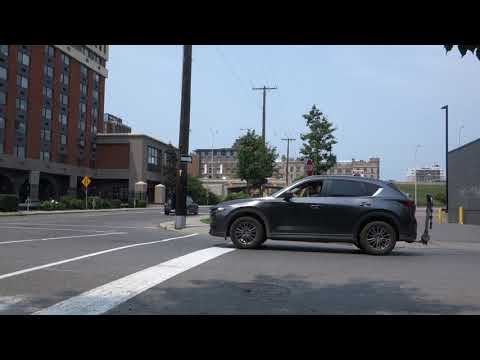
Idaho Stop for Cyclists? Drivers Already Do It!
34K views • 5 years ago
Oh The Urbanity!
A short urbanism video presenting original observations of how drivers treat stop signs, to argue that cyclists rolling through them under an Idaho stop is no different. It filmed intersections in Ottawa.
 11:09
The Wrong Way to Set Speed Limits [ST06]
2.1M views • 5 years ago
Not Just Bikes
Not Just Bikes explains how North American speed limits are set and why posted limits matter far less than street design. It argues that drivers follow the road's cues, so safe speeds have to be built into the street.
 31:39
Parking Laws Are Strangling America | Climate Town
1.9M views • 3 years ago
Climate Town
Climate Town traces the history of American parking minimums, how they came from shaky research and ITE guides, and how they shape zoning, cities and housing costs. It is a long, comedic video essay.
 7:23
How Trees Bend the Laws of Physics
5M views • 14 years ago
Veritasium
Veritasium explains how trees lift water from roots to the top of tall trunks, using transpiration pull and the negative pressure that liquid water can sustain. It explains why trees do not need pumps or valves.
 45:13
You've (Likely) Been Playing The Game Of Life Wrong
11.6M views • 11 months ago
Veritasium
Veritasium explains why many real-world systems follow power laws rather than normal distributions. It covers self-organized criticality, with simulations of sandpiles, magnetism and forest fires.
 15:48
The Best Country in the World for Drivers
2.2M views • 4 years ago
Not Just Bikes
Not Just Bikes argues that the Netherlands, famed for cycling, is also the best country for drivers. It explains how prioritizing walking, cycling and transit makes driving faster and more pleasant.
 8:05
What People Get Wrong About Induced Demand
291K views • 5 years ago
Oh The Urbanity!
Explains induced demand beyond roads, showing that it applies to transit, walking and cycling infrastructure too but with different consequences. It corrects common misunderstandings of the concept.
 6:17
Why Cars Rarely Crash into Buildings in the Netherlands
1M views • 6 years ago
Not Just Bikes
Not Just Bikes explains why cars rarely crash into buildings in the Netherlands, attributing it to street design that forgives mistakes and to systematic crash investigation. It contrasts this with North American acceptance of such crashes.
 21:05
The Zipf Mystery
28.7M views • 11 years ago
Vsauce
Vsauce's explainer on Zipf's law, the pattern in which the frequency of a word is inversely related to its rank. It shows the pattern across many domains and discusses why it remains unexplained.
 31:25
Crossing the Street Shouldn't Be Deadly (but it is)
1.9M views • 4 years ago
Not Just Bikes
Not Just Bikes explains why crossing streets is dangerous in the US and Canada, where roads are designed to move cars fast, and contrasts it with Dutch designs for pedestrians.
 17:08
Cities Aren't Loud: Cars Are Loud
2.3M views • 5 years ago
Not Just Bikes
Not Just Bikes argues that urban noise comes mostly from motor vehicles, drawing on the book Curbing Traffic and a visit to Delft, a city that takes noise seriously.
 7:19
The Lively & Liveable Neighbourhoods that are Illegal in Most of North America
2M views • 6 years ago
Not Just Bikes
Not Just Bikes explains how small pockets of shops and restaurants inside residential Dutch neighbourhoods create liveliness and help reduce traffic. It argues this kind of mixed-use design has been illegal in most of the US and Canada for a century because of zoning, and should be brought back.
 27:40
The Biggest Misconception in Physics
14.2M views • 1 year ago
Veritasium
Veritasium explores why energy is not conserved in general relativity, using Emmy Noether's theorem linking symmetries to conservation laws. Physicists interviewed explain energy loss in an expanding universe.
 4:12
Why this British crossroads was so dangerous
3.9M views • 6 years ago
Tom Scott
Tom Scott explains why Ipley Cross in England's New Forest was one of Britain's most dangerous junctions. The angled crossroads lets a car's A-pillar hide approaching traffic and cyclists because there is no relative motion in the driver's view.
 14:24
Why Japan Arrests Foreigners
8.6M views • 7 years ago
Paolo fromTOKYO
Paolo fromTOKYO explains why foreign tourists get arrested in Japan, covering strict laws and the justice system's very high conviction rate.
 4:51
The UK Election Results Were the Worst in History
8.1M views • 11 years ago
CGP Grey
CGP Grey explains how the 2015 UK general election showed the flaws of first-past-the-post voting, with parties like UKIP winning many votes but few seats.
 17:52
Holy Post - Race in America
1.7M views • 6 years ago
Holy Post Media
Phil Vischer of VeggieTales and Holy Post gives an 18-minute history of racial injustice in America, covering why anger persists despite civil rights laws. It is told from an evangelical Christian perspective and adapted from a class he co-taught.
 13:41
The Physics of Life (ft. It's Okay to be Smart & PBS Eons!)
771K views • 8 years ago
PBS Space Time
PBS Space Time, together with It's Okay to be Smart and PBS Eons, asks how a universe drifting toward disorder produced something as complex as life. It presents the idea that the laws of physics, through thermodynamics, may actually favor the emergence of life.
 14:28
How Lexus Fixed Tesla's Bad Idea: Steer-By-Wire Yoke
7M views • 3 years ago
Engineering Explained
Engineering Explained compares Lexus's steer-by-wire yoke on the RZ 450e with Tesla's yoke. It covers how steer-by-wire works and how variable steering ratios address the yoke's flaws.
 5:31
Superblocks: How Barcelona is taking city streets back from cars
7.9M views • 10 years ago
Vox
A short Vox video on Barcelona's superblocks, an urban design approach that closes interior streets to through traffic to return space to pedestrians.
 23:34
Why Democracy Is Mathematically Impossible
10.1M views • 2 years ago
Veritasium
Veritasium explains why no voting system can be perfectly fair, drawing on Arrow's theorem and the work of Eric Maskin. It looks at problems with systems like first-past-the-post and ranked-choice voting.