visual programming
 11:33
A new way to visualize General Relativity
3.6M views • 6 years ago
ScienceClic English
ScienceClic explains why the rubber sheet analogy for general relativity is misleading and offers a new visualization that includes the curvature of time and shows gravity as motion through curved spacetime.
 15:53
Quantum Field Theory visualized
2.7M views • 6 years ago
ScienceClic English
ScienceClic gives a 15-minute animated introduction to quantum field theory, covering fields, spin, conserved quantities, the standard model and interactions.
 1:19:08
A Million Dollars vs A Billion Dollars, Visualized: A Road Trip
8.3M views • 6 years ago
Tom Scott
Tom Scott makes the difference between a million and a billion dollars tangible by using distance on a road trip instead of volume. The drive makes the scale of a billion intuitively felt.
 27:14
Transformers, the tech behind LLMs | Deep Learning Chapter 5
11.6M views • 2 years ago
3Blue1Brown
3Blue1Brown's visual explanation of how transformers and GPT-style language models work, tracing data through tokens, embeddings and attention.
 28:34
But why would light "slow down"? | Visualizing Feynman's lecture on the refractive index
2.9M views • 2 years ago
3Blue1Brown
3Blue1Brown visualizes Feynman's lecture on the refractive index, explaining why light appears to slow down in glass and why the effect depends on color. It builds the idea from waves produced by oscillating charges in the material.
 26:10
Attention in transformers, step-by-step | Deep Learning Chapter 6
4.8M views • 2 years ago
3Blue1Brown
3Blue1Brown's visual walkthrough of the attention mechanism inside transformers, covering self-attention, multiple heads and cross-attention. It is chapter 6 of his deep learning series.
 11:33
Light Waves Visualized using Photon Sieves.
69K views • 6 years ago
Huygens Optics
Huygens Optics shows how DIY photon sieves shape a laser's wave front, explaining how they differ from zone plates and how aperture count affects the focal point, with time-resolved visualizations of the diffraction.
 12:20
I Solved Klotski
2.1M views • 1 year ago
2swap
2swap explains how he solved the Klotski sliding-block puzzle by mapping its full state space as a graph and visualizing it. The video includes footage of the Guinness world-record solve and links to an interactive graph.
 14:53
What would we see if we fell into a Black Hole?
7.5M views • 5 years ago
ScienceClic English
ScienceClic visualizes what you would see falling into a black hole, from the approach and the accretion disc to crossing the horizon, in 15 minutes.
 24:26
The Beauty of Bézier Curves
2.2M views • 5 years ago
Freya Holmér
Freya Holmer explains how Bezier curves work, from the helper-line construction to their uses in animation, text rendering and shapes. It uses visuals from her Unity Shapes plugin and was a SoME1 contest winner.
 1:13:50
The Continuity of Splines
1.9M views • 3 years ago
Freya Holmér
Freya Holmer's 74-minute video essay on splines, covering Bezier curves, B-splines, derivatives and the different levels of continuity (C0, C1, C2), built with custom animation tools. She notes she did not cover non-uniform splines.
 57:03
HACKENBUSH: a window to a new world of math
562K views • 5 years ago
Owen Maitzen
Owen Maitzen's animated hour-long introduction to Hackenbush, a simple combinatorial game, and how its strategy leads to surreal numbers and the roots of the number system.
 4:01
Spherical Geometry Is Stranger Than Hyperbolic - Hyperbolica Devlog #2
1.8M views • 6 years ago
CodeParade
CodeParade's short devlog on how spherical geometry looks in 2D and 3D and why it feels so unusual, part of the Hyperbolica series on a non-Euclidean game.
 38:26
Racing the Beam Explained - Atari 2600 CPU vs. CRT Television
400K views • 5 years ago
Retro Game Mechanics Explained
Retro Game Mechanics Explained shows how the Atari 2600 draws images with almost no video memory, by having the CPU race the CRT beam line by line. It walks through the techniques in detail.
 28:28
What is PLUS times PLUS?
2.2M views • 1 year ago
2swap
2swap explores lambda calculus using John Tromp's lambda diagrams, with animated beta-reductions, asking what PLUS times PLUS gives. It touches on Church encodings and the equivalence of Turing machines and lambda calculus.
 44:23
A Swift Introduction to Geometric Algebra
1.1M views • 6 years ago
sudgylacmoe
An animated introduction to geometric algebra, presented as a language that can describe most of physics. It was made with manim and covers multivectors and how they generalize familiar tools like cross products and quaternions.
 16:30
"NO CGI" is really just INVISIBLE CGI - 1
1.5M views • 3 years ago
The Movie Rabbit Hole
VFX supervisor Jonas Ussing examines what studios mean by "no CGI", showing how much invisible CGI hides behind practical-effects marketing. It is the first part of a multi-part series that includes analysis of doctored behind-the-scenes footage.
 14:27
The Biggest Myth In Education
15.5M views • 5 years ago
Veritasium
Veritasium debunks the idea of learning styles, such as being a visual learner, with an interview with Daniel Willingham and a memory experiment. It argues that a multimodal approach helps everyone.
 7:00
CD / Color
2.9M views • 6 years ago
Captain Disillusion
Captain Disillusion's comedic, fast-paced explainer on how color works in cameras, displays and video. It covers the biology of color perception and what it means for screens.
 0:51
Sample Breakdown: Daft Punk - One More Time
2.2M views • 6 years ago
TRACKLIB
A short Tracklib video visualizing the disco sample that Daft Punk's One More Time is built from. It shows how the track is composed from the original material.
 19:25
New computers don't speed up old code
187K views • 1 year ago
Matthias random stuff
Matthias Wandel tests old and new code on a range of PCs, including a new mini PC, to measure how much faster modern hardware really is. He also shows optimization techniques such as branchless code, with benchmark programs on GitHub.
 16:43
The Equation That Explains (Nearly) Everything!
1.6M views • 4 years ago
PBS Space Time
PBS Space Time explains the Standard Model Lagrangian, the single equation encapsulating the particle physics theory, and visualizes what its terms mean.
 28:23
The Fast Fourier Transform (FFT): Most Ingenious Algorithm Ever?
2.3M views • 5 years ago
Reducible
Reducible's visual walkthrough of the Fast Fourier Transform, motivated by polynomial multiplication. It shows how the FFT's key ideas can be discovered by asking the right questions.
 26:29
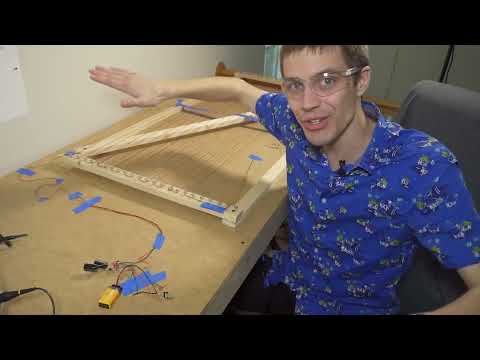
Watch electricity hit a fork in the road at half a billion frames per second
3M views • 2 years ago
AlphaPhoenix
AlphaPhoenix uses a custom high-speed measurement setup to watch voltage waves travel down wires and split at a fork. It answers how electricity knows where to go and how quickly that process happens.
 35:33
How does Computer Memory Work? 💻🛠
5.5M views • 4 years ago
Branch Education
A 36-minute animated deep dive from Branch Education into how DRAM works. It shows how memory connects to the CPU and how billions of bits are stored in nanoscale capacitor cells. It also covers why DRAM sits between SSDs and the processor.
 23:29
How Imaginary Numbers Were Invented
22.7M views • 5 years ago
Veritasium
Veritasium tells the history of how imaginary numbers arose from the quest for a general solution to the cubic equation, including the duels and secrecy among Renaissance mathematicians. It argues math had to give up the requirement that it mirror reality.
 21:14
The medical test paradox, and redesigning Bayes' rule
1.4M views • 5 years ago
3Blue1Brown
3Blue1Brown explains why positive results on accurate medical tests are often false positives, and reframes Bayes' rule using likelihood ratios (Bayes factors) to update odds. It uses visual examples to make the reasoning intuitive.
 4:12
Why this British crossroads was so dangerous
3.9M views • 6 years ago
Tom Scott
Tom Scott explains why Ipley Cross in England's New Forest was one of Britain's most dangerous junctions. The angled crossroads lets a car's A-pillar hide approaching traffic and cyclists because there is no relative motion in the driver's view.
 21:38
Risking My Life To Settle A Physics Debate
12.4M views • 5 years ago
Veritasium
Veritasium investigates whether a wind-powered vehicle can travel directly downwind faster than the wind, driving the Blackbird craft himself. The video explains the physics behind a claim some physics professors dispute.
 29:48
MOLTEN GLASS VS Prince Rupert's Drop - Smarter Every Day 285
5.8M views • 3 years ago
SmarterEveryDay
Destin Sandlin of Smarter Every Day explores molten glass and Prince Rupert's drops with a glass artist, including a process that freezes the moment glass shatters and an artisan who makes the drops.
 27:48
How are Microchips Made? 🖥️🛠️ CPU Manufacturing Process Steps
11.9M views • 2 years ago
Branch Education
Branch Education walks through a semiconductor fab and the dozens of steps used to turn silicon wafers into microchips, with 3D animation. It covers lithography, deposition and etching at a high level.
 17:46
Why do Biden's votes not follow Benford's Law?
3.7M views • 5 years ago
Stand-up Maths
Matt Parker examines claims that Biden's 2020 vote counts violate Benford's Law, explaining the law and why it often does not apply to precinct-level election data.
 19:37
Why is Japan So Weak in Software?
968K views • 2 years ago
Asianometry
Asianometry examines why Japan's software industry has lagged despite its hardware strengths. It looks at dependence on US software and the low prestige of programming.
 11:41
TRUE Limits Of Humanity – The Final Border We Will Never Cross
23.6M views • 5 years ago
Kurzgesagt – In a Nutshell
Kurzgesagt explains why, even with science-fiction technology, most of the universe is permanently out of reach because of cosmic expansion and finite resources.
 22:40
This 30-Year-Old Terminator VFX BLEW OUR MINDS!
10.6M views • 5 years ago
Corridor Crew
Corridor Crew dive into the visual effects of Terminator 2 and try recreating the T-1000 bars scene with modern tools. They explain how the original effects were achieved.
 14:20
Reveal Invisible Motion With This Clever Video Trick
2.8M views • 6 years ago
Steve Mould
Steve Mould explains motion amplification and video magnification, techniques that find tiny changes in video invisible to the eye and exaggerate them. He covers the MIT research and industrial uses such as diagnosing vibrating machinery.