web framework
 1:20
Paul Otlet, visioning a web in 1934
102K views • 18 years ago
Attila Gárdos
A one-minute clip about Paul Otlet, the Belgian bibliographer who in 1934 imagined users accessing a remote database through an electric telescope over a phone line. It presents his vision as a precursor of the web.
 13:39
How is this Website so fast!?
2.4M views • 2 years ago
Wes Bos
Wes Bos breaks down the techniques behind the McMaster-Carr website's speed: server-rendered HTML, prefetching, CDN and service worker caching, preloading, critical CSS and fixed-size images. He also notes its old-school jQuery and YUI JavaScript.
 15:15
why Japan's internet is weirdly designed
5.2M views • 3 years ago
Answer in Progress
Answer in Progress investigates why Japanese websites look different from those elsewhere, using an AI clustering approach to test the 2013 claim. It then looks at possible explanations.
Topic match · Web development 31:12
The Insane Engineering of James Webb Telescope
8.8M views • 4 years ago
Real Engineering
Real Engineering explains the engineering behind the James Webb Space Telescope, including its folding mirror, sunshield, orbit and cooling systems, and why deployment was so difficult.
 3:45
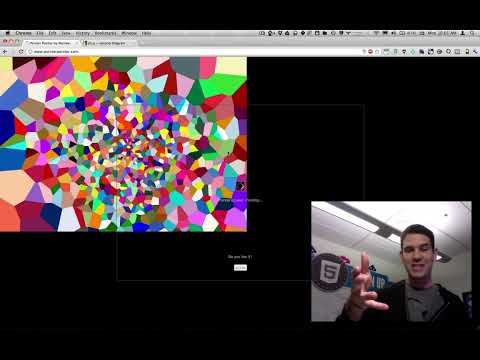
pointerpointer.com's use of voronoi, canvas, and javascript
40K views • 14 years ago
Paul Irish
Paul Irish explains how pointerpointer.com works. It uses a hidden canvas of colored Voronoi regions to look up which photo matches the cursor position.
Topic match · Web development 4:18
Flexbox vs. CSS Grid — Which is Better?
314K views • 8 years ago
Layout Land
Jen Simmons explains the difference between CSS Flexbox and CSS Grid, and when to use each. She makes the case that Grid does not replace Flexbox and most sites use both.
Topic match · Web development 25:15
Understanding the Honda CR-V Hybrid E-Drive
941K views • 5 years ago
WeberAuto
WeberAuto explains how the Honda E-Drive (i-MMD) hybrid transaxle works in the CR-V, Accord, Insight and Clarity hybrids. It walks through the system's three modes of operation.
 12:23
Xanadu Basics 1a - VISIBLE CONNECTION
20K views • 8 years ago
TheTedNelson
Ted Nelson explains the original Xanadu hypertext idea of visible connection, the notion that links between documents should be shown and preserved. He argues that the Web and current document standards lost this concept.
 3:37
Why Web Filters Don't Work: Penistone and the Scunthorpe Problem
3.6M views • 10 years ago
Tom Scott
Tom Scott visits Penistone to explain the Scunthorpe problem, showing why naive web and profanity filters block innocent words.
 4:59
This library has every book ever published.
2.4M views • 3 years ago
Tom Scott
Tom Scott visits the British Library, a UK legal deposit library that receives a copy of everything published, and discusses storing so much material, including the web archive.
 10:39
This Video Has 77,321,815 Views
77.3M views • 6 years ago
Tom Scott
Tom Scott's video whose title shows its own live view count, and the story of how he made that work. It explains why open APIs were once common and why they largely disappeared.
Topic match · Web development 10:13
The Problem with Time & Timezones - Computerphile
4.4M views • 12 years ago
Computerphile
Tom Scott explains for Computerphile why handling time and timezones in code is so hard, walking through a simple web app that computes how long ago something happened. It covers the quirks of timezones and calendars and ends in an exasperated rant.
 43:43
Principles for Dealing with the Changing World Order by Ray Dalio
232.4M views • 4 years ago
Principles by Ray Dalio
An animated 44-minute summary of Ray Dalio's book Principles for Dealing with the Changing World Order. It lays out the Big Cycle of rising and declining nations, covering debt cycles, internal conflict, and shifts in global power over the past 500 years.
 9:37
Characters, Symbols and the Unicode Miracle - Computerphile
2.1M views • 13 years ago
Computerphile
Tom Scott explains for Computerphile how Unicode and UTF-8 grew out of messy older character encodings to become the web's standard. It covers why the design works and how it handles worldwide text.
 10:36
Renting vs. Buying a Home: The 5% Rule
5.3M views • 7 years ago
Ben Felix
Ben Felix explains how to compare renting and buying a home by looking at unrecoverable costs, and distills it into the 5% rule of thumb. It is framed for a Canadian audience but broadly applicable.
 11:07
How to achieve nanometer precision in space?
748K views • 4 years ago
Breaking Taps
Breaking Taps explains how the cryogenic mirror actuators on the James Webb Space Telescope achieve nanometer precision using flexures. It shows a 3D-printed replica and how one motor handles both coarse and fine motion.
 10:09
RSA ANIMATE: The Secret Powers of Time
4.4M views • 16 years ago
Royal Society of Arts
An RSA Animate illustrating a lecture by psychologist Philip Zimbardo on how people's perspectives on time (past, present, future) shape work, health and well-being.