The Lighthill debate on Artificial Intelligence: "The general purpose robot is a mirage"
Pierre-Yves Oudeyer1 HN recommender · recommended in 1 month, 2019-2025
15K views · 8 years ago · lecture · evergreen
The full 1973 BBC Lighthill debate on artificial intelligence, featuring James Lighthill, Donald Michie, Richard Gregory and John McCarthy. It documents the argument that preceded the 1970s AI winter and includes early robot demos.
HN cites it as primary-source history of AI hype and skepticism, and for the vintage Freddy robot footage.
 14:06
The Lighthill Debate (1973) - part 1 of 6
bilkable
13K views • 16 years ago
 2:03
GE Walking Truck - Cybernetic Anthropomorphous Machine (CAM) 1969.
Reuben Hoggett
248K views • 16 years ago
 25:48
Ted Nelson struggles with uncomprehending radio interviewer, 1979
TheTedNelson
19K views • 9 years ago
 5:46
Apple Knowledge Navigator Video (1987)
Mac History
235K views • 14 years ago
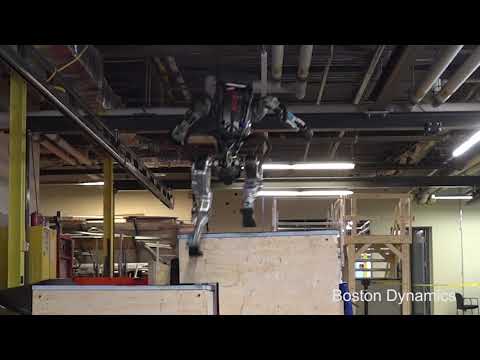 0:30
Parkour Atlas
Boston Dynamics
13.5M views • 8 years ago
 56:58
The KGB, the Computer, and Me (Complete)
GBPPR2
305K views • 15 years ago
 1:18
Tesla Bot Update | Sort & Stretch
Tesla
2.3M views • 3 years ago
 2:20:15
The Final Demonstration of the Xerox 'Star' computer
Computer History Museum
22K views • 13 years ago
 3:47
Sketchpad, by Dr. Ivan Sutherland with comments by Alan Kay
David Carroll
54K views • 19 years ago
 1:06
Atlas | Partners in Parkour
Boston Dynamics
17.3M views • 5 years ago
 24:30
Bill Atkinson: Polaroids showing the Evolution of the Lisa GUI
Computer History Museum
13K views • 1 year ago
 2:04
NavLab 1 (1986) : Carnegie Mellon : Robotics Institute History of Self-Driving Cars
CMU Robotics Institute
44K views • 10 years ago
 1:06
Tesla Bot Update
Tesla
5.2M views • 3 years ago
 7:27
Lamport on writing "Time, Clocks, and the Ordering of Events in a Distributed System"
Turing Awardee Clips
24K views • 6 years ago
 56:58
The KGB, the Computer, and Me.
DragonFartOutLoud
87K views • 13 years ago
 2:05
Alan Kay Demos GRaIL
Vincent Gable
30K views • 17 years ago
 17:10
Xerox Star User Interface: An overview
ACM SIGCHI
20K views • 5 years ago
 2:35
Figure Status Update - OpenAI Speech-to-Speech Reasoning
Figure
3.1M views • 2 years ago
 1:14
A Compilation of Robots Falling Down at the DARPA Robotics Challenge
IEEE Spectrum
3.1M views • 11 years ago
 14:46
Computers for Cynics 0 - The Myth of Technology
TheTedNelson
33K views • 14 years ago
6 comments from Hacker News
Nice robot demo. Here's another one: ▶ this video A robot assembling a puzzle with machine vision! And it's only from the 1970's.
I'd like you to view this demo from 1974 that showcases the then current state of research in AI. Then reflect that the research presented in the link is 50 years later. ▶ this video
Ah, the AI versus advanced automation debate and the Lighthill Report (UK, 1973). [1] Report: link [2] Video of the public debate: ▶ this video
To be honest, 89-92% sounds too optimistic for a real-world application. But I was talking about applications of the lego assembly model. My intuition is that lego is a special case: the pieces are made to interlock with each other and there are only a small number of ways in which two pieces can lock together. Compare this with building a prefab house, for example, or a car, where elements must be bound together with nails, mortar, soldering, or glue etc, in essentially unpredictable ways. I say that the approach described is pointless because I can't see any real-world applications of extracting assembly plans from a visualisation of an already-known assembly plan. Even less so when the object assembled is just a toy. And it's been possible to assemble toys using machine vision, given a pre-determined set of instructions, from the 1970's already: (Donald Michie presenting the Edinburgh Research Purpose General Assembly Robot, a.k.a. "Freddy"): ▶ this video More info of Freddy here link Freddy was tediously hand-programmed with a full plan but it used vision and touch to find the pieces of the toy it assembles in the video.
> ... "AI can't do X" until we actually achieve X and then the goalpost is moved. This gets said often but I don't think anybody whose credible in the field actually makes statements like this. Take Chess for instance. In the IBM "Big Blue" documentary from ~2004, they quote journalists as saying "AI can't play Chess as well as humans but if it could, then AI would be solved." Why did the techniques from Big Blue not seem to go anywhere? I know for a fact that scientists _were not saying this_. The Lighthill Debates on AI specifically talk about why playing games well doesn't really prove anything. [0] I do agree that OCR has improved greatly by AI but this feels very niche. Somebody mentioned defect anomaly detection in another comment and I was not aware of this. All useful for sure. Still, this doesn't amount to anywhere near the hype that was announced earlier last decade. Moreover, the economics in AI are mostly awful despite everybody's seemingly best efforts. [1] Even if its useful in some vague sense, it's not necessarily economically useful. Amazon has ~10,000 people working on Alexa. [2] Have they turned a profit on these endeavours? I understand they can absorb the costs but its not clear to me how the economics will work out here. ML models haven't even been useful in places where statistical methods have reined supreme such as Renaissance Technologies and other hedge funds. No large companies are using neural networks in a significant capacity to my knowledge. An
Anyone interested in the History of AI can also watch the report being presented by Lighthill, and subsequently debated by John McCarthy, Donald Michie, and Richard Gregory. ▶ this video