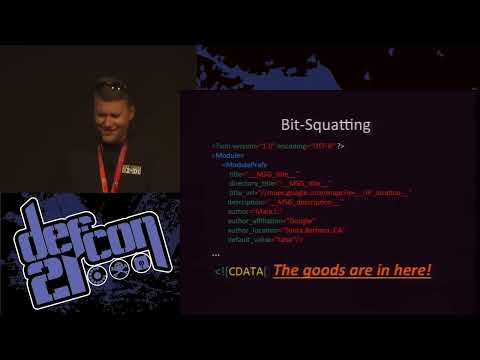
DEF CON 19 - Artem Dinaburg - Bit-squatting: DNS Hijacking Without Exploitation
DEFCONConference2 HN recommenders · recommended in 2 months, 2018-2023
4K views · 13 years ago · talk · evergreen
Artem Dinaburg's DEF CON 19 talk on bit-squatting, where DRAM bit flips cause DNS requests to go to domains one bit off from the intended one. It shows how hardware faults can be exploited for hijacking without any software exploit.
Recommended as a fun, practical talk on why bit flips matter for security, and cited in ECC memory discussions.
 45:14
DEFCON 19: Bit-squatting: DNS Hijacking Without Exploitation (w speaker)
Christiaan008
24K views • 14 years ago
 37:02
DEFCON 21 - DNS May Be Hazardous to Your Health - Robert Stucke
Robert Stucke (bobhex)
20K views • 13 years ago
 46:04
DEF CON 26 - Christopher Domas - GOD MODE UNLOCKED Hardware Backdoors in redacted x86
DEFCONConference
86K views • 8 years ago
 48:47
Massscanning the Internet - Defcon 22 (2014)
vissago
109K views • 12 years ago
 24:32
Defcon 20 - Dan Tentler - Drinking from the caffeine firehose we know as shodan
vissago
182K views • 14 years ago
 46:22
DEF CON 19 - Moxie Marlinspike - SSL And The Future Of Authenticity
DEFCONConference
11K views • 13 years ago
 46:34
The Memory Sinkhole - Unleashing An X86 Design Flaw Allowing Universal Privilege Escalation
Black Hat
169K views • 10 years ago
 5:22
Lest We Remember: Cold Boot Attacks on Encryption Keys
pucitp
749K views • 18 years ago
 48:29
DEF CON 30 - Sam Bent - Tor - Darknet Opsec By a Veteran Darknet Vendor
DEFCONConference
557K views • 4 years ago
 1:09:16
Defeating Ssl Using Sslstrip (Marlinspike Blackhat)
TheSecurityTube
61K views • 14 years ago
 33:41
OffensiveCon19 - Alex Ionescu - Keynote - Reversing Without Reversing
OffensiveCon
20K views • 7 years ago
 42:36
Defcon 21 - The Secret Life of SIM Cards
HackersOnBoard
708K views • 12 years ago
 53:09
DEF CON 23 - Zoz - And That's How I Lost My Other Eye...Explorations in Data Destruction (Fixed)
DEFCONConference
533K views • 11 years ago
 50:59
DEF CON 22 - Adrian Crenshaw- Dropping Docs on Darknets: How People Got Caught
DEFCONConference
219K views • 11 years ago
 52:43
DEFCON 19: Introduction to Tamper Evident Devices
Christiaan008
352K views • 15 years ago
 50:56
DEFCON 20: Hacker + Airplanes = No Good Can Come Of This
Christiaan008
226K views • 13 years ago
 1:41:27
Defcon 21 - Decapping Chips The Strike Easy Hard Way
HackersOnBoard
69K views • 12 years ago
 50:06
Protected KVM on Arm64: A Technical Deep Dive - Quentin Perret, Google
The Linux Foundation
6K views • 4 years ago
 38:49
DEF CON 23 - Chris Domas - Repsych: Psychological Warfare in Reverse Engineering
DEFCONConference
173K views • 10 years ago
 55:59
DEF CON 18 - Jason Scott - You're Stealing It Wrong! 30 Years of Inter-Pirate Battles
DEFCONConference
60K views • 13 years ago
5 comments from Hacker News
Encryption and signing don't protect against memory corruption. For example, I download software from the internet then hash it. The hash matches. Before the bytes are written to disk locally, a bit flips in RAM. The corrupted data is written to disk and used. Likewise, dnssec doesn't protect you against DNS bitsquatting attacks[1] because the domain name can be changed before the DNS request is made. So the DNS response your computer makes for a-azon.com might be totally valid and signed. It can come through DoH or whatever. The problem is that your browser thought it was the response for amazon.com and chrome send a bitsquatter your amazon cookies. (Oops). [1] ▶ this video
A really fun DefCon talk on bitsquatting. Bitsquatting is the practice of registering domains that are one bit off from a popular one: ▶ this video google.com vs ooogle.com >>> chr(int('0b1100111', 2)) 'g' >>> chr(int('0b1101111', 2)) 'o' If the 4th to last bit of 'g' were to flip before writing to disk, you could get persistent requests to ooogle.com Having done queries against very large datasets at a large company, I can say for certain that this happens much more than you think it might.
This reminds me of Bitsquatting, which is like typosquatting but uses domains one bit-flip away instead of one mistyped letter away.[0] In a small experiment, for some popular domains, the author reportedly got a lot of hits. In the associated DEFCON talk, the author notes that even if you use ECC memory, it's unlikely that the DRAM in your hard drives does too.[1] 0: link 1: ▶ this video
The thing about ECC vs. non-ECC. If you don't have ECC, you don't know silent bit corruption is happening, and when it's finally (if it's ever) discovered, there's nothing that can be done. ECC (SECDED) keeps data safer than it would be otherwise. ECC is necessary for anything real or important based on the financial cost of losing data. For everything else, it can be optional. Plus, don't forget the security issues of bitsquatting and other attacks that are the real results of silent bitflips. DEF CON 19 - Artem Dinaburg - Bit-squatting: DNS Hijacking Without Exploitation ▶ this video
Regarding "some hardware errors": This might include operationg conditions you didn't consider; say: The divisor in your code went through a non-ECC DRAM module (maybe in a disk drive) that runs hotter than its specified operating temperature would allow and a random bit-flip changes your `1` into a `0`. On this topic, the talk on Bitsquatting from Artem Dinaburg during Defcon 19 is worth watching. The most interesting part on bit flips starts around 15:05 minutes: ▶ this video