The Lightning Network Explained (Litecoin/Bitcoin)
Franklyn2 HN recommenders · recommended in 2 months, 2017-2018
119K views · 9 years ago · explainer · dated
An 8-minute explainer on the Lightning Network and how it relates to Segwit, Bitcoin and Litecoin. It covers how off-chain payment channels route payments to scale blockchain transactions.
Commenters point to it as a short, high-level overview of how Lightning payment channels work.
 9:11
How The Banks Bought Bitcoin | Lightning Network
Decentralized Thought
184K views • 8 years ago
 25:14
Rick Reacts to Lightning (Again) and brings up a previously undiscussed flaw
We Are All Satoshi
14K views • 8 years ago
 25:16
But how does bitcoin actually work?
3Blue1Brown
18.1M views • 9 years ago
 28:19
Bitcoin 2012 London: Mike Hearn
Independent POV
79K views • 14 years ago
 27:08
Peter Rizun, Andrew Stone -- 1 GB Block Tests -- Scaling Bitcoin Stanford.
OnChain Scaling
12K views • 8 years ago
 17:50
Blockchain 101 - A Visual Demo
Anders Brownworth
3.3M views • 10 years ago
 1:44
What is Bitcoin? (v1)
WeUseCoins
10.3M views • 15 years ago
 1:06:36
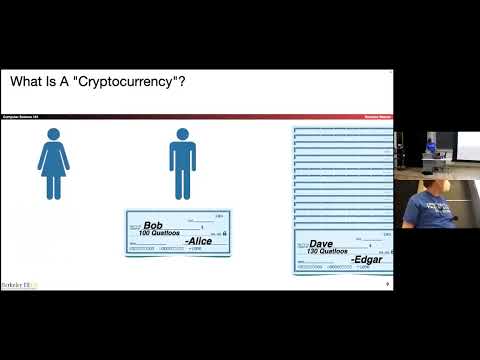
Computer Security 161 Cryptocurrency Lecture
Nicholas C Weaver
128K views • 4 years ago
 35:53
Exposing Tether - Bitcoin's Biggest Secret
Coffeezilla
4.6M views • 5 years ago
 2:16
Andreas Antonopoulos - 51% Bitcoin Attack
Rodolfo Díaz
72K views • 11 years ago
 22:36
Computer Scientist Explains One Concept in 5 Levels of Difficulty | WIRED
WIRED
7.2M views • 4 years ago
 32:35
CNBC TechCheck+ chats with Tether's CTO and general counsel — 7/21/21
CNBC Television
42K views • 5 years ago
 24:20
Satoshi Has No Clothes: Failures in On-Chain Privacy by Ian Miers (Devcon4)
Ethereum Foundation
5K views • 7 years ago
 30:20
Blockchain vs. Bullshit: Thoughts on the Future of Money [Classic Bitcoin & Open Blockchain Talk]
aantonop
383K views • 9 years ago
 1:02:04
1. Introduction for 15.S12 Blockchain and Money, Fall 2018
MIT OpenCourseWare
7.2M views • 6 years ago
 26:29
Watch electricity hit a fork in the road at half a billion frames per second
AlphaPhoenix
3M views • 2 years ago
 17:12
Cryptocurrency Explained: Money as a System-of-Control
aantonop
144K views • 9 years ago
 38:22
Kim Nilsson - Cracking MtGox
TheBitcoinArmy
47K views • 9 years ago
 47:18
OpenFlow @ Google - Urs Hoelzle, Google
Open Networking Summit
47K views • 14 years ago
 42:26
AWS re:Invent 2015 | (NET403) Another Day, Another Billion Packets
Amazon Web Services
55K views • 11 years ago
3 comments from Hacker News
Each transaction spending the locked funds bears the signature of the party making the payment. The other party can then provide the counter-signature making the transaction valid on the Bitcoin network. The main security problem to solve is preventing one party from publishing a previous channel state (half-signed transaction) giving themselves more money than they actually have by rights. For example, Alice and Bob might start with a channel giving each of them 5 bitcoin. Then Alice makes two one-bitcoin payments to Bob: A | B ------ 4 | 6 3 | 7 Alice decides she wants to take back her last payment and instead publish the earlier transaction (signed by Bob) giving herself 4 bitcoin rather than the one giving herself 3. This problem is solved with hashed timelock contracts (HTLCs). Without getting too technical, HTLCs make it possible for a party who spots a counterparty attempting to publish an invalid transaction to take all of the money in the channel (i.e., Bob would take all 10 bitcoin). The main idea is that cryptographic hash functions are one-way. If I make a payment contingent on knowing a preimage to a hash value, I can cause the payment to become valid by revealing the preimage. Along with the signature to a transaction, Alice must also give Bob the preimage for the previous transaction before he will accept it. When she does, Bob knows that if Alice tries to play games, he can take all of her money. This video gives a high-level overview: ▶ this video
I would modify that slightly and say Litecoin is back because of the Lightning Network, which benefits greatly from features provided by Segwit, and which itself leverages payment channels backed by multi-sig addresses. While Lightning can be enabled without Segwit, it's far more trustworthy with it, than without it. ▶ this video
> partly because these off-chain networks would quickly form large central "hubs" which would obviate many of the benefits of Bitcoin The Lightning Network is open-source and decentralized. It has no "hubs", but rather just peers that route payments to each-other using a payment routing algorithm. Lightning has no counterparty risk, as no one can ever steal your bitcoins and you're always in full control. The best way to describe Lightning is as an write-cache layer. It improves the scalability properties of Bitcoin by many factors, makes micro- and nano- payments a reality, reduces fees to fractions of a cent, and even improves privacy (using a Tor-like onion routing for anonymized payments). ▶ this video link