abstract algebra
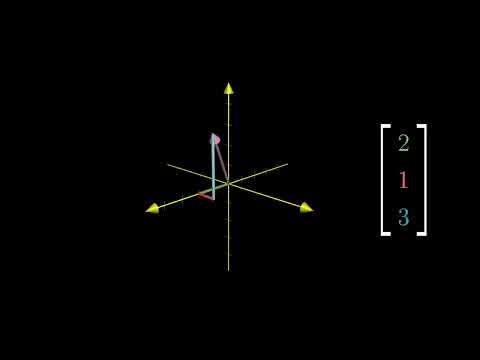 9:52
Vectors | Chapter 1, Essence of linear algebra
13M views • 10 years ago
3Blue1Brown
The first chapter of 3Blue1Brown's Essence of Linear Algebra series, introducing vectors with animated geometric visuals. It begins a series that builds intuition for linear algebra from the basics.
 1:37:22
Siggraph2019 Geometric Algebra
87K views • 7 years ago
Bivector
A SIGGRAPH 2019 course on geometric algebra. Charles Gunn gives an intro, then Steven De Keninck gives a programmer-focused course with live examples in ganja.js.
 5:09
Essence of linear algebra preview
2.8M views • 10 years ago
3Blue1Brown
A five-minute preview of 3Blue1Brown's Essence of Linear Algebra series, which uses animation to build geometric intuition for topics from a standard linear algebra course.
 44:23
A Swift Introduction to Geometric Algebra
1.1M views • 6 years ago
sudgylacmoe
An animated introduction to geometric algebra, presented as a language that can describe most of physics. It was made with manim and covers multivectors and how they generalize familiar tools like cross products and quaternions.
 59:53
CppCon 2019: Chandler Carruth “There Are No Zero-cost Abstractions”
147K views • 7 years ago
CppCon
Chandler Carruth argues in a CppCon 2019 talk that C++ has no truly zero-cost abstractions. Using examples like unique_ptr, ABI constraints and compile-time costs, he shows that abstractions cost runtime, compile time or human effort.
 35:32
Cheng Lou - On the Spectrum of Abstraction at react-europe 2016
63K views • 10 years ago
ReactEurope
Cheng Lou's react-europe 2016 talk lays out a mental framework for thinking about abstraction levels in JavaScript tooling, from Angular and Grunt to Webpack and React. It uses that framework to reason about the cost of abstractions and how to choose between competing solutions.
 1:04:35
The Algebra of Algebraic Data Types
27K views • 13 years ago
London Haskell
A London Haskell talk on the algebra of algebraic data types, showing how sum and product types behave like arithmetic. It frames types as numbers obeying algebraic laws.
 21:58
Group theory, abstraction, and the 196,883-dimensional monster
3.8M views • 6 years ago
3Blue1Brown
3Blue1Brown introduces group theory and abstract groups, then builds toward classification of finite simple groups and the enormous Monster group with its 196,883 dimensions.
 39:49
Lec 1 | MIT 18.06 Linear Algebra, Spring 2005
4.9M views • 17 years ago
MIT OpenCourseWare
The first lecture of Gilbert Strang's MIT 18.06 Linear Algebra course, covering the geometry of linear equations. It opens a full 35-lecture university course.
 17:16
Eigenvectors and eigenvalues | Chapter 14, Essence of linear algebra
6.4M views • 10 years ago
3Blue1Brown
3Blue1Brown's chapter on eigenvectors and eigenvalues in the Essence of Linear Algebra series. It builds a visual intuition for what they mean, why an eigenbasis is useful, and ends with a puzzle.
 51:16
Why can't you multiply vectors?
524K views • 3 years ago
Freya Holmér
Freya Holmer's Dutch Game Day 2023 talk asking why vectors can't be multiplied, building from complex numbers to a single axiom and arriving at geometric algebra, quaternions and multivectors.
 25:01
Dan Abramov The wet codebase
27K views • 5 years ago
eswarnichtsmehrfrei
Dan Abramov's talk on the wet codebase, using visualizations to show how removing all duplication too early produces wrong abstractions that are hard to unwind.
 10:03
The determinant | Chapter 6, Essence of linear algebra
5M views • 10 years ago
3Blue1Brown
A 10-minute 3Blue1Brown chapter explaining the determinant as the factor by which a linear transformation scales area or volume. It builds the idea geometrically with animations before any formulas.
 0:23
Carl Sagan: If you wish to make an apple pie from scratch, you must first invent the universe.
323K views • 16 years ago
pkrumins
A very short clip of Carl Sagan saying that to make an apple pie from scratch you must first invent the universe. It illustrates how everything depends on a chain of prior things.
 38:47
RailsConf 2014 - All the Little Things by Sandi Metz
190K views • 12 years ago
Confreaks
Sandi Metz takes an ugly section of conditional code and refactors it into a few simple objects, bridging object-oriented theory and practice. The talk includes her take on the Gilded Rose refactoring kata and the idea that duplication is cheaper than the wrong abstraction.
 1:28:23
Quantum Computing for Computer Scientists
2.2M views • 8 years ago
Microsoft Research
An 88-minute Microsoft Research talk that explains how quantum computers beat classical ones using basic linear algebra, qubits, superposition and gates. It works through the Deutsch oracle problem and ends with entanglement, teleportation and a live demo.
 46:06
Lower Latency Graph Queries in Cypher with Redis GraphRoi Lipman, Redis LabsTim Davis, Texas A&M U
3K views • 8 years ago
Redis
Redis Labs and Tim Davis present RedisGraph, which uses GraphBLAS to treat graph queries in Cypher as sparse linear algebra for lower latency.
 40:39
Category Theory in Life - Eugenia Cheng
113K views • 9 years ago
Lambda World
Eugenia Cheng gives the opening keynote at Lambda World 2017, presenting category theory as very abstract algebra whose abstraction gives it broad applicability. She applies it to everyday questions including privilege and prejudice.
 1:12:56
Lecture 1A: Overview and Introduction to Lisp
420K views • 7 years ago
MIT OpenCourseWare
The first lecture of MIT's 6.001 (SICP) with Abelson and Sussman, giving an overview of the course and an introduction to Lisp. It argues that computer science is about managing complexity and abstraction, not computers.
 1:04:41
Jonathan Blow - Preventing the Collapse of Civilization (English only)
268K views • 7 years ago
bus
Jonathan Blow's DevGAMM 2019 talk argues that software knowledge is being lost between generations and that growing layers of abstraction could lead to a decline in technological civilization.
 41:06
"Unison: a new distributed programming language" by Paul Chiusano
45K views • 7 years ago
Strange Loop Conference
Paul Chiusano's Strange Loop 2019 talk introduces Unison, an open-source functional language for distributed, elastic systems. It covers content-addressed code identified by hashes of the syntax tree, a codebase manager, and algebraic effects called abilities.
 2:50:14
Simple Code, High Performance
463K views • 5 years ago
Molly Rocket
Casey Muratori's University of Twente guest lecture is a case study in how straightforward code can cut thousands of lines and tens of seconds of runtime down to a few dozen lines running in under a second. It uses concrete examples to show why software is often an order of magnitude slower than it should be.
 19:12
Taking Vector Transposes Seriously | Jiahao Chen | JuliaCon 2017
7K views • 9 years ago
The Julia Programming Language
Jiahao Chen's JuliaCon 2017 talk argues that vector transposes should be taken seriously in type systems and linear algebra libraries. It explains why treating vectors as matrices causes trouble in languages.
 5:56
Special Topics - The Kalman Filter (1 of 55) What is a Kalman Filter?
660K views • 11 years ago
Michel van Biezen
The first video in a 55-part series by Michel van Biezen that introduces the Kalman filter and builds from the rationale through algebraic examples to the full matrix treatment. The videos are short, blackboard-style lectures.
 30:55
[JSConfUS 2013] Steven Wittens: Making WebGL Dance
56K views • 13 years ago
JSConf
Steven Wittens' JSConf US 2013 talk on drawing with WebGL, using animated visuals to walk through vectors, matrices and the rendering pipeline. Despite the title, it works as a visual primer on the linear algebra behind 3D graphics.
 51:40
Constraints Liberate, Liberties Constrain — Runar Bjarnason
44K views • 10 years ago
Scala World
Runar Bjarnason's Scala World talk argues that restraint and precision in components beat power and flexibility. Constraints on parts make them easier to compose into systems.
 47:02
Elm Europe 2017 - Evan Czaplicki - The life of a file
72K views • 9 years ago
Elm Europe
Elm creator Evan Czaplicki's talk on how a file grows and when to split code up. He argues for keeping code in one file until it hurts and warns against premature extraction.
 23:29
How Imaginary Numbers Were Invented
22.7M views • 5 years ago
Veritasium
Veritasium tells the history of how imaginary numbers arose from the quest for a general solution to the cubic equation, including the duels and secrecy among Renaissance mathematicians. It argues math had to give up the requirement that it mirror reality.
 35:53
RailsConf 2015 - Nothing is Something
84K views • 11 years ago
Confreaks
Sandi Metz argues that hidden assumptions in code are missing concepts, and shows how to name and expose them so code is easier to understand and change. It covers null objects and messages in Ruby.
 18:41
Why our IQ levels are higher than our grandparents' | James Flynn
3.2M views • 13 years ago
TED
Moral philosopher James Flynn explains the Flynn effect, the steady rise of IQ scores across the 20th century. He argues the shift reflects a move toward abstract, hypothetical thinking as cognitively demanding professions grew.
 1:20:33
Lecture 1 | Convex Optimization I (Stanford)
753K views • 18 years ago
Stanford
The introductory lecture of Stephen Boyd's Stanford Convex Optimization I course (EE 364A). It outlines convex sets, functions and problems, and the course's coverage of least-squares, linear and semidefinite programming, duality and interior-point methods.
 40:19
Physics in Clojure - Colin Smith
13K views • 9 years ago
ClojureTV
Colin Smith introduces Structure and Interpretation of Classical Mechanics and his Clojure port, sicmutils. He shows how higher-order functions and a symbolic algebra system can represent Lagrangian mechanics.
 2:00:10
Oral History of Bjarne Stroustrup
75K views • 11 years ago
Computer History Museum
A two-hour Computer History Museum oral history interview with Bjarne Stroustrup, conducted by Paul McJones in 2015. It covers his youth, education at Aarhus and Cambridge, his career at Bell Labs and elsewhere, and the design and evolution of C++.
 1:01:40
A Philosophy of Software Design | John Ousterhout | Talks at Google
547K views • 8 years ago
Talks at Google
John Ousterhout, Stanford professor and creator of Tcl, presents the ideas of his book A Philosophy of Software Design in a Talks at Google session. He covers managing complexity, deep modules and interfaces, and what he teaches in his Stanford software design course.
 1:12:56
Lecture 1A | MIT 6.001 Structure and Interpretation, 1986
995K views • 17 years ago
MIT OpenCourseWare
The first lecture of MIT's 1986 6.001 Structure and Interpretation of Computer Programs, given by Harold Abelson, introducing Lisp and the idea of computer science as the study of process.
 1:01:39
"Simple Made Easy" - Rich Hickey (2011)
434K views • 5 years ago
ClojureTV
Rich Hickey's Strange Loop 2011 keynote separates 'simple' (not intertwined) from 'easy' (familiar or near at hand) and argues that software complexity comes from complecting things. It offers a vocabulary for judging designs and abstractions.
 51:07
Alan Kay, 2015: Power of Simplicity
145K views • 11 years ago
Kenneth Friedman
Alan Kay's 2015 talk on the power of simplicity, arguing that systems become simpler by building on more sophisticated fundamental building blocks and that big research horizons drove invention at Xerox PARC. It ranges across computing, tools and scaling software.
 32:24
RustLatam 2019 - Without Boats: Zero-Cost Async IO
55K views • 7 years ago
Rust Programming Language
Without Boats, a Rust language team member, explains the design of Rust's async/await at RustLatam 2019. He covers the history and constraints behind zero-cost, allocation-free async state machines.
 48:36
Matt Might - Winning the War on Error Solving the Halting Problem and Curing Cancer
9K views • 9 years ago
Curry On!
Matt Might's Curry On talk on ending errors in code, both software and the human genome. He covers conservative approximation of the halting problem via static analysis and a computational approach to precision medicine.
 1:06:44
Programming is terrible—Lessons learned from a life wasted. EMF2012
1.7M views • 13 years ago
tef ebooks
Tef's EMF 2012 talk on lessons from a career in programming, a candid and humorous look at why programming is so often terrible. Slides and a draft script are available online.