cache
 1:47:35
Bryan Cantrill on ARC: A Self-Tuning, Low Overhead Replacement Cache [PWL SF] 10/2017
13K views • 9 years ago
PapersWeLove
Bryan Cantrill presents the ARC (Adaptive Replacement Cache) paper by Megiddo and Modha at Papers We Love. He opens with a survey of caching strategies before digging into the self-tuning LRU/MFU design.
 59:21
A Crash Course in Modern Hardware by Cliff Click
21K views • 9 years ago
Devoxx
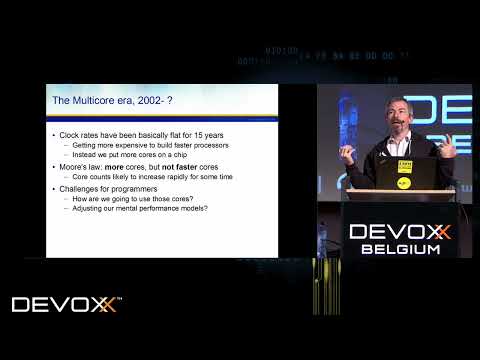
Cliff Click walks through a small performance example on a modern out-of-order CPU. He covers pipelining, ILP, CISC vs RISC, multicore, and why cache misses and the memory subsystem dominate performance.
Topic match · Computer architecture & CPUs 55:42
CppCon 2019: Matt Godbolt “Path Tracing Three Ways: A Study of C++ Style”
77K views • 7 years ago
CppCon
Matt Godbolt builds a toy path tracer in C++ in three different styles and compares them on clarity, testability, compile time and run-time performance. The talk was given at CppCon 2019.
Topic match · Software performance & optimization 1:04:26
CppCon 2018: G. Nishanov “Nano-coroutines to the Rescue! (Using Coroutines TS, of Course)”
40K views • 8 years ago
CppCon
Gor Nishanov's CppCon 2018 talk on using tiny C++ coroutines to hide memory latency, interleaving useful work while prefetches bring cache lines in from main memory.
Topic match · Software performance & optimization 44:05
FreeBSD optimizations used by Netflix serving at 800Gb/s - Drew Gallatin - EuroBSDcon 2022
28K views • 4 years ago
EuroBSDCon
Netflix engineer Drew Gallatin's EuroBSDcon 2022 talk quantifies the older FreeBSD optimizations that let Netflix serve web traffic at 800Gb/s, including TSO, LRO, VM page cache zones, asynchronous sendfile and unmapped mbufs.
Topic match · Software performance & optimization 19:36
Your web app but good: Aaron Boodman (Local-First Conf)
8K views • 2 years ago
Local-First Conf
Aaron Boodman of Replicache asks why sync engines have not yet fixed web app complexity and what is missing for them to go mainstream. The talk lays out the ideas that led to the Zero sync engine.
 49:55
How Python was Shaped by leaky Internals, Armin Ronacher, Flask framework
20K views • 10 years ago
Видео с мероприятий {speach!
Armin Ronacher, creator of Flask, explains how CPython's internals and C API leak into the language's semantics. Using examples like the complexity of the add operation, he shows why Python is hard to optimize or reimplement.
Topic match · Software performance & optimization 49:15
Erlang Factory 2014 - That's 'Billion' with a 'B': Scaling to the Next Level at WhatsApp
50K views • 12 years ago
Erlang Solutions
Rick Reed of WhatsApp explains at Erlang Factory 2014 how the service scaled to billions of messages with a very small engineering team. He covers the FreeBSD and Erlang stack, Mnesia usage, server counts and bottleneck work.
Topic match · Software performance & optimization 18:41
Refterm Lecture Part 1 - Philosophies of Optimization
93K views • 5 years ago
Molly Rocket
Casey Muratori's first refterm lecture lays out philosophies of optimization, distinguishing optimization from non-pessimization, which means avoiding needless work. It uses his fast terminal renderer project to show how fast computers really are.
Topic match · Software performance & optimization 1:06:20
USENIX ATC '21/OSDI '21 Joint Keynote Address-It's Time for Operating Systems to Rediscover Hardware
46K views • 5 years ago
USENIX
Timothy Roscoe of ETH Zurich delivers the joint USENIX ATC/OSDI 2021 keynote arguing that operating systems must reckon with modern hardware, which is a heterogeneous collection of processors, firmware and coprocessors rather than a simple machine. It shows how much runs below and beside Linux.
Topic match · Computer architecture & CPUs 1:04:53
Jim Keller: Moore’s Law is Not Dead
77K views • 7 years ago
UC Berkeley EECS
Jim Keller gives a UC Berkeley EECS colloquium arguing that Moore's Law is not dead. He surveys upcoming technologies and the multiple innovation curves that can keep transistor density and performance scaling.
Topic match · Computer architecture & CPUs 40:13
"Programming a 144-computer chip to minimize power" - Chuck Moore (2013)
19K views • 5 years ago
Strange Loop Conference
Chuck Moore, inventor of Forth, presents GreenArrays' 144-core asynchronous chip at Strange Loop 2013. He explains how idle cores draw almost no power and how tight code minimizes energy use.
Topic match · Computer architecture & CPUs 58:05
Guarding Against Physical Attacks: The Xbox One Story — Tony Chen, Microsoft
95K views • 7 years ago
Platform Security Summit
Microsoft's Tony Chen explains how the Xbox One was designed to resist physical attacks, including secure boot, encrypted memory, a security processor and a hypervisor. The goal was to make any hardware attack cost more than the price of many games.
Topic match · Computer architecture & CPUs 1:21:13
C++ and Beyond 2012: Herb Sutter - atomic Weapons 1 of 2
71K views • 9 years ago
alexsmail
Herb Sutter's deep C++ and Beyond 2012 talk on atomics and the C++ memory model, covering why programmers chasing top performance need to understand hardware ordering. This is part one of two.
Topic match · Computer architecture & CPUs 27:13
Robust-first computing: Demon Horde Sort (full version)
14K views • 13 years ago
Dave Ackley
Dave Ackley demonstrates the Demon Horde Sort, an inherently robust sorting machine running in his Movable Feast Machine simulator. This is the uncut version with all details and side thoughts.
Topic match · Computer architecture & CPUs 1:26:02
Stanford Seminar - The Soul of a New Machine: Rethinking the Computer
76K views • 6 years ago
Stanford Online
Bryan Cantrill of Oxide Computer Company gives a Stanford EE380 talk on rethinking the server. He argues that hyperscaler-style rack-scale machines with open firmware, RISC-V and Rust should be available to everyone, not just the giants.
Topic match · Computer architecture & CPUs 34:55
"Outperforming Imperative with Pure Functional Languages" by Richard Feldman
98K views • 5 years ago
Strange Loop Conference
Richard Feldman explains how pure functional languages can match or beat imperative ones on performance. Compilers can turn immutable code into in-place mutation, avoiding naive copying. The talk draws on his work on the Roc language.
Topic match · Software performance & optimization 1:12:02
Java on a 1000 Cores - Tales of Hardware / Software CoDesign
23K views • 17 years ago
Google TechTalks
Cliff Click of Azul Systems gives a Google Tech Talk on running Java business applications on a machine with about a thousand cores. He covers hardware and software codesign, including garbage collection hardware and the JIT.
Topic match · Computer architecture & CPUs 58:36
Advanced Topics in Programming Languages: A Lock-Free Hash Table
29K views • 14 years ago
GoogleTalksArchive
A 2007 Google Tech Talk in which Cliff Click of Azul Systems presents a lock-free concurrent hash table that scales to 768 CPUs. He explains why it is correct by reasoning in a different way than usual happens-before and memory-order arguments.
Topic match · Software performance & optimization 40:13
Zach Tellman - Everything Will Flow
27K views • 11 years ago
ClojureTV
Zach Tellman's Clojure West talk covers the basics of queueing theory and its practical use in systems, including backpressure, how queues break down under load, and pitfalls of naive core.async use.
Topic match · Software performance & optimization 32:07
Larry Hastings - Removing Python's GIL: The Gilectomy - PyCon 2016
49K views • 10 years ago
PyCon 2016
Larry Hastings explains what Python's GIL is, what problems it solves and how it works, and presents his Gilectomy project to remove it, including the performance and C-extension obstacles.
Topic match · Software performance & optimization 1:15:09
Cliff Click @ VMSS16: Bits of Advice For the VM Writer
4K views • 10 years ago
softdevteamuk
Cliff Click, author of HotSpot's JIT compiler, shares hard-won advice for people writing virtual machines at the VMSS16 workshop. Topics include interpreters, JITs and performance lessons.
Topic match · Software performance & optimization 1:19:57
Simon Peyton Jones: Data Parallel Haskell
28K views • 16 years ago
nuACM
Simon Peyton Jones explains nested data parallelism and Data Parallel Haskell, an approach to exploiting multicore and distributed hardware while keeping a simple single-control-flow programming model.
Topic match · Computer architecture & CPUs 35:42
Progressive Performance (Chrome Dev Summit 2016)
34K views • 9 years ago
Chrome for Developers
Alex Russell's Chrome Dev Summit 2016 talk on building web experiences that work on slow, flaky networks and low-power devices. It argues developers should focus on the performance of real-world mobile hardware rather than desktop machines.
Topic match · Software performance & optimization 1:04:48
"Performance (Really) Matters" with Emery Berger
7K views • 6 years ago
Association for Computing Machinery (ACM)
Emery Berger argues that performance is hard to measure and deliver on modern systems, showing how code layout and link order can swamp optimization effects. He presents tools that evaluate performance more reliably.
Topic match · Software performance & optimization 1:24:36
C++ Exceptions for Smaller Firmware - Khalil Estell - CppCon 2024
23K views • 1 year ago
CppCon
Khalil Estell's CppCon 2024 talk argues C++ exceptions can reduce binary size in firmware. He digs into how exceptions work and how to shrink their code footprint on embedded platforms.
Topic match · Software performance & optimization 25:52
Halide Talk
53K views • 12 years ago
Andrew Adams
Andrew Adams, a Halide developer, presents the Halide language for image processing and tensor computation. The talk explains the separation of algorithm from schedule with illustrated examples of parallelism, locality and redundancy tradeoffs.
Topic match · Software performance & optimization 24:46
Building a 6800 CPU on an FPGA with nMigen (part 1)
27K views • 6 years ago
Robert Baruch
The first part of Robert Baruch's series on building a 6800 CPU on an FPGA with nMigen, a Python-based hardware description language. It introduces the HDL while implementing a simpler 6800 core.
Topic match · Computer architecture & CPUs 29:51
Refterm v2 - Resource usage, binary splat, glyph sizing, and more
68K views • 5 years ago
Molly Rocket
Casey Muratori follows up his refterm proof-of-concept, a GPU-based terminal renderer, with a second part covering memory usage, glyph sizing and correct Unicode and VT handling. It is built to show that a terminal can be fast and correct without heroic effort.
Topic match · Software performance & optimization 57:39
CppCon 2016: Chandler Carruth “Garbage In, Garbage Out: Arguing about Undefined Behavior..."
94K views • 10 years ago
CppCon
Chandler Carruth's CppCon 2016 talk tries to defuse the heated debate over undefined behavior in C and C++. He explains from the compiler writer's perspective why UB exists and how it enables optimization.
Topic match · Software performance & optimization 46:04
DEF CON 26 - Christopher Domas - GOD MODE UNLOCKED Hardware Backdoors in redacted x86
86K views • 8 years ago
DEFCONConference
Christopher Domas presents research at DEF CON 26 showing a hidden alternate instruction set and undocumented hardware backdoor in some x86 processors, found on a third-party CPU. He uses it to ask how feasible wider hardware backdoors are.
Topic match · Computer architecture & CPUs 1:00:17
Stephan T. Lavavej “Floating-Point <charconv>: Making Your Code 10x Faster With C++17's Final Boss”
41K views • 7 years ago
CppCon
Stephan T. Lavavej's CppCon 2019 talk on implementing floating-point to_chars and from_chars in Microsoft's C++ STL. It covers the history of float-string conversion and the algorithms that make it much faster.
Topic match · Software performance & optimization 14:46
Robust-first computing: Beyond efficiency
8K views • 13 years ago
Dave Ackley
Dave Ackley gives a high-level introduction to robust-first computing, which prioritizes robustness over efficiency in computer architecture. A sorting demo illustrates the idea.
Topic match · Computer architecture & CPUs 1:37:12
[7] Jim Keller, Silicon Wizard 🧙♂️
67K views • 5 years ago
TechTechPotato
Ian Cutress interviews chip architect Jim Keller about his time at AMD, Intel and elsewhere, management advice, design approach, Moore's Law and x86 versus Arm.
Topic match · Computer architecture & CPUs 42:44
Armin Ronacher - A Python for Future Generations
6K views • 9 years ago
EuroPython Conference
Armin Ronacher's EuroPython 2017 keynote examining how the CPython interpreter's leaky abstractions affect language design and how Python could evolve, drawing on JavaScript and Rust experience.
Topic match · Software performance & optimization 45:05
Servo Architecture: Safety and Performance
12K views • 9 years ago
linux conf au 2017 - Hobart, Australia
Jack Moffitt presents the architecture of Servo, Mozilla's experimental browser engine written in Rust, focusing on parallelism across cores, GPUs and SIMD and the safety properties gained from Rust.
Topic match · Software performance & optimization 40:03
Google I/O 2013 - High Performance Audio
62K views • 13 years ago
Google for Developers
A Google I/O 2013 talk by Android audio engineers on why reliable, low-latency audio is hard on the platform. It covers problem areas across the stack, platform work underway and techniques apps can use.
Topic match · Software performance & optimization 1:30:03
C++Now 2018: Matt Godbolt “What Else Has My Compiler Done For Me Lately?”
11K views • 8 years ago
CppNow
Matt Godbolt, creator of Compiler Explorer, tours surprising optimizations modern compilers perform, such as turning loops into closed-form sums and using popcount instructions. He explores what the compiler does behind the scenes.
Topic match · Software performance & optimization 52:21
ASPLOS Keynote: The Golden Age of Compiler Design in an Era of HW/SW Co-design by Dr. Chris Lattner
52K views • 5 years ago
SiFive
Chris Lattner's ASPLOS 2021 keynote on the golden age of compiler design in an era of hardware and software co-design, covering compiler infrastructure for accelerators and unifying hardware IRs.
Topic match · Computer architecture & CPUs 35:45
RAAIS 2017 - Simon Knowles, Co-Founder and CTO of Graphcore
7K views • 9 years ago
The Research and Applied AI Summit - RAAIS
Simon Knowles, co-founder and CTO of Graphcore, talks about "intelligence processors", chips designed specifically for machine learning. The talk was given at the RAAIS 2017 summit and covers Graphcore's architecture.
Topic match · Computer architecture & CPUs