commit graph
 38:31
The $200M Machine that Prints Microchips: The EUV Photolithography System
2.4M views • 1 year ago
Branch Education
Branch Education's animated deep dive into ASML's EUV photolithography machine and how it prints nanometer-scale transistors onto chips. It covers the system's components and the process of chip manufacturing.
 21:08
Demographic Collapse — China's Reckoning (Part 1)
3M views • 5 years ago
PolyMatter
PolyMatter's first part of a series on China's demographic collapse, covering the effects of the one-child policy, shrinking workforce and economic consequences.
 12:36
Why PlayStation 1 Graphics Warped and Wobbled so much | MVG
2.3M views • 6 years ago
Modern Vintage Gamer
Modern Vintage Gamer explains why PlayStation 1 graphics warped and jittered, comparing it with the Nintendo 64. The causes are affine texture mapping and the lack of sub-pixel vertex precision.
 2:12
3D Gaussian Splatting - Why Graphics Will Never Be The Same
2M views • 3 years ago
IndividualKex
A two-minute explainer of 3D Gaussian Splatting, the rendering technique from a 2023 research paper. It outlines why it could change how 3D graphics are made.
 17:05
How Physicists Created a Holographic Wormhole in a Quantum Computer
2.4M views • 3 years ago
Quanta Magazine
Quanta Magazine explains the 2022 experiment that claimed to create a holographic wormhole on Google's quantum computer. The description now notes that a later independent analysis questioned whether any wormhole was created.
 14:47
SOUTH KOREA IS OVER
15.9M views • 1 year ago
Kurzgesagt – In a Nutshell
A Kurzgesagt animation on South Korea's record-low fertility rate and rapidly aging population. It explains why a demographic collapse looks hard to reverse and projects the population shrinking sharply by 2060.
 38:26
Racing the Beam Explained - Atari 2600 CPU vs. CRT Television
400K views • 5 years ago
Retro Game Mechanics Explained
Retro Game Mechanics Explained shows how the Atari 2600 draws images with almost no video memory, by having the CPU race the CRT beam line by line. It walks through the techniques in detail.
 55:00
The Closest Thing We Have to Alien Technology
64.9M views • 10 months ago
Veritasium
Veritasium explains how ASML's EUV lithography machines make the most advanced computer chips, covering the engineering of the light source, mirrors and the supply chain around them. It is a long-form explainer on the world's most complex commercial machine.
 12:20
I Solved Klotski
2.1M views • 1 year ago
2swap
2swap explains how he solved the Klotski sliding-block puzzle by mapping its full state space as a graph and visualizing it. The video includes footage of the Guinness world-record solve and links to an interactive graph.
 24:26
The Beauty of Bézier Curves
2.2M views • 5 years ago
Freya Holmér
Freya Holmer explains how Bezier curves work, from the helper-line construction to their uses in animation, text rendering and shapes. It uses visuals from her Unity Shapes plugin and was a SoME1 contest winner.
 17:20
The Extreme Engineering of ASML’s EUV Light Source
698K views • 4 years ago
Asianometry
Asianometry explains the EUV light source inside ASML's lithography machines, where lasers hit falling tin droplets twice to produce 13.5 nm light. It walks through the engineering of the droplet generator, the pre-pulse and main laser, and the plasma that results.
 7:49
Your Post Code Is the Directions, Not the Destination
3.9M views • 1 year ago
CGP Grey
CGP Grey explains that postal codes are routing instructions for mail rather than geographic regions. He looks at the quirks and problems this causes.
 22:36
Computer Scientist Explains One Concept in 5 Levels of Difficulty | WIRED
7.2M views • 4 years ago
WIRED
WIRED has UCLA professor Amit Sahai explain zero-knowledge proofs to a child, a teen, a college student, a grad student and an expert. Each round goes deeper into the cryptography and why it matters.
 27:48
How are Microchips Made? 🖥️🛠️ CPU Manufacturing Process Steps
11.9M views • 2 years ago
Branch Education
Branch Education walks through a semiconductor fab and the dozens of steps used to turn silicon wafers into microchips, with 3D animation. It covers lithography, deposition and etching at a high level.
 4:30
The highway where trucks work like electric trains
5.3M views • 5 years ago
Tom Scott
Tom Scott visits an eHighway test in Lubeck, Germany, where electric trucks with pantographs draw power from overhead wires. He explains how this could electrify road freight.
 22:54
Did People Used To Look Older?
21M views • 4 years ago
Vsauce
Vsauce explores whether people in past decades really looked older than people of the same age today, or whether photographic and cultural factors make them seem so. It draws on old photos, yearbooks and perception research.
 1:13:50
The Continuity of Splines
1.9M views • 3 years ago
Freya Holmér
Freya Holmer's 74-minute video essay on splines, covering Bezier curves, B-splines, derivatives and the different levels of continuity (C0, C1, C2), built with custom animation tools. She notes she did not cover non-uniform splines.
 14:12
How Harley-Davidson Killed Itself
5M views • 6 years ago
FortNine
FortNine explains how Harley-Davidson ended up in decline, from a narrow lifestyle niche and an aging customer base to the pandemic hitting a company already in trouble.
 20:57
Atari's Quadrascan Explained
239K views • 5 years ago
Retro Game Mechanics Explained
Retro Game Mechanics Explained dissects how Atari's Quadrascan vector displays and vector generator hardware drew games like Asteroids and Tempest.
 21:46
Surface-Stable Fractal Dithering Explained
646K views • 1 year ago
runevision
Rune Skovbo Johansen explains Surface-Stable Fractal Dithering, a technique he invented and released as open source. It makes dithering stick to 3D surfaces and covers the experiments and shortcomings along the way, inspired by Return of the Obra Dinn.
 8:14
Why are British place names so hard to pronounce?
6.6M views • 5 years ago
Map Men
The Map Men explain why British place names are so hard to pronounce, tracing it to layers of Viking, Anglo-Saxon, Celtic and Norman influence, with a pronunciation guide.
 46:24
How are holograms possible?
7.2M views • 2 years ago
3Blue1Brown
3Blue1Brown explains how holograms record a 3D scene on 2D film, using wave diffraction and phase. The video includes demonstrations of several real holograms.
 22:59
How Does SHA-256 Work?
374K views • 6 years ago
learnmeabitcoin
A step-by-step animated explanation of how SHA-256 works, from padding and message schedule to the compression function and final hash, with source code for the animations.
 40:45
Exclusive: Metro Exodus Enhanced Edition Analysis - The First Triple-A Game Built Around Ray Tracing
915K views • 5 years ago
Digital Foundry
Digital Foundry's Alex Battaglia analyzes Metro Exodus Enhanced Edition, the first AAA game built around ray tracing. It covers the new global illumination, emissive lighting, DLSS and performance on AMD and Nvidia hardware.
 17:51
Does "land area" assume a country is perfectly flat?
859K views • 6 years ago
Stand-up Maths
Matt Parker of Stand-up Maths asks whether a country's reported land area accounts for hills and mountains, working through how surface area depends on the resolution of elevation data. It follows up on a question from a viewer and work by researchers who measured it.
 11:33
Light Waves Visualized using Photon Sieves.
69K views • 6 years ago
Huygens Optics
Huygens Optics shows how DIY photon sieves shape a laser's wave front, explaining how they differ from zone plates and how aperture count affects the focal point, with time-resolved visualizations of the diffraction.
 17:40
3D Gaussian Splatting! - Computerphile
273K views • 2 years ago
Computerphile
A Computerphile video in which Dr Mike Pound and PhD student Lewis Stuart explain 3D Gaussian splatting, a quick technique that turns photos of a scene into a 3D model without much compute. It includes a demo and compares the approach to NeRFs.
 10:58
DON'T Buy a Used Mining GPU! - $h!t Manufacturers Say
3.7M views • 5 years ago
Linus Tech Tips
Linus Tech Tips looks at whether buying a used GPU that was previously used for crypto mining is a good idea, as miners prepare to sell off cards. The video discusses how mining affects wear on cards and what to watch for.
 8:25
Large Language Models from scratch
375K views • 4 years ago
Graphics in 5 Minutes
A short cartoon explaining how language models like ChatGPT work, from autocomplete and conditional probabilities to neural networks, gradient descent and backpropagation. It shows how networks act as universal function approximators.
 18:31
Fourier Optics used for Optical Pattern Recognition
103K views • 6 years ago
Huygens Optics
Huygens Optics explains the Fourier transform and shows how a lens performs one optically. A DLP projector is used as a Fourier filter to do simple pattern recognition on lithographic character patterns.
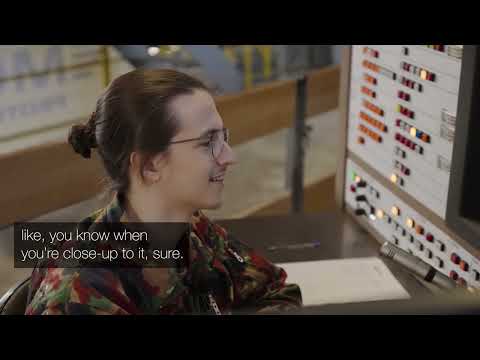 4:40
This 1970s tank simulator drives through a tiny world
12M views • 4 years ago
Tom Scott
Tom Scott visits the Swiss Military Museum to see the last surviving 1970s tank-driving simulator. It uses a real camera moving over a miniature model landscape rather than any computer graphics.
 11:43
Walmart's $250 laptop is AWESOME!
3.4M views • 6 years ago
Linus Tech Tips
Linus Tech Tips reviews Walmart's $250 Motile 14-inch Ryzen laptop and finds it surprisingly decent for the price. It covers the Ryzen 3 chip, Vega graphics, and aluminum build.