complex systems
 28:21
Velocity 2012: Richard Cook, "How Complex Systems Fail"
60K views • 14 years ago
O'Reilly
Dr. Richard Cook, a physician and patient safety researcher, presents his ideas on how complex systems fail, at Velocity 2012. He argues for designing for resiliency rather than trying to exhaustively handle every failure mode.
 40:51
Geoffrey West on COMPLEXITY
23K views • 15 years ago
FQxI
Physicist Geoffrey West speaks at an FQXi conference on time about complexity and scaling laws. He covers how metabolism, growth and lifespan scale across organisms and how the same mathematics applies to cities and companies.
 46:15
AWS re:Invent 2014 | (SPOT302) Under the Covers of AWS: Its Core Distributed Systems
10K views • 11 years ago
Amazon Web Services
An AWS re:Invent 2014 talk on the core distributed systems primitives behind AWS and Amazon.com, such as consensus, key-value stores and transactional logging. It describes how AWS builds large services from a few common building blocks.
 36:58
"A (Not So Gentle) Introduction To Systems Programming In ATS" by Aditya Siram
26K views • 9 years ago
Strange Loop Conference
Aditya Siram introduces ATS, a statically typed ML-like language that compiles to C and offers type-safe pointer arithmetic and a full proof language. The Strange Loop talk shows off C interop, concurrency and verification features with non-trivial examples.
 42:45
RustConf 2017 - Closing Keynote: Safe Systems Software and the Future of Computing by Joe Duffy
2K views • 9 years ago
Confreaks
Joe Duffy's RustConf 2017 closing keynote on his experience at Microsoft building Midori, an operating system written in a Rust-like safe systems language. He covers the technical and cultural challenges of applying those lessons to Windows.
 25:35
Epicycles, complex Fourier series and Homer Simpson's orbit
421K views • 8 years ago
Mathologer
Mathologer explains epicycles and complex Fourier series, inspired by an animation of Homer Simpson drawn with epicycles. It covers the shape of the Moon's orbit around the Sun and how to make your own epicycle drawings.
 33:32
Condition Systems in an Exceptional Language - Chris Houser
16K views • 10 years ago
ClojureTV
Chris Houser's Clojure/conj talk on why Clojure's exceptions destroy information as the stack unwinds, unlike Common Lisp's condition system, which can resume from the error site. He surveys the existing libraries that approximate conditions, explains why they don't compose with each other, and considers what a better design would look like.
 40:20
"Testing Distributed Systems w/ Deterministic Simulation" by Will Wilson
55K views • 12 years ago
Strange Loop Conference
Will Wilson of FoundationDB explains how the team tested their distributed database using deterministic simulation. By running the whole system in a simulator with injected faults and reproducible seeds, they could find rare concurrency and network bugs.
 20:28
The Most COMPLEX Pop Song of All Time
8.3M views • 5 years ago
Rick Beato
Rick Beato analyzes a pop song he argues is among the most harmonically complex ever, breaking down its chords and key changes. It is a music theory deep dive aimed at general music fans.
 52:35
Debugging Under Fire: Keep your Head when Systems have Lost their Mind • Bryan Cantrill • GOTO 2017
101K views • 9 years ago
GOTO Conferences
Bryan Cantrill's GOTO Chicago 2017 talk on debugging production systems under pressure, centered on the incident where an operator's mistyped command rebooted an entire Joyent datacenter. It covers human factors, automation and architecture.
 36:53
Rails Conf 2012 Keynote: Simplicity Matters by Rich Hickey
220K views • 14 years ago
Confreaks
Rich Hickey's keynote at RailsConf 2012, a close sibling of his 'Simple Made Easy' talk. He distinguishes simple (not intertwined) from easy (familiar), and argues that software complexity comes from complecting things, with Rails-specific examples including large gem collections.
 51:07
Alan Kay, 2015: Power of Simplicity
145K views • 11 years ago
Kenneth Friedman
Alan Kay's 2015 talk on the power of simplicity, arguing that systems become simpler by building on more sophisticated fundamental building blocks and that big research horizons drove invention at Xerox PARC. It ranges across computing, tools and scaling software.
 50:09
Old pinball machines are amazingly complex
3.5M views • 3 years ago
Technology Connections
Technology Connections takes a long, detailed look at how a 1970s electromechanical pinball machine works, from relays to stepper motors and mechanical logic. It is the first part of a series.
 52:29
"I See What You Mean" by Peter Alvaro
59K views • 11 years ago
Strange Loop Conference
Peter Alvaro's Strange Loop 2015 talk argues that query languages let you state what you mean, and applies that to distributed programming. It covers Datalog, Dedalus and the Bloom lineage for reasoning about distributed systems.
 54:55
Dconf 2014 Day 2 Keynote: The Last Thing D Needs -- Scott Meyers
19K views • 8 years ago
The D Language Foundation
Scott Meyers' keynote at DConf 2014, drawing on 25 years of C++ experience to offer the D language community a plea about what it should avoid. It centers on the accumulated complexity and pitfalls of C++ as a cautionary tale.
 37:15
Stuart Halloway - Narcissistic Design
29K views • 9 years ago
Reaktor
Stuart Halloway's satirical talk describes how to protect yourself from industry change by spreading complexity through systems while following idiomatic practice. It uses this inversion to catalog software design anti-patterns.
 48:02
James Burke Legend Connections 1 The Trigger Effect
389K views • 4 years ago
Tim Callinan
The first episode of James Burke's Connections series, 'The Trigger Effect', explores how modern society depends on interlinked technological systems and how quickly it breaks down when they fail, starting with a power blackout.
 47:25
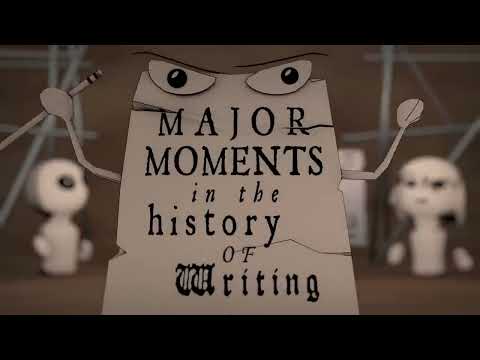
Thoth's Pill - an Animated History of Writing
1.3M views • 11 years ago
NativLang
NativLang's 47-minute animated documentary traces the birth and evolution of writing, from early cave marks to modern scripts. It presents the history of the world's writing systems as a story.
 54:31
Does APL Need a Type System? by Aaron W Hsu at #FnConf18
6K views • 7 years ago
ConfEngine
Aaron Hsu's FnConf18 talk asks whether APL needs a static type system. He argues that APL's expressiveness and rapid iteration already deliver the benefits usually credited to types.
 53:21
GSMT - Dan Holohan, Author: "The Lost Art of Steam Heating"
71K views • 11 years ago
The General Society of Mechanics and Tradesmen
Dan Holohan, author of The Lost Art of Steam Heating, talks about the old steam heating systems he learned about from veteran tradesmen. He shares stories and practical lessons on how these systems work, including running steam at low temperatures.
 49:39
NeWS: A Networked and Extensible Window System, lecture by James Gosling
5K views • 10 years ago
Computer History Museum
A 1990 lecture by James Gosling on NeWS, Sun's networked window system in which clients send PostScript programs to the server for execution. It covers the high-level imaging model and compares NeWS with similar systems.
 40:15
Bringing Types to Elixir by Giuseppe Castagna and Guillaume Duboc | ElixirConf EU 2023
7K views • 3 years ago
Code Sync
ElixirConf EU 2023 talk by Giuseppe Castagna and Guillaume Duboc on bringing set-theoretic types to Elixir, and the benefits such a type system could offer such as catching bugs.
 47:18
The Tragedy of systemd
1.3M views • 7 years ago
linux.conf.au
FreeBSD developer Benno Rice traces the history of init and bootstrap systems at linux.conf.au 2019 to explain why systemd was seen as necessary and why it provokes such strong reactions. He also discusses why change is scary.
 29:36
1. How Buildings Learn - Stewart Brand - 1 of 6 - “Flow”
115K views • 14 years ago
Stewart Brand
The first episode of Stewart Brand's 1997 BBC series based on his book How Buildings Learn, covering how buildings change after they are built. Brand presents and the series has music by Brian Eno.
 51:16
Why can't you multiply vectors?
524K views • 3 years ago
Freya Holmér
Freya Holmer's Dutch Game Day 2023 talk asking why vectors can't be multiplied, building from complex numbers to a single axiom and arriving at geometric algebra, quaternions and multivectors.
 59:50
Leslie Lamport: Thinking Above the Code
403K views • 12 years ago
Microsoft Research
Leslie Lamport argues that programmers, like architects, should write rigorous specifications before coding, especially for concurrent and distributed systems. The talk introduces the case for writing specs (the TLA+ mindset) as a way of thinking above the code.
 40:13
Zach Tellman - Everything Will Flow
27K views • 11 years ago
ClojureTV
Zach Tellman's Clojure West talk covers the basics of queueing theory and its practical use in systems, including backpressure, how queues break down under load, and pitfalls of naive core.async use.
 23:20
Dwarf Fortress Creator Explains its Complexity & Origins | Noclip Interview
2M views • 6 years ago
/noclip
A /noclip interview with Tarn Adams of Bay 12 Games about Dwarf Fortress: where the ASCII simulation came from, how it works, and the plans for its Steam release. It includes his telling of the famous bug in which cats were poisoned by alcohol.
 23:29
How Imaginary Numbers Were Invented
22.7M views • 5 years ago
Veritasium
Veritasium tells the history of how imaginary numbers arose from the quest for a general solution to the cubic equation, including the duels and secrecy among Renaissance mathematicians. It argues math had to give up the requirement that it mirror reality.
 43:39
CRDTs and the Quest for Distributed Consistency
68K views • 8 years ago
InfoQ
Martin Kleppmann's QCon London 2018 talk on keeping data consistent in distributed systems without a central leader. It surveys CRDT algorithms for syncing devices and collaborative editing over peer-to-peer networks.
 29:43
Pi hiding in prime regularities
2.8M views • 9 years ago
3Blue1Brown
3Blue1Brown shows how pi emerges from prime numbers via complex numbers and sums of squares, culminating in a formula for approximating pi.
 42:20
Writing a Wayland Compositor in Zig - Isaac Freund
26K views • 6 years ago
Zig SHOWTIME
Isaac Freund, author of the River Wayland compositor, talks about writing a Wayland compositor in Zig. He covers why he chose Zig over C and Rust and how Zig can wrap a hairy C library.
 40:05
"Uptime 15,364 days - The Computers of Voyager" by Aaron Cummings
349K views • 7 years ago
Strange Loop Conference
A Strange Loop 2019 talk by Aaron Cummings on the computing systems aboard Voyager 1 and 2, which control the spacecraft and record and return data decades after launch in 1977.
 23:06
Bob Nystrom - Is There More to Game Architecture than ECS?
301K views • 8 years ago
Roguelike Celebration
Bob Nystrom, author of Game Programming Patterns, gives a Roguelike Celebration 2018 talk questioning whether entity component systems are the only way to structure a game. He walks through alternative architectures drawn from roguelike development.
 22:15
Badness 0 (Apostrophe‛s version)
258K views • 2 years ago
suckerpinch
Tom 7's pilot episode of a series that plays with type systems and absurd programming, presented as a parody of the GPL v3 license. It mixes a typesetting experiment with a long, story-driven intro on the origin of TeX. Source code and papers are linked from the author's site.
 21:01
Self: The Movie;
21K views • 13 years ago
Jecel Assumpção Jr
A 1995 Sun Microsystems film about the Self programming language, a prototype-based Smalltalk relative, showing its live, graphical programming environment.
 32:35
Scale By The Bay 2019: Bryan Cantrill, Was He Wright All Along? Software After Moore's Law
11K views • 6 years ago
FunctionalTV
Bryan Cantrill's Scale By The Bay 2019 talk on software after Moore's Law. He covers the end of easy scaling and the move toward specialized, emerging architectures.
 52:48
Object-Oriented Programming is Garbage: 3800 SLOC example
258K views • 10 years ago
Brian Will
Brian Will critiques object-oriented programming and rewrites a roughly 3800-line OO program in a procedural style, cutting code and complexity. It is part of a series of OOP critiques.
 53:12
Yehuda Katz - Why Rails is Hard (Railsberry 2012)
29K views • 14 years ago
applicake
Yehuda Katz's Railsberry 2012 talk on why Rails is hard to learn and use. He explains that the framework's many features reflect real complexity in web applications that newcomers do not yet see.
 41:08
"Transactions: myths, surprises and opportunities" by Martin Kleppmann
84K views • 11 years ago
Strange Loop Conference
Martin Kleppmann's Strange Loop talk on database transactions, covering why they were dropped by NoSQL, their reputation for being slow, and newer algorithms that make serializable transactions perform and scale. It touches on consistency, linearizability and the CAP theorem.