computer world
 10:00
SICP / What is "Computer Science" ?
131K views • 20 years ago
LarryNorman
An excerpt from Hal Abelson's opening SICP lecture introducing computer science and contrasting declarative and imperative knowledge. He argues that computer science is not really a science and is more like magic or engineering of ideas.
 1:21:22
Light Years Ahead | The 1969 Apollo Guidance Computer
2.8M views • 6 years ago
TNMoC
Robert Wills of TNMoC explains the Apollo Guidance Computer hardware and software, then walks through the Apollo 11 landing procedure step by step, including the 1202 alarms.
 1:15:47
Richard Feynman Computer Science Lecture - Hardware, Software and Heuristics
978K views • 14 years ago
Muon Ray
A lecture by Richard Feynman on how computers work, using the analogy of a filing clerk that becomes progressively dumber and faster. It also covers heuristics and how computers handle data and solve problems in finite time.
 16:37
Why the world population won’t exceed 11 billion | Hans Rosling | TGS.ORG
2M views • 10 years ago
THINK Global School
Hans Rosling uses population statistics to explain why the world population will level off rather than grow without limit. He shows that falling child mortality and rising prosperity lead to smaller families.
 58:49
Why our generals were more successful in World War II than in Korea, Vietnam or Iraq/Afghanistan
2.2M views • 15 years ago
UC Berkeley Events
Thomas Ricks's Nimitz Memorial Lecture at UC Berkeley asks why US generals did better in World War II than in Korea, Vietnam or Iraq and Afghanistan. A central point is the WWII practice of quickly reassigning or relieving underperforming generals.
 44:09
Lec 1 | MIT 6.042J Mathematics for Computer Science, Fall 2010
2.8M views • 13 years ago
MIT OpenCourseWare
The first lecture of MIT 6.042J Mathematics for Computer Science, taught by Tom Leighton, introducing mathematical proofs. It covers propositions, implication and basic proof methods.
 8:07
Seymour Papert 1983
28K views • 19 years ago
Cynthia Solomon
An eight-minute excerpt of a 1983 video featuring Seymour Papert, creator of Logo, on children learning programming and abstract ideas through embodied play. It shows kids acting out the Logo turtle.
 1:31:28
Stanford Seminar: Beyond Floating Point: Next Generation Computer Arithmetic
33K views • 9 years ago
Stanford Online
John Gustafson presents posits, a proposed drop-in replacement for IEEE 754 floats that is simpler in hardware and more flexible in precision. The seminar includes a live demo and machine learning results.
 57:57
Lecture 1 | Introduction to Convolutional Neural Networks for Visual Recognition
2.9M views • 9 years ago
Stanford University School of Engineering
The first lecture of Stanford's CS231n course on convolutional neural networks for visual recognition. It surveys the history and key challenges of computer vision, from the Cambrian explosion and Hubel and Wiesel to ImageNet.
 1:57:00
Origins of the Apple Human Interface
13K views • 7 years ago
Computer History Museum
A 1997 Computer History Museum lecture in which Larry Tesler and Chris Espinosa recount how the Apple human interface was born, from the Lisa through the Macintosh. It covers design decisions such as discoverability and the standard editing keys.
 1:12:56
Lecture 1A | MIT 6.001 Structure and Interpretation, 1986
995K views • 17 years ago
MIT OpenCourseWare
The first lecture of MIT's 1986 6.001 Structure and Interpretation of Computer Programs, given by Harold Abelson, introducing Lisp and the idea of computer science as the study of process.
 55:27
Leonard Susskind on The World As Hologram | TVO Docs
4.1M views • 15 years ago
TVO Docs
Stanford physicist Leonard Susskind gives a public lecture on the holographic principle, the indestructibility of information and the nature of black holes. It asks whether the world could be a hologram.
 56:11
A Brief History of Quantum Mechanics - with Sean Carroll
4.7M views • 6 years ago
The Royal Institution
Sean Carroll gives a Royal Institution talk tracing the history of quantum mechanics from Einstein and Bohr to today. He covers the Copenhagen interpretation and the many worlds interpretation.
 1:16:22
If Brains are Computers, Who Designs the Software? - with Daniel Dennett
873K views • 9 years ago
The Royal Institution
Daniel Dennett's Royal Institution lecture on whether the brain is a computer and where its software comes from. He argues that minds are built by evolution and culture, with competence arising without comprehension.
 1:00:26
Colossus - The Greatest Secret in the History of Computing
1M views • 6 years ago
The Centre for Computing History
Chris Shore of the Centre for Computing History explains how Colossus was built, how it worked, and how it affected the course of World War II. It is an hour-long museum lecture on the codebreaking computer.
 1:06:36
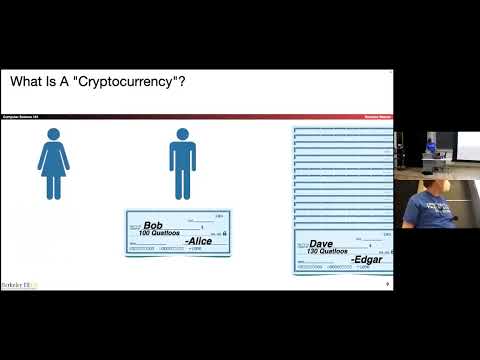
Computer Security 161 Cryptocurrency Lecture
128K views • 4 years ago
Nicholas C Weaver
A UC Berkeley CS 161 lecture by Nicholas Weaver on cryptocurrency and blockchains, covering how they work and the case against them. It is aimed at a computer security course audience.
 59:19
The Extreme World of Ultra Intense Lasers - with Kate Lancaster
859K views • 11 years ago
The Royal Institution
Royal Institution lecture by Dr Kate Lancaster on the most powerful lasers in the world and the extreme conditions they create. It includes live demonstrations and covers applications from industry to fusion.
 58:51
DON'T PANIC — Hans Rosling showing the facts about population
3.3M views • 11 years ago
Gapminder Foundation
Hans Rosling uses data and animated statistics to show how world population is changing, why birth rates fall as child survival and wealth rise, and why population is expected to peak around 11 billion. It also tackles common misconceptions about Africa and family planning.
 1:31:53
Gwynne Dyer -- Geopolitics in a Hotter World
82K views • 16 years ago
The University of British Columbia
Historian and journalist Gwynne Dyer gives a long UBC talk on how climate change will reshape international politics. He covers food, borders, refugees and the possibility of unilateral geoengineering by affected nations.
 54:41
Jack Szostak (Harvard/HHMI) Part 1: The Origin of Cellular Life on Earth
378K views • 14 years ago
Science Communication Lab
Jack Szostak's lecture covers how cellular life could have arisen from chemistry on the early Earth, starting from the odds of life elsewhere in the galaxy. It is part of a series on protocells and the RNA world.
 51:32
Great Impractical Ideas in Computer Science: PowerPoint Programming
2.2M views • 7 years ago
Tom Wildenhain
Tom Wildenhain's guest lecture for CMU's Esoteric Programming Languages course shows that PowerPoint transitions and slides are Turing complete without macros, building up to a mind-bending fractal ending.
 1:03:31
How to Enjoy the End of the World
167K views • 7 years ago
Sid Smith
A Virginia Tech presentation by Sid Smith about collapse, fossil fuels and overshoot, arguing that industrial civilization faces a decline and how one might live with that. It was later expanded into a video series.
 11:01
Milton Friedman - The Real World Effects Of Unions
432K views • 12 years ago
LibertyPen
An 11-minute clip of Milton Friedman explaining the incentives of unions and how they affect employment. He argues unions restrict labor supply, raising pay for some workers while hurting low-skill workers.
 43:11
Who is Yahweh - How a Warrior-Storm God became the God of the Israelites and World Monotheism
3.7M views • 3 years ago
ESOTERICA
An ESOTERICA episode tracing Yahweh from a warrior-storm god near Mt Seir to the god of the Israelites in the Judean highlands. It examines how Yahwism absorbed and contended with Canaanite religion.
 1:19:38
John Hennessy and David Patterson 2017 ACM A.M. Turing Award Lecture
150K views • 8 years ago
Association for Computing Machinery (ACM)
Hennessy and Patterson's 2018 Turing Award lecture at ISCA, A New Golden Age for Computer Architecture. It covers domain-specific hardware, security, open instruction sets and agile chip development.
 1:00:06
Computer Science - Brian Kernighan on successful language design
332K views • 10 years ago
University of Nottingham
Brian Kernighan gives a talk at the University of Nottingham on how to succeed in language design without really trying. He draws on his experience with awk and other languages.
 1:02:47
Secret History of Silicon Valley
491K views • 17 years ago
Computer History Museum
Steve Blank's Computer History Museum lecture argues that Silicon Valley's roots lie in WWII radar and electronic warfare work, Stanford's Fred Terman and Cold War military funding rather than the semiconductor alone.
 2:05:23
Richard Stallman: Copyright vs. Community
51K views • 13 years ago
RU Computer Science
A 2012 lecture by Richard Stallman at Reykjavik University arguing that copyright, built for the printing press, fits poorly with computer networks. He criticizes draconian enforcement and corporate lobbying.
 1:37:22
Siggraph2019 Geometric Algebra
87K views • 7 years ago
Bivector
A SIGGRAPH 2019 course on geometric algebra. Charles Gunn gives an intro, then Steven De Keninck gives a programmer-focused course with live examples in ganja.js.
 1:13:22
Sacha Arnoud, Director of Engineering, Waymo - MIT Self-Driving Cars
109K views • 8 years ago
Lex Fridman
Sacha Arnoud, Waymo's Director of Engineering, gives a lecture in MIT's 2018 deep learning for self-driving cars course on the rise of machine learning in autonomous vehicles. It covers how Waymo uses deep learning and how it handles tricky driving situations.
 1:26:50
The Mill CPU Architecture - the Belt (2 of 13)
38K views • 13 years ago
Mill Computing, Inc.
The second talk in the Mill CPU series by Mill Computing, covering the Belt, the Mill's operand-passing model that replaces general registers. It explains the cost of register renaming in conventional wide CPUs and how the Belt reaches high instruction-level parallelism.
 1:06:43
Scott Aaronson | How Much Math Is Knowable?
58K views • 1 year ago
Harvard CMSA
Scott Aaronson's Harvard CMSA talk traces what mathematical truths are knowable, from Godel and Turing to the Busy Beaver function. He covers recent work on Busy Beaver values.
 1:02:57
Peter Norvig - The Unreasonable Effectiveness of Data
74K views • 15 years ago
UBC Computer Science
Peter Norvig's UBC distinguished lecture on how massive amounts of simple data, such as for language modeling, can yield understanding that hand-built models could not.
 49:39
NeWS: A Networked and Extensible Window System, lecture by James Gosling
5K views • 10 years ago
Computer History Museum
A 1990 lecture by James Gosling on NeWS, Sun's networked window system in which clients send PostScript programs to the server for execution. It covers the high-level imaging model and compares NeWS with similar systems.
 28:03
AT&T Archives: Similiarities of Wave Behavior (Bonus Edition)
473K views • 14 years ago
AT&T Tech Channel
A Bell Labs film in which Dr. J.N. Shive uses a mechanical wave machine to demonstrate reflection, standing waves, resonance and impedance matching. He includes some equations but relies mostly on real-world examples a layperson can follow.
 58:58
George Lakoff: Moral Politics
201K views • 18 years ago
University of California Television (UCTV)
Cognitive scientist George Lakoff lectures on how political debates are framed through language and metaphors tied to values, and on the moral worldviews behind progressive and conservative politics. It was given in 2005 at UC San Diego.
 1:12:56
Lecture 1A: Overview and Introduction to Lisp
420K views • 7 years ago
MIT OpenCourseWare
The first lecture of MIT's 6.001 (SICP) with Abelson and Sussman, giving an overview of the course and an introduction to Lisp. It argues that computer science is about managing complexity and abstraction, not computers.
 1:42:09
Crockford on JavaScript - Volume 1: The Early Years
252K views • 15 years ago
YUI Library
Douglas Crockford's first Yahoo lecture puts JavaScript in historical context. He traces the language's structure and quirks back through the early decades of computer science and programming language history.
 18:41
Refterm Lecture Part 1 - Philosophies of Optimization
93K views • 5 years ago
Molly Rocket
Casey Muratori's first refterm lecture lays out philosophies of optimization, distinguishing optimization from non-pessimization, which means avoiding needless work. It uses his fast terminal renderer project to show how fast computers really are.
 14:34
Blockchains Are a Bad Idea (James Mickens)
68K views • 8 years ago
HBS Digital Initiative
James Mickens of Harvard gives a funny lecture at HBS's Future Assembly arguing that blockchains are a very bad idea. He covers their trust, legal and practical shortcomings for real-world problems.