core rope memory
 49:03
Apollo Core Rope Memory (Apollo Guidance Computer Part 30)
759K views • 3 years ago
CuriousMarc
CuriousMarc's Apollo Guidance Computer restoration series looks at core rope memory, the ROM that held the Moon landing programs. Mike Stewart builds a custom reader to recover lost AGC programs.
 21:04
Apollo Guidance Computer Part 1: Restoring the computer that put man on the Moon
588K views • 7 years ago
CuriousMarc
The first episode of CuriousMarc's series restoring a real Apollo Guidance Computer, led by AGC expert Mike Stewart. They set up a makeshift lab in a Houston hotel room to open up a rare machine owned by a private collector.
 35:33
How does Computer Memory Work? 💻🛠
5.5M views • 4 years ago
Branch Education
A 36-minute animated deep dive from Branch Education into how DRAM works. It shows how memory connects to the CPU and how billions of bits are stored in nanoscale capacitor cells. It also covers why DRAM sits between SSDs and the processor.
 35:45
RAAIS 2017 - Simon Knowles, Co-Founder and CTO of Graphcore
7K views • 9 years ago
The Research and Applied AI Summit - RAAIS
Simon Knowles, co-founder and CTO of Graphcore, talks about "intelligence processors", chips designed specifically for machine learning. The talk was given at the RAAIS 2017 summit and covers Graphcore's architecture.
 1:22:21
Introducing a Memory-Safe Successor Language in Large C++ Code Bases - John McCall - CppNow 2023
18K views • 3 years ago
CppNow
John McCall of Apple's Swift team presents at CppNow 2023 on introducing a memory-safe successor language into large C++ code bases. He argues incremental improvement of C++ hits hard limits and explains Swift's C++ interoperability for gradual migration.
 48:36
The Charming Genius of the Apollo Guidance Computer - Brian Troutwine
170K views • 11 years ago
Erlang Solutions
Brian Troutwine's Code Mesh 2015 talk on the Apollo Guidance Computer. It covers the AGC's design, core rope memory, its interrupt and software behavior, and the pioneering engineering effort behind it.
 9:33
Yanis Varoufakis exposes Europe's energy scam
315K views • 3 years ago
DiEM25
Yanis Varoufakis argues that Europe's electricity price spikes stem from how the energy market was designed and privatised, plus corporate profiteering. He proposes ways out.
 36:10
CppCon 2019: Emery Berger “Mesh: Automatically Compacting Your C++ Application's Memory”
15K views • 7 years ago
CppCon
Emery Berger's CppCon 2019 talk introducing Mesh, a drop-in malloc replacement that compacts memory in unmodified C and C++ programs. It tackles fragmentation by merging pages without changing pointers.
 48:01
The Man With The Seven Second Memory
13.1M views • 10 years ago
Real Stories
A documentary on Clive Wearing, a renowned musician whose brain was damaged by a virus in 1985, leaving him with a memory spanning only about seven seconds. It follows his life and condition.
 1:38:57
Carbon Language Successor Strategy: From C++ Interop to Memory Safety - Chandler Carruth - CppNow 23
24K views • 3 years ago
CppNow
Chandler Carruth's CppNow 2023 talk describes Carbon as a successor language to C++ rather than a superset, focusing on C++ interop and a path to memory safety in large existing codebases. It explains why Carbon takes a different approach from Cpp2 and Circle.
 1:27
Teacher admits he helped write Common Core to end white privilege
485K views • 12 years ago
Campus Reform
A short Campus Reform clip in which a teacher claims to have helped write Common Core with the aim of ending white privilege. It is a brief, politically charged advocacy-media piece.
 11:45
The History of Europe: Every Year
33.9M views • 8 years ago
Cottereau
An animated map showing the borders and populations of European countries for every year since 400 BC. Vassal states and colonies are excluded from population counts.
 3:34
Milton Friedman talks about property taxes
75K views • 12 years ago
Benjamin Ljung
A four-minute clip of Milton Friedman, from a 1978 address, discussing property taxes and land value taxation. He says property tax is the least bad tax and explains why it is so unpopular.
 48:30
What's a Memory Allocator Anyway? - Benjamin Feng
89K views • 6 years ago
Zig SHOWTIME
A Zig SHOWTIME talk by Benjamin Feng on what a memory allocator is, followed by an interview. It covers allocation strategies and different allocator types in Zig.
 1:12:30
George Friedman, "Europe: Destined for Conflict?"
887K views • 11 years ago
Chicago Council on Global Affairs
George Friedman of Stratfor speaks at the Chicago Council on Global Affairs about flashpoints in Europe that he expects to erupt again, including borderlands and cultural fault lines.
 5:51
Europe Is Actually Five Different Groups of Countries
14.9M views • 13 years ago
CGP Grey
A short CGP Grey explainer on the overlapping and inconsistent membership arrangements of European countries across the EU, Schengen, the euro and the EEA. It shows why "the EU" is full of exceptions.
 3:48
Magnus Carlsen's Mind-Blowing Memory! World Chess Champion tested
4.8M views • 5 years ago
chess24
Grandmaster David Howell tests Magnus Carlsen by showing him chess positions and asking which famous games they come from. Carlsen recognizes many almost instantly.
 20:49
How Prince of Persia Defeated Apple II's Memory Limitations | War Stories | Ars Technica
1.5M views • 6 years ago
Ars Technica
In an Ars Technica War Stories episode, Prince of Persia creator Jordan Mechner describes how he made the game on the Apple II, fighting hardware memory limits and the platform's decline. It covers the rotoscoped animation and the engineering tricks involved.
 33:39
Music Software & Interface Design: MuseScore
959K views • 7 years ago
Tantacrul
Tantacrul gives a detailed UX and UI design review of the MuseScore 3 notation software and compares it with Sibelius. It examines visual appeal, navigation and notation quality.
 1:45
Yes Minister — Why Britain Joined the European Union
1.8M views • 10 years ago
Hostis Humani Generis
A short Yes Minister clip in which the civil servant explains why Britain joined the European Union, delivered as satire of British foreign policy.
 21:57
Toxic Propellant Hazards In Rocketry 1966 NASA
27K views • 9 years ago
markdcatlin
A 1966 NASA safety film teaching workers how to handle toxic rocket propellants such as hydrazine and nitrogen tetroxide. It explains the hazards of these corrosive, flammable and toxic chemicals and what to do after contamination.
 0:50
Geographical limit between Balkan and Central Europe
3.4M views • 18 years ago
kunc
A one-minute clip of Slavoj Zizek showing what he calls the official geographical limit between the Balkans and Central Europe, standing at a river in Ljubljana. It is a short, absurd and funny piece of cultural geography.
 1:02:33
CppCon 2017: Kate Gregory “10 Core Guidelines You Need to Start Using Now”
144K views • 9 years ago
CppCon
Kate Gregory's CppCon 2017 talk picks ten highlights from the C++ Core Guidelines and shows examples and benefits for each. It is aimed at C++ developers of any experience level who have not read the full guidelines.
 4:04
Monzy performs at Stanford Univ.
507K views • 19 years ago
NerdcoreForLife
Raw footage of nerdcore rapper Monzy performing outside Stanford's computer science building, shot for the documentary Nerdcore for Life. The set includes his song about the kill -9 Unix command.
 36:31
Hey Underscore, You're Doing It Wrong!
141K views • 13 years ago
InfoQ
Brian Lonsdorf explains why Underscore.js falls short as a functional programming library, then introduces currying, composition and point-free style in JavaScript. He argues for data-last argument ordering.
 1:21:13
C++ and Beyond 2012: Herb Sutter - atomic Weapons 1 of 2
71K views • 9 years ago
alexsmail
Herb Sutter's deep C++ and Beyond 2012 talk on atomics and the C++ memory model, covering why programmers chasing top performance need to understand hardware ordering. This is part one of two.
 1:12:02
Java on a 1000 Cores - Tales of Hardware / Software CoDesign
23K views • 17 years ago
Google TechTalks
Cliff Click of Azul Systems gives a Google Tech Talk on running Java business applications on a machine with about a thousand cores. He covers hardware and software codesign, including garbage collection hardware and the JIT.
 19:40
How I Designed a Free Music Font for 5 Million Musicians (MuseScore 3.6)
608K views • 5 years ago
Tantacrul
Tantacrul explains how he and engraver Simon Smith designed the free music notation font for MuseScore 3.6. It draws on the history of the SCORE notation application by Leland Smith.
 47:17
John Hughes - Testing the Hard Stuff and Staying Sane
39K views • 12 years ago
ClojureTV
John Hughes, co-creator of QuickCheck, talks about property-based testing of hard systems. He shows production examples where it found very low-level bugs, including issues in the CAN bus standard.
 46:33
How We Made MuseScore 4 - Music App Design is Challenging!
814K views • 3 years ago
Tantacrul
Tantacrul walks through how the MuseScore 4 team was built and how design decisions were made for the overhaul of a huge legacy notation app. It covers playback and engraving quality improvements.
 1:14:22
CppCon 2017: Fedor Pikus “C++ atomics, from basic to advanced. What do they really do?”
288K views • 9 years ago
CppCon
Fedor Pikus's CppCon 2017 talk on C++ atomics, looking at what they let the programmer express and what the hardware actually does. It covers memory ordering and lock-free programming from basic to advanced.
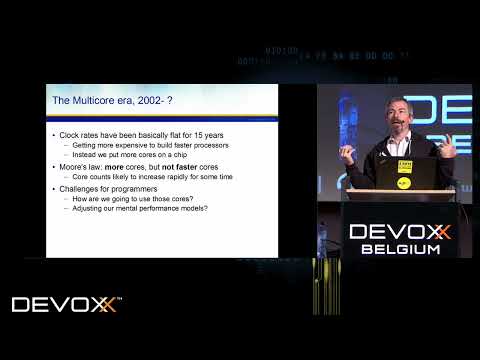 59:21
A Crash Course in Modern Hardware by Cliff Click
21K views • 9 years ago
Devoxx
Cliff Click walks through a small performance example on a modern out-of-order CPU. He covers pipelining, ILP, CISC vs RISC, multicore, and why cache misses and the memory subsystem dominate performance.
 1:32:33
C++ and Beyond 2012: Herb Sutter - atomic Weapons 2 of 2
29K views • 9 years ago
alexsmail
Part two of Herb Sutter's C++ and Beyond 2012 session on atomic weapons, a deep dive into the C++ memory model, atomics, memory ordering, and hardware behavior. It ends with the modern meaning of volatile.
 39:03
RustConf 2020 - Closing Keynote by Siân Griffin
10K views • 6 years ago
Rust Programming Language
RustConf 2020 closing keynote by Sian Griffin that dives into Pokemon Blue glitches, notably Missingno and arbitrary-code-execution tricks. It uses them to explain how memory unsafety works and how memory-safe languages like Rust prevent such bugs.
 1:04:33
CppCon 2014: Jeff Preshing "How Ubisoft Develops Games for Multicore - Before and After C++11"
53K views • 12 years ago
CppCon
CppCon 2014 talk by Jeff Preshing on how Ubisoft Montreal developed games for multicore hardware, before and after C++11 concurrency support. It goes into atomics and lock-free programming in practice.
 20:37
The riddle of experience vs. memory | Daniel Kahneman
1.5M views • 16 years ago
TED
In this TED talk, Nobel laureate Daniel Kahneman distinguishes the experiencing self from the remembering self, using examples such as vacations and colonoscopies. He explains how the two perceive happiness differently and what that means for economics, policy and self-awareness.
 17:49
Shenzhen: A New Breed of Intellectual Property (Part 3) | Future Cities | WIRED
172K views • 10 years ago
Uncanny Valley by WIRED
Part 3 of WIRED's Future Cities series on Shenzhen. It examines how attitudes toward patents and intellectual property differ from the West, and how shanzhai (copycat) manufacturing created an ecosystem of rapid iteration and distribution.
 6:06
Strong Towns: Property Tax vs. Land Value "Tax" (LVT)
61K views • 10 years ago
John Snow
Chuck Marohn of Strong Towns explains how a land value tax differs from an ordinary property tax, why it makes economic sense, and why it is rarely used. It is a short six-minute explainer.
 56:49
Escape from the Heap: Low-Level Programming in Common Lisp
17K views • 10 years ago
Arthur Gleckler
Ahmon Dancy of Franz Inc explains low-level programming in Common Lisp, including off-heap data structures used in AllegroGraph to manage memory outside the garbage collector.
 31:17
[Minecraft Computer Engineering] - Quad-Core Redstone Computer v5.0 [12k sub special!]
3.6M views • 7 years ago
legomasta99
A showcase of the author's fifth-generation quad-core computer built entirely from Minecraft redstone, after two years of development. It features cache, a hardware stack, a GPU driving a 15x15 display, and serial I/O ports.