course
 11:11
The Agricultural Revolution: Crash Course World History #1
17.7M views • 14 years ago
CrashCourse
The first episode of Crash Course World History, in which John Green covers the shift from hunting and gathering to agriculture and how it shaped civilization. It is delivered fast and with jokes.
 4:00
Basic Beginners FreeCAD v1.0 : Introduction to Course
264K views • 1 year ago
MangoJelly Solutions for FreeCAD
The introduction to MangoJelly's beginner course for FreeCAD 1.0. The course teaches solid modeling with the Part Design, Sketcher and Part workbenches.
 7:49
Crash Course - The SMIDSY
288K views • 17 years ago
lbtv
A motorcycle safety video on the SMIDSY (sorry mate, I didn't see you) accident, explaining the perception and optical illusion that makes drivers fail to see riders, and how riders can spot the signs and avoid it.
 14:36
Distributed Systems 1.1: Introduction
382K views • 6 years ago
Martin Kleppmann
The first lecture in Martin Kleppmann's 8-lecture distributed systems series from the University of Cambridge undergraduate course. It introduces the subject, and accompanying lecture notes are available.
Topic match · University lectures & courses 17:26
Lecture 1 | Programming Paradigms (Stanford)
1.2M views • 18 years ago
Stanford
The first lecture of Stanford's CS107 Programming Paradigms, taught by Jerry Cain, giving an overview of the course. The course goes from C and assembly through C++, concurrency, Scheme and Python.
Topic match · University lectures & courses 9:18
The Most IMPORTANT Video You'll Ever See (part 1 of 8)
5.4M views • 19 years ago
wonderingmind42
Part 1 of a lecture by physicist Albert Bartlett on the exponential function and its consequences for population growth, resource use and energy. It argues that steady growth rates quickly lead to enormous quantities.
Topic match · University lectures & courses 5:04
30 Essential Ideas you should know about ADHD, 1A Intro, Chronic Developmental Disability
792K views • 12 years ago
Adhd Videos
The first clip from Russell Barkley's 30 Essential Ideas about ADHD series, introducing ADHD as a chronic developmental disability. It is part of a lecture series on the disorder by a leading ADHD researcher.
Topic match · University lectures & courses 17:37
Kurt Vonnegut, Shape of Stories (subtitulos castellano)
2.2M views • 8 years ago
Eva CollinsAlonso
Kurt Vonnegut's 2004 Case College lecture, with Spanish subtitles, in which he sketches the shapes of stories on a blackboard. He plots story arcs as good and bad fortune against time.
Topic match · University lectures & courses 5:56
Special Topics - The Kalman Filter (1 of 55) What is a Kalman Filter?
660K views • 11 years ago
Michel van Biezen
The first video in a 55-part series by Michel van Biezen that introduces the Kalman filter and builds from the rationale through algebraic examples to the full matrix treatment. The videos are short, blackboard-style lectures.
Topic match · University lectures & courses 19:32
Control Bootcamp: Overview
560K views • 9 years ago
Steve Brunton
The opening lecture of Steve Brunton's Control Bootcamp, covering the kinds of control and why closed-loop feedback matters. It starts a series that follows the control chapter of the Brunton and Kutz data-driven science book.
Topic match · University lectures & courses 10:00
SICP / What is "Computer Science" ?
131K views • 20 years ago
LarryNorman
An excerpt from Hal Abelson's opening SICP lecture introducing computer science and contrasting declarative and imperative knowledge. He argues that computer science is not really a science and is more like magic or engineering of ideas.
Topic match · University lectures & courses 12:46
The Speed of Light is NOT About Light
7.1M views • 11 years ago
PBS Space Time
PBS Space Time argues that the speed of light is better understood as the speed of causality, the universal limit on how fast cause and effect propagate. Light travels at that speed because it is massless, but the limit itself is a property of spacetime.
Topic match · Fundamental physics 19:05
Why No One Has Measured The Speed Of Light
24.3M views • 6 years ago
Veritasium
Veritasium explains why the one-way speed of light has never been measured, only the round-trip speed, since measuring it requires synchronized clocks that assume the answer. It explores the implications for relativity.
Topic match · Fundamental physics 11:33
A new way to visualize General Relativity
3.6M views • 6 years ago
ScienceClic English
ScienceClic explains why the rubber sheet analogy for general relativity is misleading and offers a new visualization that includes the curvature of time and shows gravity as motion through curved spacetime.
Topic match · Fundamental physics 4:19
How Special Relativity Makes Magnets Work
4M views • 13 years ago
Veritasium
Veritasium explains magnetism as a consequence of special relativity. Length contraction of moving charges makes a current in a wire attract or repel a nearby moving charge.
Topic match · Fundamental physics 14:48
The Biggest Misconception About Electricity
28.2M views • 4 years ago
Veritasium
Veritasium argues that electric energy is carried by fields around the wires rather than by electrons moving through them, using a thought experiment with a large circuit.
Topic match · Fundamental physics 6:33
The Biggest Ideas in the Universe: Introduction
384K views • 6 years ago
Sean Carroll
Sean Carroll introduces his video series on the biggest ideas in physics, such as symmetry, space and matter, as informal discussions with follow-up Q&A videos. This is the short opening video of the series.
Topic match · Fundamental physics 7:35
Feynman: Magnets (and Why?) FUN TO IMAGINE 4/ higher quality version!
359K views • 8 years ago
Christopher Sykes
A 1983 BBC interview in which Richard Feynman is asked how magnets work and explains why 'why' questions are hard to answer in everyday terms. He reflects on what counts as an explanation and the limits of analogy.
Topic match · Fundamental physics 17:34
What Everyone Gets Wrong About Gravity
15.6M views • 6 years ago
Veritasium
Veritasium explains, with expert input, that in general relativity gravity is not a force and objects follow straight paths through curved spacetime, including why standing on the ground means you are accelerating.
Topic match · Fundamental physics 7:23
How Trees Bend the Laws of Physics
5M views • 14 years ago
Veritasium
Veritasium explains how trees lift water from roots to the top of tall trunks, using transpiration pull and the negative pressure that liquid water can sustain. It explains why trees do not need pumps or valves.
Topic match · Fundamental physics 13:02
Noether's Theorem and The Symmetries of Reality
1.1M views • 8 years ago
PBS Space Time
PBS Space Time explains Noether's theorem: conservation laws such as energy and momentum are consequences of deeper symmetries. It also covers why those laws hold only under certain conditions.
Topic match · Fundamental physics 7:33
Richard Feynman. Why.
5.5M views • 14 years ago
firewalker
A short clip of Richard Feynman answering an interviewer's question about why magnets repel, explaining that a 'why' question depends on a shared framework of understanding. It illustrates how hard it is to explain fundamentals to a layperson.
Topic match · Fundamental physics 5:55
Richard Feynman talks about light
1.8M views • 19 years ago
sdfhsfh
A PBS clip in which Richard Feynman explains the strange nature of light and electromagnetic radiation. He conveys how little of it we actually see and how radio waves are present everywhere.
Topic match · Fundamental physics 11:44
World's Roundest Object!
38.5M views • 13 years ago
Veritasium
Veritasium explains the effort to redefine the kilogram, which was still defined by a physical artifact, and how a near-perfect silicon sphere from the Avogadro project helps. It also covers the history of the unit's odd naming.
Topic match · Fundamental physics 7:07
Feynman: What things really are like FUN TO IMAGINE 1
747K views • 17 years ago
Christopher Sykes
A clip from the 1983 BBC series Fun to Imagine in which Richard Feynman explains heat as the jiggling of atoms and how we perceive it as hot and cold.
Topic match · Fundamental physics 11:22
Most People Don't Know How Bikes Work
24.9M views • 4 years ago
Veritasium
Veritasium explains why bicycles are stable, arguing that gyroscopic effects are not the answer. The video shows countersteering and an experiment where riders blocked from steering the opposite way cannot turn.
Topic match · Fundamental physics 15:29
How Time Becomes Space Inside a Black Hole | Space Time
2.5M views • 9 years ago
PBS Space Time
A PBS Space Time episode explaining how space and time swap roles inside a black hole's event horizon. It is part of the channel's black hole series.
Topic match · Fundamental physics 9:19
How to Understand What Black Holes Look Like
11M views • 7 years ago
Veritasium
Veritasium explains what a black hole should look like, using J.P. Luminet's 1979 work and a cardboard 3D model to show how light bends around it. It was made just as the first black hole image was released.
Topic match · Fundamental physics 9:49
How We're Redefining the kg
2.8M views • 9 years ago
Veritasium
Veritasium explains why the kilogram is being redefined in terms of Planck's constant rather than a physical metal artifact. It visits NIST to show the Kibble balance and why measuring mass precisely is hard.
Topic match · Fundamental physics 10:48
The True Nature of Matter and Mass | Space Time | PBS Digital Studios
1.8M views • 10 years ago
PBS Space Time
A PBS Space Time episode asking what matter, mass, and energy really are, starting with inertial versus gravitational mass and what mass-energy equivalence means.
Topic match · Fundamental physics 10:00
Is The Alcubierre Warp Drive Possible? | Space Time | PBS Digital Studios
2.5M views • 11 years ago
PBS Space Time
PBS Space Time introduces Miguel Alcubierre's warp drive, explaining how spacetime itself could be warped rather than moving a ship through it, and whether it is physically possible.
Topic match · Fundamental physics 18:04
How the Higgs Mechanism Give Things Mass
1.9M views • 4 years ago
PBS Space Time
A PBS Space Time episode on how the Higgs mechanism gives particles mass, prompted by Fermilab's heavier-than-expected W boson measurement. It goes beyond the usual pop-science treatment without heavy math.
Topic match · Fundamental physics 7:33
Richard Feynman Magnets
999K views • 17 years ago
nebulajr
A short clip of Richard Feynman answering an interviewer's question about how magnets work, in which he explains why a why-question has no simple answer without a shared frame of reference.
Topic match · Fundamental physics 7:24
Cosmos - Carl Sagan - 4th Dimension
5.4M views • 17 years ago
carlsagandotcom
A segment from Carl Sagan's original Cosmos explaining the fourth spatial dimension through analogy with a two-dimensional world and shadow projection.
Topic match · Fundamental physics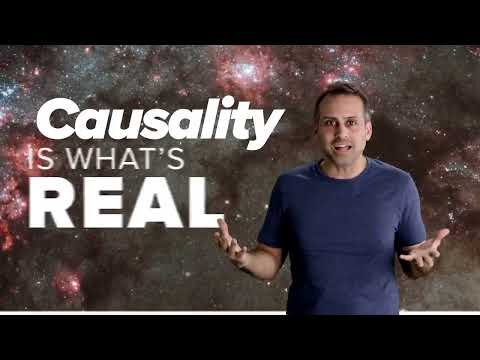 8:55
Are Space and Time An Illusion?
3.3M views • 11 years ago
PBS Space Time
A PBS Space Time episode hosted by Gabe Perez-Giz on the nature of spacetime and whether space and time are fundamental. It builds up reference frames and causality in a short, dense format.
Topic match · Fundamental physics 19:59
What Happens at the Event Horizon? | Space Time | PBS Digital Studios
3.2M views • 9 years ago
PBS Space Time
PBS Space Time explains what happens as you approach and cross a black hole's event horizon, using Penrose diagrams and light cones as the tool for understanding spacetime there.
Topic match · Fundamental physics 10:24
Why does light slow down in water?
1.3M views • 7 years ago
Fermilab
Fermilab's Don Lincoln explains why light travels slower in water and glass. He knocks down common wrong explanations such as absorption and re-emission, then gives the wave-mechanics reason tied to refractive index.
Topic match · Fundamental physics 11:33
Light Waves Visualized using Photon Sieves.
69K views • 6 years ago
Huygens Optics
Huygens Optics shows how DIY photon sieves shape a laser's wave front, explaining how they differ from zone plates and how aperture count affects the focal point, with time-resolved visualizations of the diffraction.
Topic match · Fundamental physics 16:58
Reynolds Number - Numberphile
560K views • 7 years ago
Numberphile
Numberphile with Tom Crawford of Oxford explains the Reynolds number, the second of three videos on Navier-Stokes and fluid flow, with demonstrations of laminar versus turbulent behavior.
Topic match · Fundamental physics 6:35
The Maths of General Relativity (1/8) - Spacetime and Worldlines
421K views • 5 years ago
ScienceClic English
The first of an eight-part ScienceClic series building general relativity, covering worldlines, proper time and coordinate systems with animated visualizations.
Topic match · Fundamental physics