eq
 16:55
How economic inequality harms societies | Richard Wilkinson
1.3M views • 15 years ago
TED
Richard Wilkinson presents data showing that societies with larger income gaps do worse on health, lifespan, trust and other measures. He argues the effects track inequality itself rather than average income. It is a 17-minute TED talk.
 5:50
Nick Hanauer on inequality
1.3M views • 14 years ago
WatchExtraVideo
Nick Hanauer's short TED University talk on economic inequality, which was famously not posted on TED's main site at first. He argues that rich people are not the job creators.
 17:04
The dirty secret of capitalism -- and a new way forward | Nick Hanauer
3.2M views • 7 years ago
TED
A TED talk by entrepreneur Nick Hanauer arguing that decades of 'greed is good' economic theory drove inequality and instability. He proposes an economics built on reciprocity and cooperation.
Topic match · Labor, work & inequality 20:27
Beware, fellow plutocrats, the pitchforks are coming | Nick Hanauer
1.6M views • 12 years ago
TED
Billionaire Nick Hanauer warns fellow wealthy people in a TED talk that growing inequality could lead to social upheaval like pre-revolutionary France. He argues a higher minimum wage would grow the middle class and prosperity.
Topic match · Labor, work & inequality 35:12
Jake Archibald on the web browser event loop, setTimeout, micro tasks, requestAnimationFrame, ...
808K views • 8 years ago
JSConf
Jake Archibald's JSConf.Asia 2018 talk "In the Loop" explains the browser event loop, covering tasks, microtasks, requestAnimationFrame, and how rendering interleaves with JavaScript. It uses visual walkthroughs to show why code runs in surprising orders and why setTimeout fixes are unreliable.
 1:00:56
Winners Take All | Anand Giridharadas | Talks at Google
252K views • 8 years ago
Talks at Google
Anand Giridharadas presents his book Winners Take All at Google, arguing that the global elite's philanthropy and 'win-win' framing preserve the systems that create inequity. He challenges the audience, including Google employees, to examine their own role in that system.
Topic match · Labor, work & inequality 18:38
How the US Is Destroying Young People’s Future | Scott Galloway | TED
8.2M views • 2 years ago
TED
Scott Galloway's TED talk uses data to argue that young Americans are financially worse off than earlier generations, calling it a great intergenerational theft. He covers root causes and what could change it.
Topic match · Labor, work & inequality 4:57
Rich Hickey rants about HttpServletRequest in 1080p: Death By Specificity from Clojure Made Simple
43K views • 6 years ago
Fred Overflow
A five-minute excerpt of Rich Hickey's Clojure Made Simple talk, with new slides, ranting about HttpServletRequest and specificity. He argues for using generic maps instead of many specific classes and getters.
 15:14
Velocity 2011: Jon Jenkins, "Velocity Culture"
52K views • 15 years ago
O'Reilly
Amazon's Jon Jenkins at Velocity 2011 on how operations can drive revenue and on Amazon's highly available, autonomous architectures. It includes details on deployment frequency and Amazon's move to AWS.
 11:47
!!Con 2017: HDR Photography in Microsoft Excel?! by Kevin Chen
119K views • 9 years ago
Confreaks
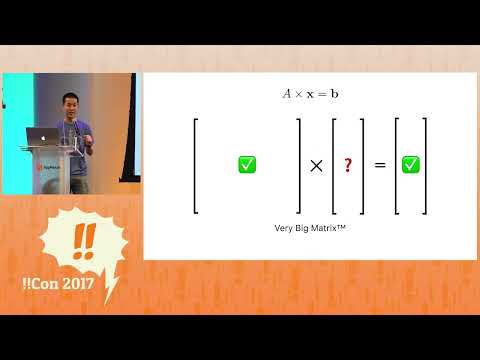
A short conference talk from !!Con 2017 in which Kevin Chen explains the HDR imaging algorithm from a foundational paper, framing it as a system of linear equations, and implements it in a Microsoft Excel spreadsheet. No prior image processing knowledge is needed.
 1:03:42
re:publica 2012 - Eben Moglen - Freedom of Thought Requires Free Media
44K views • 14 years ago
re:publica
Eben Moglen's re:publica 2012 talk argues that media which spy on and data-mine the public threaten freedom of thought, and that free technology and free culture are needed to protect it.
 47:52
Finding the Missing Memristor - R. Stanley Williams
133K views • 16 years ago
The Qualcomm Institute
R. Stanley Williams of HP Labs gives a keynote on the memristor, covering the physics, crossbar computation, and potential for memory and new computer architectures.
Topic match · Electronics & circuit design 1:03:22
What your Differential Pairs Wish You Knew with Rick Hartley - AltiumLive Keynote
107K views • 7 years ago
Altium
Rick Hartley's AltiumLive keynote on differential pairs in PC boards. He argues the rules from cables and twisted pairs do not carry over, and covers which pair geometry gives the best impedance control, the right spacing, routing practice and how much skew is acceptable.
Topic match · Electronics & circuit design 45:38
BlueHat IL 2019 - Andrew "bunnie" Huang - Supply Chain Security: "If I were a Nation State...”
21K views • 7 years ago
Microsoft Israel R&D Center
Andrew "bunnie" Huang examines how realistic hardware supply chain attacks are, from rogue insiders to nation states, in the wake of the Bloomberg Businessweek report. He explains how undocumented components could be hidden on boards and how hard they are to spot.
Topic match · Electronics & circuit design 15:42
Where in the world is it easiest to get rich? | Harald Eia | TEDxOslo
2.3M views • 10 years ago
TEDx Talks
Sociologist and comedian Harald Eia argues in a TEDxOslo talk that Nordic social democracies produce more rich people per capita than the US or UK. He credits high taxes, welfare and strong unions for creating a safety net that enables risk taking.
Topic match · Labor, work & inequality 20:03
Learning from dirty jobs | Mike Rowe
7.4M views • 17 years ago
TED
Mike Rowe, host of Dirty Jobs, shares stories from messy real-world jobs in this TED talk. He argues that hard work has been unjustly degraded in society.
Topic match · Labor, work & inequality 24:31
Introduction to LibrePCB A new, powerful and intuitive EDA tool for everyone
15K views • 8 years ago
FOSDEM
Urban Bruhin, LibrePCB's main author, introduces the open-source EDA tool at FOSDEM 2018. He explains why he started it and how its library concepts differ from KiCAD.
Topic match · Electronics & circuit design 11:48
John Rauser keynote: "Statistics Without the Agonizing Pain" -- Strata + Hadoop 2014
61K views • 12 years ago
O'Reilly
John Rauser's Strata 2014 keynote argues that programmers can learn statistics quickly by simulating random processes and shuffling data. He explains p-values through resampling rather than formulas.
Topic match · Probability & game theory 11:25
A visual guide to Bayesian thinking
2.2M views • 11 years ago
Julia Galef
Julia Galef uses pictures to explain Bayes' rule, then tells three personal stories showing how she applies it to improve her thinking.
Topic match · Probability & game theory 53:58
GDC 2010: Sid Meier Keynote - "Everything You Know is Wrong"
101K views • 16 years ago
GameSpot
Sid Meier's GDC 2010 keynote on how players perceive probability in games, including how Civilization's odds were adjusted because players misjudged them.
Topic match · Probability & game theory 1:27:44
Andrew Ng: Artificial Intelligence is the New Electricity
524K views • 9 years ago
Stanford Graduate School of Business
Andrew Ng speaks at the Stanford MSx Future Forum about how AI is transforming industry after industry, comparing its impact to electricity. The talk also touches on evil-AI worries, jobs and basic income.
Topic match · Labor, work & inequality 18:10
What prevents the poor from reaching the middle class? | VISION TALKS
37K views • 12 years ago
American Enterprise Institute
Megan McArdle's AEI Vision Talk 'Capital and Poverty' argues that social and financial capital work differently in low-income communities, and that this explains barriers to reaching the middle class.
Topic match · Labor, work & inequality 43:23
AI Ethics, Impossibility Theorems and Tradeoffs - Chris Stucchio | Crunch 2018
2K views • 7 years ago
CraftHub Events
Chris Stucchio presents the ethical principles behind algorithmic decision making and shows with examples from lending, criminology and education that they cannot all be satisfied at once. The talk frames AI fairness as a set of quantitative tradeoffs.
Topic match · Probability & game theory 31:52
Reading Silicon: How to Reverse Engineer Integrated Circuits
416K views • 9 years ago
HACKADAY
Ken Shirriff walks through how to reverse engineer integrated circuits from die photos, using famous chips as examples, in a Hackaday SuperConference talk.
Topic match · Electronics & circuit design 17:01
The mathematics of love | Hannah Fry
2M views • 11 years ago
TED
Mathematician Hannah Fry's TED talk on patterns in dating and mate-seeking, including optimal stopping and three math-backed tips for finding a partner.
Topic match · Probability & game theory 31:28
rand() Considered Harmful
16K views • 13 years ago
aghuttun
Stephan T. Lavavej's GoingNative 2013 talk explaining why calling rand() and using rand() % 100 is bad in C++, and how the C++11 <random> header does the job properly.
Topic match · Probability & game theory 55:40
Antifragille: Things That Gain from Disorder | Nassim Nicholas Taleb | Talks at Google
589K views • 13 years ago
Talks at Google
Nassim Nicholas Taleb talks at Google about his book Antifragile, on systems that gain from disorder and volatility. It draws on themes from his earlier books.
Topic match · Probability & game theory 9:16
The magic washing machine | Hans Rosling
791K views • 15 years ago
TED
Hans Rosling makes the case that the washing machine was the greatest invention of the industrial revolution. Using Gapminder graphics, he shows how electricity and economic growth free up time for reading and learning.
Topic match · Labor, work & inequality 1:07:31
The A.I. Dilemma - March 9, 2023
3.7M views • 3 years ago
Center for Humane Technology
Tristan Harris and Aza Raskin of the Center for Humane Technology present why current AI capabilities pose catastrophic societal risks. They argue companies are racing to deploy without adequate safety, and that institutions must adapt. It was given before GPT-4's launch.
 1:28:23
Quantum Computing for Computer Scientists
2.2M views • 8 years ago
Microsoft Research
An 88-minute Microsoft Research talk that explains how quantum computers beat classical ones using basic linear algebra, qubits, superposition and gates. It works through the Deutsch oracle problem and ends with entanglement, teleportation and a live demo.
 16:29
The great porn experiment | Gary Wilson | TEDxGlasgow
17.8M views • 14 years ago
TEDx Talks
Gary Wilson's TEDxGlasgow talk argues that internet pornography hyperstimulates the brain's reward system and can cause symptoms that reverse when people stop. TED notes that several claims are not supported by respected academic studies.
 1:14:52
Effective Programs - 10 Years of Clojure - Rich Hickey
176K views • 9 years ago
ClojureTV
Rich Hickey's talk at Clojure's tenth anniversary on the kind of programs Clojure is designed for. He argues for situated programs that deal with changing requirements, and for dynamic typing and data over static types.
 1:06:39
Ruby Midwest 2011 - Keynote: Architecture the Lost Years by Robert Martin
172K views • 14 years ago
Confreaks
Robert C. Martin's Ruby Midwest 2011 keynote argues that software architecture should express the application's intent rather than its framework. He covers separating entities, interactors and boundaries so the web, database and framework are details.
 1:21:13
Dr. Michael Greger | How Not To Die | Talks at Google
1.4M views • 10 years ago
Talks at Google
Dr. Michael Greger presents his book How Not to Die at Google NYC, arguing that diet and lifestyle changes can prevent or reverse many of the top causes of death. He walks through evidence on whole-food plant-based eating.
 1:16:14
Spec-ulation Keynote - Rich Hickey
135K views • 9 years ago
ClojureTV
Rich Hickey's keynote on software versioning, arguing that breaking changes are the real problem and that libraries should only grow by providing more and requiring less. It critiques semantic versioning and ties into Clojure spec.
 1:01:39
"Simple Made Easy" - Rich Hickey (2011)
434K views • 5 years ago
ClojureTV
Rich Hickey's Strange Loop 2011 keynote separates 'simple' (not intertwined) from 'easy' (familiar or near at hand) and argues that software complexity comes from complecting things. It offers a vocabulary for judging designs and abstractions.
 42:43
"Propositions as Types" by Philip Wadler
143K views • 11 years ago
Strange Loop Conference
Philip Wadler's Strange Loop talk on Propositions as Types, the link between logic and computation (the Curry-Howard correspondence). He traces its history through Church, Godel and Turing and shows how it shaped theorem provers and programming languages.
 52:11
Václav Smil at Driva Climate Investment Meeting 2019
38K views • 7 years ago
Nysnø Klimainvesteringer
Vaclav Smil's talk on historic energy transitions and what they imply for climate investment. He argues that transitions are slow, technology improves gradually, and only absolute cuts in energy use would truly work.
 1:01:45
A Talk Near the Future of Python (a.k.a., Dave live-codes a WebAssembly Interpreter)
26K views • 7 years ago
David Beazley
David Beazley's PyCon India closing keynote, in which he live-codes a stack machine and grows it into an interpreter that runs WebAssembly, then uses it to play a Rust-written game. It requires no prior WebAssembly knowledge.
 1:17:43
'Diablo': A Classic Game Postmortem
1.1M views • 10 years ago
GDC Festival of Gaming
David Brevik's GDC 2016 postmortem of Diablo covers how it went from a turn-based claymation DOS concept to a real-time action RPG, plus the story of Blizzard North and development anecdotes.