git
 14:40
How the Quantum Eraser Rewrites the Past | Space Time | PBS Digital Studios
2.9M views • 10 years ago
PBS Space Time
PBS Space Time explains the quantum eraser experiment, in which erasing which-path information appears to reverse causality in a double-slit setup. It discusses what this means for quantum mechanics.
 16:32
Pilot Wave Theory and Quantum Realism | Space Time | PBS Digital Studios
1.9M views • 9 years ago
PBS Space Time
A PBS Space Time episode introducing de Broglie-Bohm pilot wave theory, an interpretation of quantum mechanics that avoids much of the strangeness of the mainstream views. It is aimed at curious lay viewers.
 10:48
The True Nature of Matter and Mass | Space Time | PBS Digital Studios
1.8M views • 10 years ago
PBS Space Time
A PBS Space Time episode asking what matter, mass, and energy really are, starting with inertial versus gravitational mass and what mass-energy equivalence means.
 10:00
Is The Alcubierre Warp Drive Possible? | Space Time | PBS Digital Studios
2.5M views • 11 years ago
PBS Space Time
PBS Space Time introduces Miguel Alcubierre's warp drive, explaining how spacetime itself could be warped rather than moving a ship through it, and whether it is physically possible.
 19:59
What Happens at the Event Horizon? | Space Time | PBS Digital Studios
3.2M views • 9 years ago
PBS Space Time
PBS Space Time explains what happens as you approach and cross a black hole's event horizon, using Penrose diagrams and light cones as the tool for understanding spacetime there.
 9:32
The Higgs Mechanism Explained | Space Time | PBS Digital Studios
2.7M views • 10 years ago
PBS Space Time
PBS Space Time explains the Higgs field and how the Higgs mechanism gives particles mass within quantum field theory. It is a ten-minute overview for a lay audience.
 14:03
Quantum Entanglement and the Great Bohr-Einstein Debate | Space Time | PBS Digital Studios
2.6M views • 10 years ago
PBS Space Time
PBS Space Time explains the Bohr-Einstein debate over quantum mechanics and how quantum entanglement settled it. It covers the weirdness of measurement and nonlocal correlations.
 18:15
So... the minute hand shows progression — apparently we think of time in wildly different ways
706K views • 4 years ago
Technology Connextras
A Technology Connections video essay on how analog and digital clocks shape different mental models of time, with the minute hand acting as a progress indicator.
 12:24
The 1988 VIDEO Floppy Disk Camera: Canon Xap Shot RC-250
452K views • 8 years ago
LGR
LGR looks at the 1988 Canon Xap Shot, a still video camera that records photos to a floppy disk as analog NTSC signal rather than digital data.
Topic match · Audio & video engineering 19:42
But what is the Fourier Transform? A visual introduction.
12.6M views • 8 years ago
3Blue1Brown
3Blue1Brown's animated visual introduction to the Fourier Transform, showing how a signal breaks into frequency components.
Topic match · Information theory & signal processing 7:49
America Keeps Rejecting an ID Card It Already Has
13.6M views • 9 years ago
CGP Grey
CGP Grey explains the history of the US Social Security card and number, and why they became a de facto national ID despite never being meant for it. He also covers why America resists a proper identity card.
Topic match · Privacy, surveillance & cybercrime 18:07
The more general uncertainty principle, regarding Fourier transforms
2.3M views • 8 years ago
3Blue1Brown
3Blue1Brown shows how the uncertainty principle arises from Fourier transforms. A wave packet cannot be narrow in both position and frequency, so the principle is a property of waves rather than of measurement.
Topic match · Information theory & signal processing 15:12
JPEG DCT, Discrete Cosine Transform (JPEG Pt2)- Computerphile
697K views • 11 years ago
Computerphile
Mike Pound explains the discrete cosine transform and how it underpins JPEG compression. It is part two of Computerphile's JPEG series.
Topic match · Information theory & signal processing 18:31
Fourier Optics used for Optical Pattern Recognition
103K views • 6 years ago
Huygens Optics
Huygens Optics explains the Fourier transform and shows how a lens performs one optically. A DLP projector is used as a Fourier filter to do simple pattern recognition on lithographic character patterns.
Topic match · Information theory & signal processing 7:39
Propaganda Games: Sesame Credit - The True Danger of Gamification - Extra Credits
2M views • 10 years ago
Extra Credits
An Extra Credits episode on China's Sesame Credit, which gamifies obedient citizenship through a social score. It covers how the system rewards conformity and pressures people through their friends' behavior.
Topic match · Privacy, surveillance & cybercrime 19:40
How I Designed a Free Music Font for 5 Million Musicians (MuseScore 3.6)
608K views • 5 years ago
Tantacrul
Tantacrul explains how he and engraver Simon Smith designed the free music notation font for MuseScore 3.6. It draws on the history of the SCORE notation application by Leland Smith.
Topic match · Linux & open-source ecosystems 9:37
Characters, Symbols and the Unicode Miracle - Computerphile
2.1M views • 13 years ago
Computerphile
Tom Scott explains for Computerphile how Unicode and UTF-8 grew out of messy older character encodings to become the web's standard. It covers why the design works and how it handles worldwide text.
Topic match · Information theory & signal processing 14:27
Why is TV 29.97 frames per second?
2.2M views • 10 years ago
Stand-up Maths
Matt Parker explains the history behind NTSC television running at 29.97 frames per second rather than 30, tracing it to the backward-compatible addition of color. He walks through the arithmetic behind the odd ratio.
Topic match · Audio & video engineering 4:26
British Plugs Are Better Than All Other Plugs, And Here's Why
7.6M views • 12 years ago
Tom Scott
Tom Scott explains the design of the British BS 1363 plug and socket, including fuses, shutters and safety features, and why he thinks it beats other plugs.
Topic match · Electronics & circuit design 11:23
How a transistor works
847K views • 11 years ago
Ben Eater
Ben Eater gives a detailed look at how an NPN bipolar junction transistor works and what it does. It is an eleven-minute explanation aimed at building real understanding of the device.
Topic match · Electronics & circuit design 4:38
The Only Safe Phone Is One Even the Police Can't Unlock
4.1M views • 10 years ago
CGP Grey
A five-minute CGP Grey explainer arguing that a phone is effectively an extension of your mind, and that any backdoor or master key into encrypted devices will inevitably be abused or leaked. It frames the encryption debate as locks that are either unbreakable or absent.
Topic match · Privacy, surveillance & cybercrime 7:00
CD / Color
2.9M views • 6 years ago
Captain Disillusion
Captain Disillusion's comedic, fast-paced explainer on how color works in cameras, displays and video. It covers the biology of color perception and what it means for screens.
Topic match · Audio & video engineering 13:55
Segmented Displays
7.2M views • 4 years ago
Posy
Posy explores segmented displays, from the seven-segment display to alternative designs with fewer or more segments, with patents and history.
Topic match · Audio & video engineering 11:28
Here's What's Preventing You From Finishing Projects
147K views • 5 years ago
Zack Freedman
Zack Freedman gives advice on why makers fail to finish projects, including scrapping bad ideas, showing work publicly and writing a plan that keeps projects fun. It is aimed at hardware DIY but generalizes.
Topic match · 3D printing, CNC & maker projects 12:31
The Superheterodyne Radio: No really, that's its name
987K views • 7 years ago
Technology Connections
Technology Connections explains why the superheterodyne radio has its name and how mixing frequencies lets it tune stations well. It walks through the underlying wave phenomena and algebra and why the design solved a hard tuning problem.
Topic match · Electronics & circuit design 4:20
Why Snow and Confetti Ruin YouTube Video Quality
10.4M views • 10 years ago
Tom Scott
Tom Scott explains why confetti and snow wreck video quality, using interframe compression and bitrate. He demonstrates it live by changing the quality on screen.
Topic match · Information theory & signal processing 13:14
How Analog Color TV Works: The Beginnings
503K views • 8 years ago
Technology Connections
Technology Connections explains the early history of analog color television, from the 1954 start of modern color broadcasting, and how shadow masks work in CRTs. It is the first in a series on how analog color TV works.
Topic match · Audio & video engineering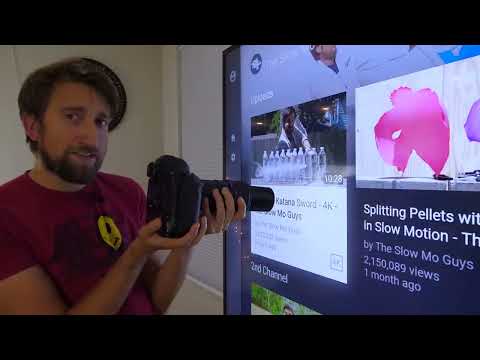 11:39
How a TV Works in Slow Motion - The Slow Mo Guys
45.7M views • 8 years ago
The Slow Mo Guys
The Slow Mo Guys film a TV and screens with a high-speed camera to show how displays build an image. The footage includes CRT-style scanning and how pixels light up over time.
Topic match · Audio & video engineering 16:29
Why Sony's Beta Videotape System Failed--and failed hard (Part 1)
1.5M views • 9 years ago
Technology Connections
Part one of Technology Connections' account of the VHS versus Betamax format war. It argues Sony was caught off guard by JVC's cheaper, more practical VHS system.
Topic match · Audio & video engineering 9:16
Floating Point Numbers - Computerphile
2.5M views • 12 years ago
Computerphile
Tom Scott explains for Computerphile how floating point numbers work, why moving the binary point is fast, and why it handles money badly.
Topic match · Information theory & signal processing 11:18
The simple, clever sensor behind automatic windshield wipers
1.8M views • 2 years ago
Technology Connections
Technology Connections explains how automatic windshield wiper rain sensors work, using an infrared light source and total internal reflection in the glass.
Topic match · Electronics & circuit design 9:27
What is a Geometry Kernel? C3D vs ACIS vs Parasolid
25K views • 4 years ago
nickkallen1
The Plasticity creator explains what a geometry kernel is and compares commercial options C3D, ACIS, and Parasolid, describing his months of research and why he chose as he did.
Topic match · 3D printing, CNC & maker projects 13:09
Moon Landings Faked? Filmmaker Says Not!
1.4M views • 13 years ago
VideoFromSpace
A filmmaker explains why the Apollo moon landing footage could not have been faked in a studio, based on the video and film technology of the late 1960s. He walks through the limits of cameras, frame rates and effects of the era.
Topic match · Audio & video engineering 5:31
The hidden background noise that can catch criminals
5.8M views • 4 years ago
Tom Scott
Tom Scott explains Electrical Network Frequency analysis, where hum from the power grid in a recording is matched against grid logs to date and place it. He talks to a researcher and sets them a challenge.
Topic match · Privacy, surveillance & cybercrime 15:00
The Material Science of Metal 3D Printing
2.7M views • 7 years ago
Real Engineering
Real Engineering explains the materials science behind metal 3D printing, including crystal structure, laser sintering, and why printed parts develop fatigue cracks. It shows how process imperfections limit the strength of printed metal.
Topic match · 3D printing, CNC & maker projects 12:32
Protecting Privacy with MATH (Collab with the Census)
451K views • 7 years ago
minutephysics
minutephysics, in collaboration with the US Census Bureau, explains differential privacy and why the 2020 census adds noise to protect individuals' data. It walks through how statistics can leak private information.
Topic match · Privacy, surveillance & cybercrime 14:48
Is 5G Spelling Our DOOM?! How EM Waves Can Hurt
4.2M views • 6 years ago
ElectroBOOM
ElectroBOOM examines whether 5G and other electromagnetic waves can harm people, explaining the EM spectrum and the difference between ionizing and non-ionizing radiation. It includes experiments and measurements in his usual humorous style.
Topic match · Electronics & circuit design 19:17
How Wrong Is VERITASIUM? A Lamp and Power Line Story
4.4M views • 4 years ago
ElectroBOOM
ElectroBOOM's Mehdi Sadaghdar responds to Veritasium's lamp-and-long-wire puzzle, analysing it as an electrical engineer. He covers where the original framing misleads and the role of stray capacitance.
Topic match · Electronics & circuit design 17:04
These Are Not Pixels: Revisited
611K views • 8 years ago
Technology Connections
Technology Connections follows up on his analog TV video to clear up the debate over whether CRT phosphor dots are pixels. He explains the shadow mask, color triads and how they relate to the scanned picture.
Topic match · Audio & video engineering 15:14
The most deadly project on the Internet
6.8M views • 4 years ago
bigclivedotcom
BigClive explains why microwave oven transformer projects are extremely dangerous, since the high voltage and high current can kill. He contrasts them with spot welder builds where the secondary is replaced by low-voltage heavy wire.
Topic match · Electronics & circuit design