haskell
 1:04:16
Simon Peyton-Jones: Escape from the ivory tower: the Haskell journey
170K views • 9 years ago
Churchill College, University of Cambridge
Simon Peyton Jones gives Churchill College's annual computer science lecture on Haskell's birth and evolution. He covers the most influential ideas, from laziness to monads and type system evolution, plus current developments and guesses about the future.
 16:04
Redoing Make - Haskell from Scratch #1
57K views • 13 years ago
jekor
The first episode of a screencast series building djb's redo build system from scratch in Haskell. It explains the purpose of redo, writes initial code and sets up a GitHub repository.
 1:50:07
JSON Parser 100% From Scratch in Haskell (only 111 lines)
205K views • 6 years ago
Tsoding
Tsoding live-codes a JSON parser from scratch in Haskell in about 111 lines, using only the standard library. It is an edited Twitch stream that explains the intuition behind parser combinators, functors, applicatives and monads.
 1:07:28
CUFP 2011 Keynote: Pragmatic Haskell (Lennart Augustsson Standard Chartered Bank)
7K views • 14 years ago
anilmvs
Lennart Augustsson's CUFP 2011 keynote covers using Haskell commercially at Standard Chartered Bank. He discusses non-standard Haskell implementations, including a strict dialect, and weighs strict against lazy evaluation.
 1:33:37
Adventure with Types in Haskell - Simon Peyton Jones (Lecture 1)
69K views • 12 years ago
jasonofthel33t
Simon Peyton Jones's first lecture on types in Haskell from the Oregon Programming Languages Summer School 2013. It covers type classes and how they relate to OOP, subtyping and polymorphism.
 6:23
Simon Peyton Jones - Haskell is useless
385K views • 14 years ago
bunidanoable
A short clip of Simon Peyton Jones talking about the future of programming languages, saying Haskell is useless in the sense that pure programs cannot have effects, while mainstream languages are useful but unsafe. He describes languages converging, with ideas such as STM and LINQ moving between them.
 1:19:57
Simon Peyton Jones: Data Parallel Haskell
28K views • 16 years ago
nuACM
Simon Peyton Jones explains nested data parallelism and Data Parallel Haskell, an approach to exploiting multicore and distributed hardware while keeping a simple single-control-flow programming model.
 41:53
Gabriella Gonzalez – How to market Haskell to a mainstream programmer
8K views • 6 years ago
Konfy
Gabriella Gonzalez argues that developers misunderstand marketing as deception or hype, and applies the technology-adoption ideas of Crossing the Chasm to Haskell. She looks at what keeps Haskell from reaching mainstream programmers and what a community can do about it.
 1:03:34
Simon Peyton Jones - Linear Haskell: practical linearity in a higher-order polymorphic language
19K views • 8 years ago
Curry On!
Simon Peyton Jones presents linear types for Haskell, showing how practical linearity can fit into a higher-order polymorphic language. The talk covers motivations such as resource handling and relates the ideas to Rust.
 1:17:07
Alexis King - “Effects for Less” @ ZuriHac 2020
25K views • 6 years ago
Zürich Friends of Haskell
Alexis King's ZuriHac 2020 talk on how effect systems in Haskell can be implemented efficiently. It looks at the performance cost of effect libraries and how to reduce it.
Topic match · Functional programming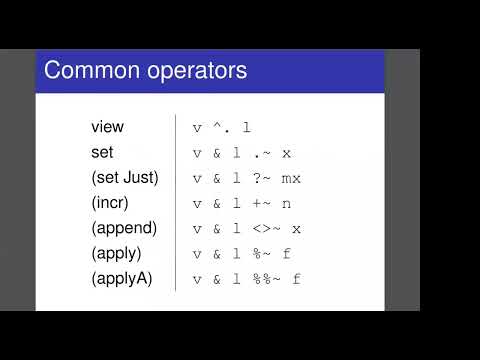 47:19
John Wiegley: Putting Lenses to Work
13K views • 9 years ago
Bay Area Haskell
John Wiegley's BayHac 2017 talk walks through Haskell lenses by example, showing many practical uses beyond simple record access. It is aimed at people who want to become productive with the lens library.
Topic match · Functional programming 1:42:53
Edward Kmett - Type Classes vs. the World
36K views • 11 years ago
Boston Haskell
Edward Kmett speaks at the Boston Haskell meetup about type classes and the design tradeoffs of global coherence compared with other approaches to implicit instances. It covers why uniqueness of instances matters for reasoning and refactoring.
Topic match · Programming language design 1:54:46
Lenses, Folds, and Traversals
54K views • 13 years ago
Edward Kmett
Edward Kmett's talk to the NY Haskell User Group on the lens library, building from fmap and function composition up to lenses, folds and traversals. It shows how these composable combinators access and modify parts of data structures.
Topic match · Functional programming 1:04:35
The Algebra of Algebraic Data Types
27K views • 13 years ago
London Haskell
A London Haskell talk on the algebra of algebraic data types, showing how sum and product types behave like arithmetic. It frames types as numbers obeying algebraic laws.
Topic match · Functional programming 4:00
Hitler reacts to functional programming
275K views • 7 years ago
Rymdkraftverk
A Downfall-style parody in which Hitler rages about functional programming concepts such as monads and Haskell. It runs about four minutes.
Topic match · Functional programming 29:59
John Carmack's keynote at Quakecon 2013 part 4
139K views • 13 years ago
Kostiantyn Kostin
Part 4 of John Carmack's QuakeCon 2013 keynote, covering OpenGL, functional programming, Haskell, Lisp and Scheme, typing, multithreading, events and garbage collection.
Topic match · Functional programming 2:49:19
John Carmack Keynote - Quakecon 2013
101K views • 13 years ago
IGN
John Carmack's roughly three-hour QuakeCon 2013 keynote, delivered from a few bullet points. Topics include his Haskell experiments with functional programming and static typing, game state, and cloud gaming.
Topic match · Functional programming 1:26:11
Succinct Data Structures
9K views • 12 years ago
Edward Kmett
Edward Kmett's 2013 talk at Prezi in Budapest on succinct data structures, which store data in close to the information-theoretic minimum space while supporting fast queries. It ties together the research and walks through his Haskell succinct library.
Topic match · Functional programming 1:07:10
Brian Beckman: Don't fear the Monad
415K views • 13 years ago
jasonofthel33t
Microsoft's Brian Beckman gives an hour-long, whiteboard-style walk through monads, building from function composition and monoids using school-level math. It is aimed at practicing programmers rather than category theorists.
Topic match · Functional programming 46:46
Category Theory 1.1: Motivation and Philosophy
394K views • 10 years ago
Bartosz Milewski
The first lecture in Bartosz Milewski's category theory series for programmers. It covers the motivation and philosophy behind category theory and why composition matters for handling complexity.
Topic match · Functional programming 1:30:45
The Simple Essence of Automatic Differentiation - Conal Elliott
17K views • 8 years ago
Microsoft Research
Conal Elliott presents his paper on automatic differentiation, deriving a simple, generalized AD algorithm from a natural specification. Varying the representation of derivatives yields forward and reverse mode algorithms that avoid the complexity and statefulness of backpropagation.
Topic match · Functional programming 1:12:14
Beyond functional programming: a taste of Verse. Simon Peyton Jones & Tim Sweeney | Lambda Days 2023
30K views • 3 years ago
Code Sync
A Lambda Days keynote by Simon Peyton Jones and Tim Sweeney introducing Verse, Epic's functional logic language for the metaverse. It covers existential variables, unification and expressions yielding multiple values.
Topic match · Functional programming 43:31
Analyzing Programs with Z3
24K views • 10 years ago
Compose Conference
Tikhon Jelvis's Compose Conference talk on using the Z3 SMT solver to analyze and verify programs, including checking invariants with bounded loops. He demonstrates verifying programs in a small language by compiling them to Z3.
Topic match · Functional programming 49:47
Monads and Gonads
148K views • 13 years ago
Google TechTalks
Douglas Crockford's Google Tech Talk explains monads without category theory or Haskell, implementing them in JavaScript and tying them to Ajax and promises. He also touches on odd asides such as coloring code by scope.
Topic match · Functional programming 53:22
Ruby Conf 12 - Y Not- Adventures in Functional Programming by Jim Weirich
65K views • 13 years ago
Confreaks
Jim Weirich's RubyConf 2012 talk derives the Y combinator step by step, live-coding in Ruby lambdas. It builds up an understanding of functional programming and lambda calculus from first principles.
Topic match · Functional programming 49:55
How Python was Shaped by leaky Internals, Armin Ronacher, Flask framework
20K views • 10 years ago
Видео с мероприятий {speach!
Armin Ronacher, creator of Flask, explains how CPython's internals and C API leak into the language's semantics. Using examples like the complexity of the add operation, he shows why Python is hard to optimize or reimplement.
Topic match · Programming language design 42:03
The Soul of Erlang and Elixir • Sasa Juric • GOTO 2019
384K views • 7 years ago
GOTO Conferences
Sasa Juric explains what makes Erlang and Elixir suited to server-side systems, focusing on the BEAM concurrency model rather than syntax or ecosystem. He demonstrates processes, supervision, and fault tolerance.
Topic match · Functional programming 1:01:39
"Simple Made Easy" - Rich Hickey (2011)
219K views • 5 years ago
Strange Loop Conference
Rich Hickey's Strange Loop 2011 keynote distinguishing 'simple' (not intertwined) from 'easy' (familiar or near at hand). It argues that software complexity comes from complecting things and that we should pick simple constructs.
Topic match · Functional programming 25:06
"Making Impossible States Impossible" by Richard Feldman
63K views • 10 years ago
elm-conf
Richard Feldman's elm-conf talk on designing models so that bugs from impossible application states cannot occur, using Elm's compiler and types. It demonstrates techniques for making invalid states unrepresentable.
Topic match · Functional programming 1:31:06
William Byrd on "The Most Beautiful Program Ever Written" [PWL NYC]
367K views • 9 years ago
PapersWeLove
William Byrd presents at Papers We Love NYC on what he calls the most beautiful program ever written, a Lisp interpreter written in Lisp. He walks through the metacircular interpreter and related ideas, and demos relational programming and program synthesis near the end.
Topic match · Functional programming 46:09
Why Isn't Functional Programming the Norm? – Richard Feldman
1.6M views • 7 years ago
Metosin
Richard Feldman argues that functional programming is not the norm largely because of historical accidents, such as C++ popularity, platform exclusivity, marketing spend and network effects, rather than merit. He traces the history of how languages become mainstream.
Topic match · Functional programming 31:44
The Value of Values with Rich Hickey
145K views • 14 years ago
InfoQ
Rich Hickey's JaxConf 2012 keynote examines what values are and why immutable values matter as information systems grow more complex and data gets bigger. It contrasts places with values and builds the case for immutability.
Topic match · Functional programming 1:03:29
Maybe Not - Rich Hickey
181K views • 7 years ago
ClojureTV
Rich Hickey's Clojure/Conj 2018 keynote argues that Maybe/Option types and rigid type signatures are a poor way to model data that changes over time. He builds the case around optionality, schema growth and compatibility, and presents the ideas behind Clojure spec as an alternative.
Topic match · Programming language design 1:02:26
Solving Problems the Clojure Way - Rafal Dittwald
87K views • 7 years ago
Clojure/north
Rafal Dittwald's Clojure/north talk shows how to move from writing Java-style code in Clojure to thinking in data-driven, functional terms. He walks through a JavaScript example, refactoring imperative code step by step into a functional core.
Topic match · Functional programming 1:12:56
Lecture 1A: Overview and Introduction to Lisp
420K views • 7 years ago
MIT OpenCourseWare
The first lecture of MIT's 6.001 (SICP) with Abelson and Sussman, giving an overview of the course and an introduction to Lisp. It argues that computer science is about managing complexity and abstraction, not computers.
Topic match · Functional programming 7:48
Conway's Game Of Life in APL
236K views • 17 years ago
Dyalog
A short Dyalog demonstration building Conway's Game of Life in a single line of APL, step by step. It shows how array operations replace loops.
Topic match · Programming language design 1:42:09
Crockford on JavaScript - Volume 1: The Early Years
252K views • 15 years ago
YUI Library
Douglas Crockford's first Yahoo lecture puts JavaScript in historical context. He traces the language's structure and quirks back through the early decades of computer science and programming language history.
Topic match · Programming language design 53:31
Growing a Language, by Guy Steele
165K views • 14 years ago
Bill Pugh
Guy Steele's 1998 OOPSLA keynote on designing a programming language that its users can grow. He builds the talk using only one-syllable words and terms he has defined, to demonstrate the idea.
Topic match · Programming language design 1:12:56
Lecture 1A | MIT 6.001 Structure and Interpretation, 1986
995K views • 17 years ago
MIT OpenCourseWare
The first lecture of MIT's 1986 6.001 Structure and Interpretation of Computer Programs, given by Harold Abelson, introducing Lisp and the idea of computer science as the study of process.
Topic match · Functional programming 39:49
Hammock Driven Development - Rich Hickey
333K views • 13 years ago
ClojureTV
Rich Hickey's philosophical talk from the first Clojure Conj in 2010. He argues that good design comes from deliberate, away-from-keyboard thinking, and describes how to feed the background mind so it solves problems.
Topic match · Functional programming