haskell
 41:53
Gabriella Gonzalez – How to market Haskell to a mainstream programmer
8K views • 6 years ago
Konfy
Gabriella Gonzalez argues that developers misunderstand marketing as deception or hype, and applies the technology-adoption ideas of Crossing the Chasm to Haskell. She looks at what keeps Haskell from reaching mainstream programmers and what a community can do about it.
 47:19
John Wiegley: Putting Lenses to Work
13K views • 9 years ago
Bay Area Haskell
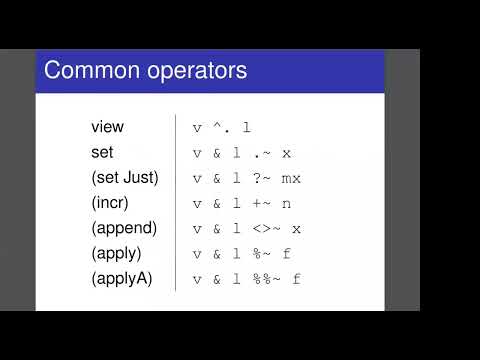
John Wiegley's BayHac 2017 talk walks through Haskell lenses by example, showing many practical uses beyond simple record access. It is aimed at people who want to become productive with the lens library.
Topic match · Functional programming 29:59
John Carmack's keynote at Quakecon 2013 part 4
139K views • 13 years ago
Kostiantyn Kostin
Part 4 of John Carmack's QuakeCon 2013 keynote, covering OpenGL, functional programming, Haskell, Lisp and Scheme, typing, multithreading, events and garbage collection.
Topic match · Functional programming 46:46
Category Theory 1.1: Motivation and Philosophy
394K views • 10 years ago
Bartosz Milewski
The first lecture in Bartosz Milewski's category theory series for programmers. It covers the motivation and philosophy behind category theory and why composition matters for handling complexity.
Topic match · Functional programming 43:31
Analyzing Programs with Z3
24K views • 10 years ago
Compose Conference
Tikhon Jelvis's Compose Conference talk on using the Z3 SMT solver to analyze and verify programs, including checking invariants with bounded loops. He demonstrates verifying programs in a small language by compiling them to Z3.
Topic match · Functional programming 49:47
Monads and Gonads
148K views • 13 years ago
Google TechTalks
Douglas Crockford's Google Tech Talk explains monads without category theory or Haskell, implementing them in JavaScript and tying them to Ajax and promises. He also touches on odd asides such as coloring code by scope.
Topic match · Functional programming 53:22
Ruby Conf 12 - Y Not- Adventures in Functional Programming by Jim Weirich
65K views • 14 years ago
Confreaks
Jim Weirich's RubyConf 2012 talk derives the Y combinator step by step, live-coding in Ruby lambdas. It builds up an understanding of functional programming and lambda calculus from first principles.
Topic match · Functional programming 49:55
How Python was Shaped by leaky Internals, Armin Ronacher, Flask framework
20K views • 10 years ago
Видео с мероприятий {speach!
Armin Ronacher, creator of Flask, explains how CPython's internals and C API leak into the language's semantics. Using examples like the complexity of the add operation, he shows why Python is hard to optimize or reimplement.
Topic match · Programming language design 42:03
The Soul of Erlang and Elixir • Sasa Juric • GOTO 2019
384K views • 7 years ago
GOTO Conferences
Sasa Juric explains what makes Erlang and Elixir suited to server-side systems, focusing on the BEAM concurrency model rather than syntax or ecosystem. He demonstrates processes, supervision, and fault tolerance.
Topic match · Functional programming 25:06
"Making Impossible States Impossible" by Richard Feldman
63K views • 10 years ago
elm-conf
Richard Feldman's elm-conf talk on designing models so that bugs from impossible application states cannot occur, using Elm's compiler and types. It demonstrates techniques for making invalid states unrepresentable.
Topic match · Functional programming 46:09
Why Isn't Functional Programming the Norm? – Richard Feldman
1.6M views • 7 years ago
Metosin
Richard Feldman argues that functional programming is not the norm largely because of historical accidents, such as C++ popularity, platform exclusivity, marketing spend and network effects, rather than merit. He traces the history of how languages become mainstream.
Topic match · Functional programming 31:44
The Value of Values with Rich Hickey
145K views • 14 years ago
InfoQ
Rich Hickey's JaxConf 2012 keynote examines what values are and why immutable values matter as information systems grow more complex and data gets bigger. It contrasts places with values and builds the case for immutability.
Topic match · Functional programming 53:31
Growing a Language, by Guy Steele
165K views • 14 years ago
Bill Pugh
Guy Steele's 1998 OOPSLA keynote on designing a programming language that its users can grow. He builds the talk using only one-syllable words and terms he has defined, to demonstrate the idea.
Topic match · Programming language design 39:49
Hammock Driven Development - Rich Hickey
333K views • 13 years ago
ClojureTV
Rich Hickey's philosophical talk from the first Clojure Conj in 2010. He argues that good design comes from deliberate, away-from-keyboard thinking, and describes how to feed the background mind so it solves problems.
Topic match · Functional programming 49:15
Erlang Factory 2014 - That's 'Billion' with a 'B': Scaling to the Next Level at WhatsApp
50K views • 12 years ago
Erlang Solutions
Rick Reed of WhatsApp explains at Erlang Factory 2014 how the service scaled to billions of messages with a very small engineering team. He covers the FreeBSD and Erlang stack, Mnesia usage, server counts and bottleneck work.
Topic match · Functional programming 58:39
Tim Ewald - Clojure: Programming with Hand Tools
48K views • 12 years ago
ClojureTV
Tim Ewald's Clojure/conj talk uses furniture making with hand tools versus machine tools as an allegory for software. It explores how automation changes what we make and how we think about our work, and why Clojure's small set of simple tools matters.
Topic match · Functional programming 45:55
Ruby Conf 12 - Boundaries by Gary Bernhardt
58K views • 13 years ago
Confreaks
Gary Bernhardt's RubyConf 2012 talk on testing in isolation without mocking everything. It goes through behavior versus data, mutation versus immutability, and how a functional core with an imperative shell yields natural isolation and parallelism.
Topic match · Functional programming 57:38
Clasp: Common Lisp using LLVM and C++ for Molecular Metaprogramming
52K views • 11 years ago
Google TechTalks
Christian Schafmeister's Google Tech Talk on designing spiroligomer molecules and building Clasp, a Common Lisp on LLVM that interoperates with C++, to program molecular design. It covers the chemistry, automatic differentiation for force fields, and how the compiler is built.
Topic match · Functional programming 44:35
Object-Oriented Programming is Bad
2.6M views • 10 years ago
Brian Will
Brian Will makes the case for procedural programming over object-oriented programming, arguing that OOP's promised encapsulation and decoupling are largely illusory. He analyzes real code examples and the problems of tying data to behavior in classes.
Topic match · Programming language design 42:43
"Propositions as Types" by Philip Wadler
143K views • 11 years ago
Strange Loop Conference
Philip Wadler's Strange Loop talk on Propositions as Types, the link between logic and computation (the Curry-Howard correspondence). He traces its history through Church, Godel and Turing and shows how it shaped theorem provers and programming languages.
Topic match · Programming language design 43:58
"The Economics of Programming Languages" by Evan Czaplicki (Strange Loop 2023)
141K views • 3 years ago
Strange Loop Conference
Evan Czaplicki, creator of Elm, examines how programming languages are funded. He looks at where compiler engineers' salaries come from, why Go has about 5 engineers while Dart has about 30, and how this limits language design.
Topic match · Programming language design 45:50
"The Mess We're In" by Joe Armstrong
398K views • 12 years ago
Strange Loop Conference
Joe Armstrong, co-inventor of Erlang, gives a funny and opinionated Strange Loop talk on the tangled state of software: build tools, package managers, entropy and the physical limits of computation. He argues for ideas like naming things by content hash and throwing away your first version.
Topic match · Functional programming 36:42
Bottom Up vs Top Down Design in Clojure - Mark Bastian
29K views • 10 years ago
ClojureTV
Mark Bastian contrasts top-down object-oriented design with bottom-up, data-oriented design in Clojure. He models a board game as plain data plus small composable functions and compares it with a roughly 22-class OOP version.
Topic match · Functional programming 40:13
"Programming a 144-computer chip to minimize power" - Chuck Moore (2013)
19K views • 5 years ago
Strange Loop Conference
Chuck Moore, inventor of Forth, presents GreenArrays' 144-core asynchronous chip at Strange Loop 2013. He explains how idle cores draw almost no power and how tight code minimizes energy use.
Topic match · Functional programming 43:04
"Stop Writing Dead Programs" by Jack Rusher (Strange Loop 2022)
468K views • 4 years ago
Strange Loop Conference
Jack Rusher's Strange Loop 2022 talk argues that most programming languages are still designed around punchcard-era assumptions. He makes the case for live, interactive programming environments, drawing on Lisp, Smalltalk and REPL-driven development.
Topic match · Programming language design 36:53
Rails Conf 2012 Keynote: Simplicity Matters by Rich Hickey
220K views • 14 years ago
Confreaks
Rich Hickey's keynote at RailsConf 2012, a close sibling of his 'Simple Made Easy' talk. He distinguishes simple (not intertwined) from easy (familiar), and argues that software complexity comes from complecting things, with Rails-specific examples including large gem collections.
Topic match · Functional programming 54:14
Zig: A programming language designed for robustness, optimality, and clarity – Andrew Kelley
75K views • 8 years ago
Recurse Center
Andrew Kelley, creator of Zig, introduces the language at the Recurse Center's Localhost series in 2018. He covers its goals of robustness, optimality and clarity, C interop, cross-compilation and explicit allocators.
Topic match · Programming language design 41:06
"Unison: a new distributed programming language" by Paul Chiusano
45K views • 7 years ago
Strange Loop Conference
Paul Chiusano's Strange Loop 2019 talk introduces Unison, an open-source functional language for distributed, elastic systems. It covers content-addressed code identified by hashes of the syntax tree, a codebase manager, and algebraic effects called abilities.
Topic match · Functional programming 36:31
Hey Underscore, You're Doing It Wrong!
141K views • 13 years ago
InfoQ
Brian Lonsdorf explains why Underscore.js falls short as a functional programming library, then introduces currying, composition and point-free style in JavaScript. He argues for data-last argument ordering.
Topic match · Functional programming 51:40
Domain Modeling Made Functional - Scott Wlaschin
71K views • 9 years ago
NDC Conferences
Scott Wlaschin's NDC talk on using statically typed functional programming, F# in particular, to model a business domain. Types are used to represent the domain precisely and to encode business rules so that illegal states cannot be built, with the compiler acting as an instant unit test.
Topic match · Functional programming 39:21
Functional Composition - Chris Ford
31K views • 13 years ago
ClojureTV
Chris Ford builds up from a single sine wave through layered abstractions to a Bach canon, using Clojure and the Overtone audio environment. The talk shows music theory as a natural fit for functional programming.
Topic match · Functional programming 59:48
The Road to Zig 1.0 - Andrew Kelley
168K views • 7 years ago
ChariotSolutions
Zig creator Andrew Kelley justifies why Zig exists and tours its distinctive features, including C interoperability and comptime, along with what people had built and what 1.0 would bring. It was given at Philly ETE 2019.
Topic match · Programming language design 23:12
dotGo 2015 - Rob Pike - Simplicity is Complicated
172K views • 10 years ago
dotconferences
Rob Pike's dotGo 2015 talk argues that Go only seems simple, and that its simplicity hides real complexity that is part of the design. He explains the thinking behind Go's restraint in features.
Topic match · Programming language design 39:58
"Production Prolog" by Michael Hendricks
58K views • 12 years ago
Strange Loop Conference
Michael Hendricks of PriceCharting shares tricks and pain points from running Prolog in production for 18 months at Strange Loop. It argues Prolog is a productive modern language beyond logic puzzles, and includes a demo of changing code mid-execution.
Topic match · Functional programming 54:12
OOPSLA Conference: Growing a Language
24K views • 6 years ago
Computer History Museum
Guy Steele's classic 1998 OOPSLA keynote on how a programming language must grow with its user community. He delivers it in a playful style, starting with only monosyllabic words and defining new terms as he goes.
Topic match · Programming language design 45:00
"Transducers" by Rich Hickey
116K views • 12 years ago
Strange Loop Conference
Rich Hickey introduces transducers in Clojure, a way to make map, filter and similar algorithms composable independent of the data source. This avoids duplicated implementations and intermediate collections across sequences, channels and streams.
Topic match · Functional programming 56:27
In Search of Tomorrow
18K views • 10 years ago
Berkeley Institute for Data Science (BIDS)
Chris Granger, creator of Light Table and the Eve language, gives a Berkeley data science lecture on what computation and programming might look like in ten years. He covers the path that led to Eve and ends with demos.
Topic match · Programming language design 35:24
The Unreasonable Effectiveness of Multiple Dispatch | Stefan Karpinski | JuliaCon 2019
79K views • 7 years ago
The Julia Programming Language
Julia co-creator Stefan Karpinski explains why multiple dispatch makes Julia code and types reusable across packages with so little friction. He covers sharing basic types and sharing generic algorithms.
Topic match · Programming language design 58:23
Evan Czaplicki - Let's be mainstream! User focused design in Elm - Curry On
82K views • 11 years ago
Curry On!
Evan Czaplicki, creator of Elm, talks at Curry On 2015 about user-focused language design. He explains the principles behind Elm and how to make a functional, typed language as approachable as JavaScript.
Topic match · Programming language design 42:34
Hewitt, Meijer and Szyperski: The Actor Model (everything you wanted to know...)
131K views • 13 years ago
jasonofthel33t
A standing whiteboard conversation at Lang.NEXT 2012 among Carl Hewitt, Erik Meijer and Clemens Szyperski about the actor model. Hewitt, who originated the model, explains its foundations.
Topic match · Functional programming