human-computer interaction
 21:20
Cracking Enigma in 2021 - Computerphile
2.9M views • 5 years ago
Computerphile
Dr Mike Pound of Computerphile shows how a modern laptop can crack Enigma, using a ciphertext-only attack based on an older paper. He compares it with the tooling in CrypTool.
 17:40
3D Gaussian Splatting! - Computerphile
273K views • 2 years ago
Computerphile
A Computerphile video in which Dr Mike Pound and PhD student Lewis Stuart explain 3D Gaussian splatting, a quick technique that turns photos of a scene into a 3D model without much compute. It includes a demo and compares the approach to NeRFs.
 13:52
Ch(e)at GPT? - Computerphile
617K views • 3 years ago
Computerphile
Computerphile video in which Mike Pound explains a University of Maryland paper on watermarking LLM output. The method biases token choices so generated text can later be detected statistically.
 25:57
GPT3: An Even Bigger Language Model - Computerphile
446K views • 6 years ago
Computerphile
Rob Miles discusses GPT-3 on Computerphile, covering how scaling parameters kept improving results over GPT-2 and how the model nearly learned arithmetic without anyone knowing exactly how.
 28:43
Why build an entire computer on breadboards?
3.4M views • 6 years ago
Ben Eater
Ben Eater explains why he builds computers on breadboards, including testing their signal behavior on an oscilloscope. It is a companion to his 6502 breadboard computer series.
 21:42
Future Computers Will Be Radically Different (Analog Computing)
13.2M views • 4 years ago
Veritasium
Veritasium explains why analog computing may suit AI workloads, covering old analog computers, The Analog Thing and Mythic's analog chips that use flash memory for neural network inference. It argues digital hardware is hitting limits.
 20:13
The Most Powerful Computers You've Never Heard Of
13.7M views • 4 years ago
Veritasium
Veritasium traces analog computers from the Antikythera mechanism and Kelvin's tide-predicting machines to fire control and modern analog approaches. It explains how these machines computed continuously rather than digitally.
 12:31
The Last Human – A Glimpse Into The Far Future
15.2M views • 4 years ago
Kurzgesagt – In a Nutshell
A Kurzgesagt animation on longtermism, arguing that because the future could hold trillions of people, our actions' effect on future generations may be what matters most.
 18:57
Why the Soviet Computer Failed
4.2M views • 4 years ago
Asianometry
An Asianometry explainer on why the Soviet Union, once a leading computing power, fell far behind the US in computers by the 1980s. It traces the gap from the 1960s onward despite strong state support for science.
 14:03
The Computer Designed To Die In Microseconds
408K views • 3 years ago
Scott Manley
Scott Manley tells the story of a computerized telemetry system built to sit at the heart of a nuclear test device in place of the plutonium pit, designed to transmit data in the microseconds before it was destroyed.
 35:33
How does Computer Memory Work? 💻🛠
5.5M views • 4 years ago
Branch Education
A 36-minute animated deep dive from Branch Education into how DRAM works. It shows how memory connects to the CPU and how billions of bits are stored in nanoscale capacitor cells. It also covers why DRAM sits between SSDs and the processor.
 21:27
How Many Holes Does a Human Have?
16.2M views • 6 years ago
Vsauce
Vsauce asks how many holes a human has and uses topology to show the answer depends on what counts as a hole, with animations and expert input.
 23:04
The Computer-free Automation of a Jukebox (Electromechanics)
1.3M views • 6 years ago
Technology Connections
Technology Connections takes apart a 1970 Wurlitzer 3400 jukebox to show how electromechanical relays and switches automated its behavior without a computer.
 15:27
Can The Human Body Handle Rotating Artificial Gravity?
3M views • 5 years ago
Scott Manley
Scott Manley surveys the research on whether people can adapt to rotating artificial gravity, from early Soviet centrifuge tests to modern studies. He concludes it is an engineering problem and discusses Coriolis effects and station radius.
 23:03
The Universe is Hostile to Computers
26.5M views • 5 years ago
Veritasium
Veritasium explains how cosmic rays and other particles flip bits in computer memory, with examples including a Belgian election count error, plane incidents and game glitches. It is inspired by a RadioLab episode on bit flips.
 14:35
How Much Is a Human Worth? (according to engineers)
647K views • 3 years ago
Practical Engineering
Practical Engineering explains how engineers and agencies put a dollar value on a human life to weigh cost against safety. It covers the legal and regulatory basis for these calculations.
 19:29
Glitch Tokens - Computerphile
353K views • 3 years ago
Computerphile
Rob Miles explains "glitch" tokens, odd strings in large language model vocabularies that make the model produce gibberish. He covers how they likely arise from tokenizer training data, such as Reddit usernames, that never appeared in the model's own training.
 23:51
Why is this number everywhere?
12.1M views • 2 years ago
Veritasium
Veritasium explores why the number 37 turns up so often, drawing on Tom Magliery's collection of 37 sightings and a poll of about 200,000 people asked to pick a random number. It covers how humans choose numbers and why 37 stands out.
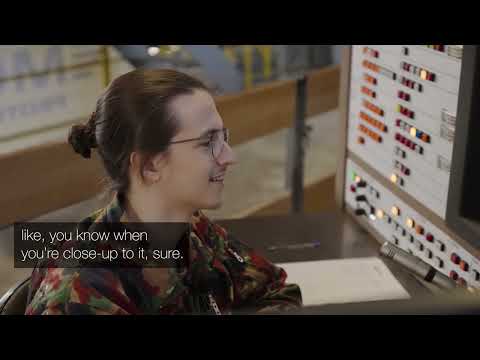 4:40
This 1970s tank simulator drives through a tiny world
12M views • 4 years ago
Tom Scott
Tom Scott visits the Swiss Military Museum to see the last surviving 1970s tank-driving simulator. It uses a real camera moving over a miniature model landscape rather than any computer graphics.
 12:55
Humanity was born way ahead of its time. The reason is grabby aliens.
1.7M views • 5 years ago
Rational Animations
Rational Animations explains Robin Hanson's grabby aliens model, which argues that humanity looks suspiciously early in cosmic history. Expanding civilizations set a deadline that explains our timing and bears on the Fermi paradox.
 17:05
How Physicists Created a Holographic Wormhole in a Quantum Computer
2.4M views • 3 years ago
Quanta Magazine
Quanta Magazine explains the 2022 experiment that claimed to create a holographic wormhole on Google's quantum computer. The description now notes that a later independent analysis questioned whether any wormhole was created.
 20:14
What if Humans Are NOT Earth's First Civilization? | Silurian Hypothesis
2.6M views • 2 years ago
PBS Space Time
PBS Space Time examines the Silurian hypothesis, the idea that an industrial civilization could have existed on Earth before humans. It looks at what traces such a civilization might leave in the geological record.
 22:36
Computer Scientist Explains One Concept in 5 Levels of Difficulty | WIRED
7.2M views • 4 years ago
WIRED
WIRED has UCLA professor Amit Sahai explain zero-knowledge proofs to a child, a teen, a college student, a grad student and an expert. Each round goes deeper into the cryptography and why it matters.
 19:59
The Future of Humanity's Energy No One Knows About | Terraform
228K views • 2 years ago
S3 | Science, Startups, & Stories
A 20-minute S3 episode touring Terraform Industries, a startup making synthetic natural gas from air and solar power. It walks through the reactor, injection system, direct air capture and electrolyzer, plus the company's cost goals and next milestone.
 19:25
New computers don't speed up old code
187K views • 1 year ago
Matthias random stuff
Matthias Wandel tests old and new code on a range of PCs, including a new mini PC, to measure how much faster modern hardware really is. He also shows optimization techniques such as branchless code, with benchmark programs on GitHub.
 18:24
The Uncanny Valley Is Wrong
236K views • 6 years ago
This Place
This Place argues that the uncanny valley is a flawed concept, since 'human likeness' is too broad and the supporting evidence is cherry-picked. It proposes that the creepiness really comes from how animated characters and robots move.
 30:02
The Future Of Reasoning
12.8M views • 5 years ago
Vsauce
Vsauce explores how human reasoning works, drawing on the social theory of reason and the extended mind thesis, made in partnership with Bill Gates around climate change.
 11:41
TRUE Limits Of Humanity – The Final Border We Will Never Cross
23.6M views • 5 years ago
Kurzgesagt – In a Nutshell
Kurzgesagt explains why, even with science-fiction technology, most of the universe is permanently out of reach because of cosmic expansion and finite resources.
 28:46
Space Shades: Humanity's Last Hope | Answers With Joe
1.1M views • 6 years ago
Joe Scott
Joe Scott takes a serious look at space sunshades as a climate fix, asking how big they would need to be, what they would cost and whether they would work. He draws on Roger Angel's paper and launch options.
 24:26
The Beauty of Bézier Curves
2.2M views • 5 years ago
Freya Holmér
Freya Holmer explains how Bezier curves work, from the helper-line construction to their uses in animation, text rendering and shapes. It uses visuals from her Unity Shapes plugin and was a SoME1 contest winner.
 1:13:50
The Continuity of Splines
1.9M views • 3 years ago
Freya Holmér
Freya Holmer's 74-minute video essay on splines, covering Bezier curves, B-splines, derivatives and the different levels of continuity (C0, C1, C2), built with custom animation tools. She notes she did not cover non-uniform splines.
 1:03:31
4.5 Billion Years in 1 Hour
17.9M views • 3 years ago
Kurzgesagt – In a Nutshell
Kurzgesagt's hour-long animated film that compresses Earth's 4.5 billion year history into one hour, roughly a million years per second. It follows the evolution of life through to humanity's tiny final stretch.
 21:46
Surface-Stable Fractal Dithering Explained
646K views • 1 year ago
runevision
Rune Skovbo Johansen explains Surface-Stable Fractal Dithering, a technique he invented and released as open source. It makes dithering stick to 3D surfaces and covers the experiments and shortcomings along the way, inspired by Return of the Obra Dinn.
 32:57
Are Seed Oils Inflammatory?! (The *Evidence* No One Shows)
480K views • 4 years ago
Nutrition Made Simple!
A nutrition-science explainer reviewing the human evidence on whether seed oils cause inflammation. It looks at nine different seed oils, heated oils, and genetic variability, and compares omega-6 intake with saturated fat.
 14:20
Reveal Invisible Motion With This Clever Video Trick
2.8M views • 6 years ago
Steve Mould
Steve Mould explains motion amplification and video magnification, techniques that find tiny changes in video invisible to the eye and exaggerate them. He covers the MIT research and industrial uses such as diagnosing vibrating machinery.
 8:35
Tesla Autopilot Crashes into Motorcycle Riders - Why?
1.1M views • 4 years ago
FortNine
FortNine looks at why Tesla Autopilot has rear-ended motorcyclists, speculating that the vision system misreads motorcycle taillights as a distant car. It argues that radar and other sensors would help.
 4:12
How Wolves Change Rivers [REMASTERED HD] - George Monbiot
356K views • 4 years ago
Sustainable Human
A short narrated video describing how reintroducing wolves to Yellowstone triggered a trophic cascade that changed wildlife, vegetation and even river courses. This is a remastered HD version of George Monbiot's viral piece.
 50:09
Old pinball machines are amazingly complex
3.5M views • 3 years ago
Technology Connections
Technology Connections takes a long, detailed look at how a 1970s electromechanical pinball machine works, from relays to stepper motors and mechanical logic. It is the first part of a series.
 55:00
The Closest Thing We Have to Alien Technology
64.9M views • 10 months ago
Veritasium
Veritasium explains how ASML's EUV lithography machines make the most advanced computer chips, covering the engineering of the light source, mirrors and the supply chain around them. It is a long-form explainer on the world's most complex commercial machine.
 8:49
How wildlife trade is linked to coronavirus
23.3M views • 6 years ago
Vox
A Vox explainer on how the wildlife trade and wet markets are linked to coronavirus and why new diseases keep emerging in China. It stresses that most people in China do not eat wildlife.