memory bandwidth
 46:23
High Volume, Bandwidth Heavy Infrastructure On The Cheap - Kyle Drake
1K views • 9 years ago
PDX Node
Kyle Drake of Neocities explains the bandwidth pricing pitfalls of the big cloud providers. He describes how to run high-volume, bandwidth-heavy infrastructure far more cheaply, including through co-location.
 36:10
CppCon 2019: Emery Berger “Mesh: Automatically Compacting Your C++ Application's Memory”
15K views • 7 years ago
CppCon
Emery Berger's CppCon 2019 talk introducing Mesh, a drop-in malloc replacement that compacts memory in unmodified C and C++ programs. It tackles fragmentation by merging pages without changing pointers.
 1:38:57
Carbon Language Successor Strategy: From C++ Interop to Memory Safety - Chandler Carruth - CppNow 23
24K views • 3 years ago
CppNow
Chandler Carruth's CppNow 2023 talk describes Carbon as a successor language to C++ rather than a superset, focusing on C++ interop and a path to memory safety in large existing codebases. It explains why Carbon takes a different approach from Cpp2 and Circle.
 48:30
What's a Memory Allocator Anyway? - Benjamin Feng
89K views • 6 years ago
Zig SHOWTIME
A Zig SHOWTIME talk by Benjamin Feng on what a memory allocator is, followed by an interview. It covers allocation strategies and different allocator types in Zig.
 1:21:13
C++ and Beyond 2012: Herb Sutter - atomic Weapons 1 of 2
71K views • 9 years ago
alexsmail
Herb Sutter's deep C++ and Beyond 2012 talk on atomics and the C++ memory model, covering why programmers chasing top performance need to understand hardware ordering. This is part one of two.
 1:14:22
CppCon 2017: Fedor Pikus “C++ atomics, from basic to advanced. What do they really do?”
288K views • 9 years ago
CppCon
Fedor Pikus's CppCon 2017 talk on C++ atomics, looking at what they let the programmer express and what the hardware actually does. It covers memory ordering and lock-free programming from basic to advanced.
 1:22:21
Introducing a Memory-Safe Successor Language in Large C++ Code Bases - John McCall - CppNow 2023
18K views • 3 years ago
CppNow
John McCall of Apple's Swift team presents at CppNow 2023 on introducing a memory-safe successor language into large C++ code bases. He argues incremental improvement of C++ hits hard limits and explains Swift's C++ interoperability for gradual migration.
 1:32:33
C++ and Beyond 2012: Herb Sutter - atomic Weapons 2 of 2
29K views • 9 years ago
alexsmail
Part two of Herb Sutter's C++ and Beyond 2012 session on atomic weapons, a deep dive into the C++ memory model, atomics, memory ordering, and hardware behavior. It ends with the modern meaning of volatile.
 39:03
RustConf 2020 - Closing Keynote by Siân Griffin
10K views • 6 years ago
Rust Programming Language
RustConf 2020 closing keynote by Sian Griffin that dives into Pokemon Blue glitches, notably Missingno and arbitrary-code-execution tricks. It uses them to explain how memory unsafety works and how memory-safe languages like Rust prevent such bugs.
 20:37
The riddle of experience vs. memory | Daniel Kahneman
1.5M views • 16 years ago
TED
In this TED talk, Nobel laureate Daniel Kahneman distinguishes the experiencing self from the remembering self, using examples such as vacations and colonoscopies. He explains how the two perceive happiness differently and what that means for economics, policy and self-awareness.
 56:49
Escape from the Heap: Low-Level Programming in Common Lisp
17K views • 10 years ago
Arthur Gleckler
Ahmon Dancy of Franz Inc explains low-level programming in Common Lisp, including off-heap data structures used in AllegroGraph to manage memory outside the garbage collector.
 35:45
RAAIS 2017 - Simon Knowles, Co-Founder and CTO of Graphcore
7K views • 9 years ago
The Research and Applied AI Summit - RAAIS
Simon Knowles, co-founder and CTO of Graphcore, talks about "intelligence processors", chips designed specifically for machine learning. The talk was given at the RAAIS 2017 summit and covers Graphcore's architecture.
 40:18
"Compacting the Uncompactable" by Bobby Powers
29K views • 7 years ago
Strange Loop Conference
Bobby Powers presents Mesh, a drop-in malloc replacement that eliminates memory fragmentation in unmodified C/C++ programs by compacting memory. The talk covers how it works despite C's fixed object addresses, and its benefits for programs like Redis.
 30:12
Casey Muratori | Smart-Pointers, RAII, ZII? Becoming an N+2 programmer
162K views • 2 years ago
xDahl
Casey Muratori argues against smart pointers and RAII, advocating grouped-element thinking, zero-is-initialization and stubs as better ways to structure memory and handle errors.
 26:34
Shared memory parallelism in Julia | Kiran Pamnany | Cambridge Julia Meetup (May 2018)
7K views • 8 years ago
The Julia Programming Language
Kiran Pamnany's Cambridge Julia Meetup talk on Julia's shared memory parallelism and its new task scheduler. It argues that fork-join and work-stealing models nest poorly and presents depth-first scheduling for composable parallelism.
 1:05:39
The One-Decade Task: Putting std::atomic in CUDA. - Olivier Giroux - CppCon 2019
11K views • 7 years ago
CppCon
Olivier Giroux's CppCon 2019 talk recounts the roughly ten-year effort to bring std::atomic and the C++ memory model to CUDA GPUs, through ten stories from that work.
 47:52
Finding the Missing Memristor - R. Stanley Williams
133K views • 16 years ago
The Qualcomm Institute
R. Stanley Williams of HP Labs gives a keynote on the memristor, covering the physics, crossbar computation, and potential for memory and new computer architectures.
 1:39:25
CppCon 2016: Herb Sutter “Leak-Freedom in C++... By Default.”
149K views • 10 years ago
CppCon
Herb Sutter's CppCon 2016 talk on lifetime safety in C++, aiming for code free of leaks and dangling pointers by default. It covers smart pointers, ownership, reference counting pitfalls and deferred reclamation resembling garbage collection.
 1:00:12
Pitfall Classic Postmortem With David Crane Panel at GDC 2011 (Atari 2600)
76K views • 15 years ago
GameSpot
David Crane, designer of Pitfall for the Atari 2600, gives a GDC 2011 postmortem on the game's design challenges. He covers how he fit a large world into the console's tiny memory. The session ends with Q&A.
 31:19
CppCon 2016: Nicholas Ormrod “The strange details of std::string at Facebook"
122K views • 10 years ago
CppCon
Nicholas Ormrod's CppCon 2016 talk on how Facebook optimizes std::string with its open-source replacement fbstring. It covers storage layout tradeoffs, small string optimization and memory allocation behavior.
 1:16:58
code::dive conference 2014 - Scott Meyers: Cpu Caches and Why You Care
231K views • 11 years ago
NOKIA Technology Center Wrocław
Scott Meyers explains how CPU caches work and why they matter for performance, covering cache levels, access speeds, associativity, and effects in multithreaded code. The focus is C++ and cache-aware, data-oriented programming.
 59:21
A Crash Course in Modern Hardware by Cliff Click
21K views • 9 years ago
Devoxx
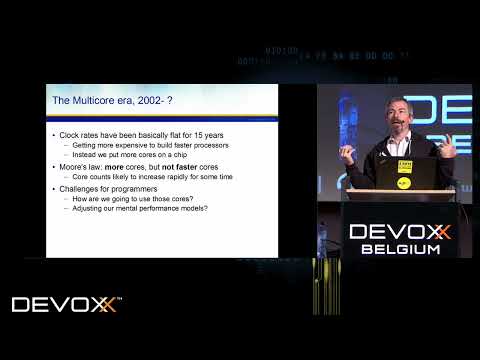
Cliff Click walks through a small performance example on a modern out-of-order CPU. He covers pipelining, ILP, CISC vs RISC, multicore, and why cache misses and the memory subsystem dominate performance.
 1:05:59
Modern C and What We Can Learn From It - Luca Sas [ ACCU 2021 ]
130K views • 5 years ago
ACCU Conference
Luca Sas's ACCU 2021 talk on Modern C, a style of C and C-like C++ aligned with data-oriented design. It covers centralized memory management, zero-is-initialization, error handling and API design.
 45:14
DEF CON 19 - Artem Dinaburg - Bit-squatting: DNS Hijacking Without Exploitation
4K views • 13 years ago
DEFCONConference
Artem Dinaburg's DEF CON 19 talk on bit-squatting, where DRAM bit flips cause DNS requests to go to domains one bit off from the intended one. It shows how hardware faults can be exploited for hijacking without any software exploit.
 48:36
The Charming Genius of the Apollo Guidance Computer - Brian Troutwine
170K views • 11 years ago
Erlang Solutions
Brian Troutwine's Code Mesh 2015 talk on the Apollo Guidance Computer. It covers the AGC's design, core rope memory, its interrupt and software behavior, and the pioneering engineering effort behind it.
 45:14
DEFCON 19: Bit-squatting: DNS Hijacking Without Exploitation (w speaker)
24K views • 14 years ago
Christiaan008
Artem Dinaburg's DEF CON 19 talk on bit-squatting, where flipped bits in DRAM cause devices to contact domains that differ by one bit from legitimate ones. He shows how registering such domains can hijack traffic without exploiting any software bug.
 40:04
ONS 2015: Wednesday Keynote - Amin Vahdat
32K views • 11 years ago
Open Networking Summit
Google's Amin Vahdat gives the ONS 2015 keynote on Google's datacenter networking, including its custom hardware, software-defined networking and very high bisection bandwidth.
 1:09:18
Is It Time to Rewrite the Operating System in Rust?
310K views • 7 years ago
InfoQ
Bryan Cantrill's QCon SF 2019 talk asking whether operating systems should be rewritten in Rust. He draws on his systems experience to discuss C, memory safety and Rust's fit for system software.
 37:02
DEFCON 21 - DNS May Be Hazardous to Your Health - Robert Stucke
20K views • 13 years ago
Robert Stucke (bobhex)
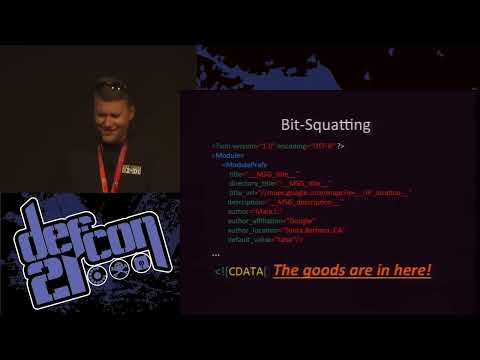
A DEFCON 21 talk by Robert Stucke on DNS errors caused by single-bit flips, which lead to requests for misspelled domains. It shows real-world data on bitsquatting.
 46:34
The Memory Sinkhole - Unleashing An X86 Design Flaw Allowing Universal Privilege Escalation
169K views • 10 years ago
Black Hat
Christopher Domas's Black Hat 2015 talk on a long-unnoticed x86 design flaw that lets an attacker reach System Management Mode, a ring below the OS. It explains how the legacy architecture allows universal privilege escalation and persistent, hard-to-detect malware.
 55:08
Rust: A Language for the Next 40 Years - Carol Nichols
367K views • 7 years ago
ChariotSolutions
Carol Nichols' Philly ETE 2019 talk on what makes Rust unique. It covers memory safety, how editions let the language evolve without breaking code, and who relies on Rust in production.
 1:04:26
CppCon 2018: G. Nishanov “Nano-coroutines to the Rescue! (Using Coroutines TS, of Course)”
40K views • 8 years ago
CppCon
Gor Nishanov's CppCon 2018 talk on using tiny C++ coroutines to hide memory latency, interleaving useful work while prefetches bring cache lines in from main memory.
 1:12:27
CppCon 2015: Andrei Alexandrescu “std::allocator...”
196K views • 11 years ago
CppCon
Andrei Alexandrescu's CppCon 2015 talk argues that std::allocator is badly designed. He proposes building high-performance allocators from small composable, templated pieces.
 42:15
"Performance Matters" by Emery Berger
502K views • 7 years ago
Strange Loop Conference
Emery Berger explains why performance is hard to measure and deliver on modern hardware, showing how code layout and alignment can swamp optimization effects. He presents Stabilizer for statistically sound evaluation and Coz, a causal profiler.
 1:54:00
Can C++ be 10x Simpler & Safer? - Herb Sutter - CppCon 2022
277K views • 3 years ago
CppCon
Herb Sutter's CppCon 2022 talk on whether C++ can become ten times simpler and safer. He introduces his experimental Cpp2 syntax and the cppfront transpiler, explaining the limits on incremental improvement.
 52:01
CppCon 2017: Louis Brandy “Curiously Recurring C++ Bugs at Facebook”
158K views • 9 years ago
CppCon
Louis Brandy presents the most common and infamous recurring C++ bugs seen in Facebook's huge codebase, including shared_ptr data races and operator[] pitfalls. He explains the surprising complexity behind seemingly simple code.
 54:35
BlueHat IL 2023 - David Weston - Default Security
47K views • 3 years ago
Microsoft Israel R&D Center
David Weston's BlueHat IL 2023 talk traces the evolution of Windows security and previews Windows 11 and hardware advances. It ends with upcoming changes such as Rust in the kernel and fonts, signed binaries and adminless Windows.
 42:45
RustConf 2017 - Closing Keynote: Safe Systems Software and the Future of Computing by Joe Duffy
2K views • 9 years ago
Confreaks
Joe Duffy's RustConf 2017 closing keynote on his experience at Microsoft building Midori, an operating system written in a Rust-like safe systems language. He covers the technical and cultural challenges of applying those lessons to Windows.
 29:25
Rust NYC: Jon Gjengset - Demystifying unsafe code
27K views • 6 years ago
Rust Programming Language
Jon Gjengset's Rust NYC talk explaining what `unsafe` in Rust actually means, why it is dangerous, and why it is sometimes necessary. He works through the Rustonomicon to separate fair concerns from overblown ones.
 58:37
NVIDIA — Securing the Future of Safety and Security of Embedded Software (Captioned)
5K views • 5 years ago
AdaCore
An AdaCore webinar in which NVIDIA engineers explain why and how they adopted Ada and SPARK for security-critical firmware. It covers the business case and the engineering experience of the transition.