nfo
 1:01:51
Lecture 1: Introduction to Information Theory
411K views • 12 years ago
Jakob Foerster
The first lecture of David MacKay's Cambridge course on information theory, pattern recognition and neural networks. It introduces the core ideas of his book Information Theory, Inference, and Learning Algorithms.
 30:38
Solving Wordle using information theory
11.8M views • 4 years ago
3Blue1Brown
3Blue1Brown uses Wordle as an excuse to teach information theory and entropy, building a solver that picks guesses by expected information and incorporating word frequencies.
 1:28:13
RL Course by David Silver - Lecture 1: Introduction to Reinforcement Learning
1.9M views • 11 years ago
Google DeepMind
The first lecture of David Silver's reinforcement learning course, introducing the field and its basic concepts. The course follows the Sutton and Barto textbook.
 53:46
Dasher: information-efficient text entry
7K views • 19 years ago
Google TechTalks
David MacKay's 2007 Google Tech Talk presents Dasher, a text-entry system driven by continuous gestures and a language model, reaching about 35 words per minute with one finger and 25 hands-free. It explains the information-theory reasoning behind the design.
 1:08:40
Lecture 1 | Machine Learning (Stanford)
2.7M views • 18 years ago
Stanford
The first lecture of Andrew Ng's Stanford CS229 Machine Learning course, giving an overview of the course. It introduces supervised and unsupervised learning, learning theory and reinforcement learning.
 17:26
Lecture 1 | Programming Paradigms (Stanford)
1.2M views • 18 years ago
Stanford
The first lecture of Stanford's CS107 Programming Paradigms, taught by Jerry Cain, giving an overview of the course. The course goes from C and assembly through C++, concurrency, Scheme and Python.
 47:50
Lecture 1 | Modern Physics: Classical Mechanics (Stanford)
1.4M views • 18 years ago
Stanford
The first lecture of Leonard Susskind's Stanford Continuing Studies course on modern physics, beginning with classical mechanics. It is the start of a six-quarter sequence on the theoretical foundations of physics.
 1:20:33
Lecture 1 | Convex Optimization I (Stanford)
753K views • 18 years ago
Stanford
The introductory lecture of Stephen Boyd's Stanford Convex Optimization I course (EE 364A). It outlines convex sets, functions and problems, and the course's coverage of least-squares, linear and semidefinite programming, duality and interior-point methods.
 49:47
Lecture 1 | Programming Methodology (Stanford)
2.6M views • 18 years ago
Stanford
First lecture of Stanford's CS106A Programming Methodology by Mehran Sahami, giving a course overview and starting on programming. The course teaches software engineering principles using Java.
 13:43
Why Quantum Information is Never Destroyed
715K views • 8 years ago
PBS Space Time
A PBS Space Time episode asking whether the universe's information can ever truly be lost, tying quantum mechanics, determinism and black holes together. It sets up the black hole information paradox.
 23:51
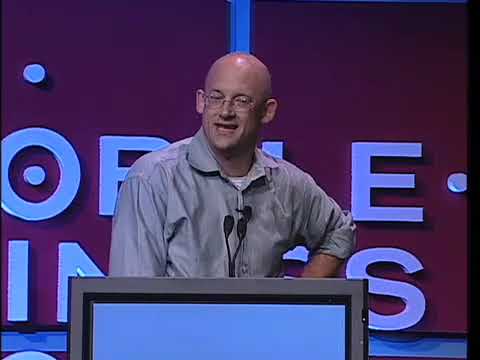
Web 2.0 Expo NY: Clay Shirky (shirky.com) It's Not Information Overload. It's Filter Failure.
55K views • 18 years ago
O'Reilly
Clay Shirky argues at Web 2.0 Expo NY that the problem online is not information overload but filter failure. He says the real challenge is building better ways to filter and organize what we see.
 17:46
Why do Biden's votes not follow Benford's Law?
3.7M views • 5 years ago
Stand-up Maths
Matt Parker examines claims that Biden's 2020 vote counts violate Benford's Law, explaining the law and why it often does not apply to precinct-level election data.
 0:49
Psaki: 'We're Flagging Problematic Posts On Facebook That Spread Disinformation'
22K views • 5 years ago
Newsweek
A short Newsweek clip of White House press secretary Jen Psaki saying the administration is flagging problematic posts to Facebook that spread COVID-19 and vaccine disinformation.
 52:29
Stanford's Sapolsky On Depression in U.S. (Full Lecture)
6.4M views • 16 years ago
Stanford
Stanford professor Robert Sapolsky lectures on depression as a real biological disease. He covers its biological and psychological causes, how it differs from ordinary sadness, and ideas such as learned helplessness. He ties these together into one account.
 1:07:02
Stanford Lecture: Don Knuth—"A Conjecture That Had To Be True" (2017)
30K views • 8 years ago
Stanford Online
Donald Knuth's 2017 Christmas Tree Lecture at Stanford about a combinatorial geometry problem whose computed numbers matched a striking formula. He tells the story of the conjecture and its sequel.
 48:11
How to Find Product Market Fit - Stanford CS183F: Startup School
198K views • 9 years ago
Stanford Online
Segment co-founder and CEO Peter Reinhardt recounts how his company found product-market fit, including how a product grew out of a small feature of another. It is a lecture from Stanford's Startup School course.
 1:04:45
Stanford Seminar - Concatenative Programming: From Ivory to Metal
14K views • 8 years ago
Stanford Online
Jon Purdy's Stanford EE380 seminar giving an overview of concatenative programming, from function composition theory and history down to low-level implementation and correctness benefits.
 15:05
Steve Jobs' 2005 Stanford Commencement Address
49.4M views • 18 years ago
Stanford
Steve Jobs' 2005 Stanford commencement address, told through three stories: connecting the dots, love and loss, and death. It includes the calligraphy class and the 'stay hungry, stay foolish' close.
 22:10
Steve Jobs' 2005 Stanford Commencement Address (with intro by President John Hennessy)
6.3M views • 18 years ago
Stanford
Steve Jobs' 2005 Stanford commencement address, in which he tells three stories from his life about connecting the dots, love and loss, and death. He urges graduates to follow their dreams and find opportunity in setbacks.
 2:39
Stanford Professor Andrei Linde celebrates physics breakthrough
3.2M views • 12 years ago
Stanford
A short Stanford video in which Chao-Lin Kuo surprises Professor Andrei Linde with BICEP2 evidence supporting cosmic inflation, the first apparent images of primordial gravitational waves.
 15:30
The Black Hole Information Paradox
1.1M views • 8 years ago
PBS Space Time
PBS Space Time episode on the black hole information paradox, covering how black holes seem to destroy information, the no-hair conjecture and the proposed role of the event horizon. It is part of a series on black holes.
 1:31:28
Stanford Seminar: Beyond Floating Point: Next Generation Computer Arithmetic
33K views • 9 years ago
Stanford Online
John Gustafson presents posits, a proposed drop-in replacement for IEEE 754 floats that is simpler in hardware and more flexible in precision. The seminar includes a live demo and machine learning results.
 1:03:32
John Schulman - Reinforcement Learning from Human Feedback: Progress and Challenges
88K views • 3 years ago
UC Berkeley EECS
UC Berkeley EECS colloquium by OpenAI's John Schulman on reinforcement learning from human feedback. He covers why RL helps with truthfulness, hallucination, and the limits of behavior cloning.
 1:10:03
Stanford Seminar - Generalized Reversible Computing and the Unconventional Computing Landscape
16K views • 9 years ago
Stanford Online
A Stanford EE380 seminar by Michael P. Frank of Sandia National Laboratories on generalized reversible computing. It surveys unconventional computing approaches as transistor scaling nears its limits and energy efficiency stops improving.
 14:34
Steve Jobs Stanford Commencement Speech 2005
12.4M views • 20 years ago
JoshuaG
Steve Jobs's 2005 Stanford commencement address, built around three stories: connecting the dots, love and loss including being fired from Apple, and death. It is a 15-minute talk on finding work you love.
 1:01:45
Information, Evolution, and intelligent Design - With Daniel Dennett
586K views • 11 years ago
The Royal Institution
Daniel Dennett gives a Royal Institution talk toward a unified theory of information, tying together evolution, learning and engineering. He argues that design can arise bottom-up through small steps without a designer.
 25:21
5 steps to designing the life you want | Bill Burnett | TEDxStanford
11.4M views • 9 years ago
TEDx Talks
TEDxStanford talk by Bill Burnett, executive director of Stanford's design program, on applying design thinking to your own life and career. He offers five practical tips such as getting curious, talking to people and trying things.
 22:10
Steve Jobs Stanford Commencement Speech 2005 high definition.flv
675K views • 14 years ago
Jed Joe
Steve Jobs's 2005 Stanford commencement address, in which he tells three stories about connecting the dots, love and loss, and death, including his remarks on typography.
 11:17
Live Forever As You Are Now With Alan Resnick | Infomercials | Adult Swim
1.9M views • 12 years ago
Adult Swim
An Adult Swim fake infomercial in which Alan Resnick pitches a four-step program for creating a digital avatar to live forever. It is absurdist satire of tech immortality and digital popularity.
 17:58
The Cult of Conformity in Silicon Valley
96K views • 3 years ago
Y Combinator
Y Combinator partners Michael Seibel and Dalton Caldwell discuss how startups shifted from attracting outsiders to status- and money-seeking conformists. They give advice for nonconformist founders.
 4:04
Monzy performs at Stanford Univ.
507K views • 19 years ago
NerdcoreForLife
Raw footage of nerdcore rapper Monzy performing outside Stanford's computer science building, shot for the documentary Nerdcore for Life. The set includes his song about the kill -9 Unix command.
 11:01
Infomercial: For-Profit Online University | Adult Swim
2.4M views • 12 years ago
Adult Swim
An Adult Swim parody infomercial for a for-profit online university that promises to let you print your own degree. It is absurdist comedy in the style of Tim and Eric.
 18:12
Does AI Actually Boost Developer Productivity? (100k Devs Study) - Yegor Denisov-Blanch, Stanford
311K views • 1 year ago
AI Engineer
Yegor Denisov-Blanch of Stanford presents a study of nearly 100,000 developers at hundreds of companies, measuring how AI affects productivity from commit data. It finds an average boost of about 20% with wide variance by codebase, task complexity and stack.
 58:02
How to Invent the Future I - Stanford CS183F: Startup School
40K views • 9 years ago
Stanford Online
Alan Kay's Stanford Startup School lecture covers his career at Xerox PARC and how to think about inventing the future. He goes through what came out of PARC and why companies fail to capitalize on such ideas.
 56:30
How to Invent the Future II - Stanford CS183F: Startup School
26K views • 9 years ago
Stanford Online
Part two of Alan Kay's Stanford Startup School lecture on inventing the future. He draws on his time at Xerox PARC and elsewhere to discuss how to think about new technology and what makes ideas useful.
 1:26:02
Stanford Seminar - The Soul of a New Machine: Rethinking the Computer
76K views • 6 years ago
Stanford Online
Bryan Cantrill of Oxide Computer Company gives a Stanford EE380 talk on rethinking the server. He argues that hyperscaler-style rack-scale machines with open firmware, RISC-V and Rust should be available to everyone, not just the giants.
 1:20:29
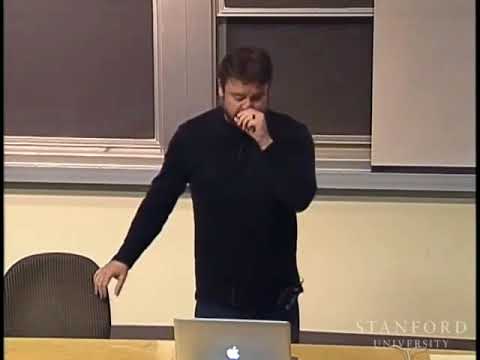
Stanford Seminar - Google's Steve Yegge on GROK
30K views • 14 years ago
Stanford Online
Steve Yegge's Stanford seminar on GROK, Google's internal large-scale, cross-language source code analysis system. It covers how the system helps with code search and understanding across Google's huge codebase.
 1:23:56
Stanford Seminar - Unethical Algorithms of Massive Scale
15K views • 9 years ago
Stanford Online
Psychologist Robert Epstein presents a Stanford EE380 colloquium on how internet algorithms such as search rankings can manipulate opinions, purchases and votes at massive scale. He also describes a new monitoring system for tracking such influence.
 5:53
CYMATICS: Science Vs. Music - Nigel Stanford
54.8M views • 11 years ago
Nigel John Stanford
Nigel Stanford's music video Cymatics, in which real science experiments, such as Chladni plates, ferrofluid and water, visualize the audio.
 28:04
Ground Source / Geothermal Heat Pumps and Other Info
1.2M views • 5 years ago
Technology Connections
A Technology Connections video on how ground-source (geothermal) heat pumps work and why they hold efficiency in winter. It also covers related heat pump information, and the description notes air-source heat pumps have since improved.