no-code
 4:17
AI Learns Noise Filtering For Photorealistic Videos | Two Minute Papers #215
65K views • 8 years ago
Two Minute Papers
A Two Minute Papers episode on NVIDIA's recurrent denoising autoencoder, which cleans up noisy Monte Carlo path-traced image sequences. It shows how a neural network can produce usable renders from very few samples.
 17:04
These Are Not Pixels: Revisited
611K views • 8 years ago
Technology Connections
Technology Connections follows up on his analog TV video to clear up the debate over whether CRT phosphor dots are pixels. He explains the shadow mask, color triads and how they relate to the scanned picture.
 9:37
Characters, Symbols and the Unicode Miracle - Computerphile
2.1M views • 13 years ago
Computerphile
Tom Scott explains for Computerphile how Unicode and UTF-8 grew out of messy older character encodings to become the web's standard. It covers why the design works and how it handles worldwide text.
 13:02
Noether's Theorem and The Symmetries of Reality
1.1M views • 8 years ago
PBS Space Time
PBS Space Time explains Noether's theorem: conservation laws such as energy and momentum are consequences of deeper symmetries. It also covers why those laws hold only under certain conditions.
 5:32
It's not you. Bad doors are everywhere.
10.6M views • 10 years ago
Vox
Vox's Joe Posner, with help from 99% Invisible, explains why bad doors are everywhere. It covers Don Norman's long-running complaint about doors and the idea that good design should not need instructions.
 13:09
Moon Landings Faked? Filmmaker Says Not!
1.4M views • 13 years ago
VideoFromSpace
A filmmaker explains why the Apollo moon landing footage could not have been faked in a studio, based on the video and film technology of the late 1960s. He walks through the limits of cameras, frame rates and effects of the era.
 12:24
The 1988 VIDEO Floppy Disk Camera: Canon Xap Shot RC-250
452K views • 8 years ago
LGR
LGR looks at the 1988 Canon Xap Shot, a still video camera that records photos to a floppy disk as analog NTSC signal rather than digital data.
 10:08
Big Plane vs Little Plane (The Economics of Long-Haul Flights)
4.3M views • 10 years ago
Wendover Productions
Wendover Productions explains why Boeing's efficient 787 beat Airbus's giant A380, contrasting hub-and-spoke with point-to-point routes. It covers the economics of long-haul flights.
 12:31
The Superheterodyne Radio: No really, that's its name
987K views • 7 years ago
Technology Connections
Technology Connections explains why the superheterodyne radio has its name and how mixing frequencies lets it tune stations well. It walks through the underlying wave phenomena and algebra and why the design solved a hard tuning problem.
 4:20
Why Snow and Confetti Ruin YouTube Video Quality
10.4M views • 10 years ago
Tom Scott
Tom Scott explains why confetti and snow wreck video quality, using interframe compression and bitrate. He demonstrates it live by changing the quality on screen.
 18:31
The LED Traffic Light and the Danger of "But Sometimes!"
4.2M views • 8 years ago
Technology Connections
Technology Connections explains how LED traffic lights, which do not melt snow, drew complaints and were blamed for accidents. He uses it to illustrate the 'but sometimes' fallacy against new technology.
 4:20
Why It's Impossible to Tune a Piano
4.1M views • 11 years ago
minutephysics
A minutephysics video explaining why a piano cannot be perfectly tuned, comparing equal temperament with just intonation and the math of harmonics.
 16:58
Reynolds Number - Numberphile
560K views • 7 years ago
Numberphile
Numberphile with Tom Crawford of Oxford explains the Reynolds number, the second of three videos on Navier-Stokes and fluid flow, with demonstrations of laminar versus turbulent behavior.
 8:44
MMO Economies - Hyperinflation, Reserve Currencies & You! - Extra Credits
1.5M views • 9 years ago
Extra Credits
An Extra Credits episode on how MMO economies get overrun by inflation when players can mint unlimited gold by killing monsters. It covers approaches borrowed from real-world economics, such as anchoring or pegging currency, as alternatives to simple gold sinks.
 13:14
How Analog Color TV Works: The Beginnings
503K views • 8 years ago
Technology Connections
Technology Connections explains the early history of analog color television, from the 1954 start of modern color broadcasting, and how shadow masks work in CRTs. It is the first in a series on how analog color TV works.
Topic match · Audio & video engineering 5:51
Bitcoin Q&A: Energy Consumption
96K views • 8 years ago
aantonop
Andreas Antonopoulos answers a Bitcoin Q&A question about energy consumption in mining. He argues that mining is arbitrage for the cheapest electricity, drives investment in renewables, and that the traditional financial system has hidden externalities.
Topic match · Cryptography 10:58
Flaw in the Enigma Code - Numberphile
5.4M views • 13 years ago
Numberphile
Numberphile's Dr James Grime explains the flaw in the Enigma machine, namely that a letter could never be encrypted to itself, and how that helped the Allies break the code. It touches on the Bombe and Alan Turing.
 11:38
The Economics of Airline Class
12.2M views • 9 years ago
Wendover Productions
Wendover Productions explains how airlines make money from different cabin classes and why premium seats matter so much to profits. It also touches on how this shaped decisions such as the decline of supersonic travel.
 7:42
Triangle of Power
812K views • 10 years ago
3Blue1Brown
3Blue1Brown presents the Triangle of Power, an alternate notation that unifies powers, logarithms and roots in a single triangular symbol. The video shows how the inverse operations relate and how the notation could help.
 4:47
Noam Chomsky: The five filters of the mass media machine | The Listening Post
2.9M views • 9 years ago
Al Jazeera English
A short Al Jazeera animation narrated by Amy Goodman presenting Noam Chomsky's five filters of the mass media: ownership, advertising, media elite sourcing, flak and a common enemy. It is part of the MediaTheorised series.
 6:43
Explained: "Go Fast" UFO Video - Not Low and Not Fast - Like a Balloon!
156K views • 7 years ago
Mick West
Mick West analyzes the Navy "Go Fast" UFO footage and shows with simple trigonometry and the data overlay that the object is slow and high up, consistent with a balloon. He explains how parallax makes it look fast and argues the original TV claims were wrong.
 11:11
Hauntology, Lost Futures and 80s Nostalgia
451K views • 8 years ago
Jonas Čeika - CCK Philosophy
A video essay explaining hauntology, Mark Fisher's idea of lost futures, and 80s nostalgia. It uses the Fallout games and other media as examples of a retro-futurism that mourns futures that never arrived.
 12:16
LCCS: The LCD / CRT Hybrid from JVC
2.3M views • 7 years ago
Technology Connections
A Technology Connections video on JVC's LCCS, a display hybrid that cycles a color LCD shutter over a monochrome CRT to produce field-sequential color without dots or stripes. It builds on his earlier videos about analog TV and compatible color.
Topic match · Audio & video engineering 9:51
Comparing Beta & VHS on Quality: Was Beta Really Better?
710K views • 9 years ago
Technology Connections
Technology Connections compares Betamax and VHS picture quality using footage from a 1979 RCA VCR and argues the Beta quality advantage was largely marketing.
Topic match · Audio & video engineering 13:43
The Senseless Ambiguity of North American Turn Signals
4.2M views • 8 years ago
Technology Connections
Technology Connections explains why North American tail light rules, which allow red turn signals and flashing brake lights, make signals ambiguous. He argues for amber signals and cites studies showing a safety benefit.
 6:18
Fear the Boom and Bust: Keynes vs. Hayek - The Original Economics Rap Battle!
8.9M views • 16 years ago
Radical Discourse
A rap battle in which John Maynard Keynes and F. A. Hayek debate the causes of boom and bust, stimulus, and bailouts. It was produced by Econstories to teach the two schools of thought.
 6:47
The US Has More Tribes Than the World Has Countries
7.3M views • 6 years ago
CGP Grey
CGP Grey explains why "Indian" is often preferred over "Native American" in the United States, especially near reservations, and how many tribes exist in the US. He draws on conversations with people who identify as Indian.
 8:57
Small Planes Over Big Oceans (ETOPS Explained)
3.3M views • 9 years ago
Wendover Productions
A short Wendover Productions explainer on ETOPS, the rules that let twin-engine jets fly long routes over oceans. It covers the economics that favored twinjets like the 787 over four-engine aircraft like the A380 and 747.
 4:07
Why do competitors open their stores next to one another? - Jac de Haan
7.4M views • 14 years ago
TED-Ed
A short animated TED-Ed lesson in which two competing ice cream vendors on a beach illustrate why rival shops cluster together. It introduces game theory and the Nash equilibrium through the Hotelling model.
 17:32
'Oumuamua Is Not Aliens
790K views • 7 years ago
PBS Space Time
PBS Space Time examines the interstellar object 'Oumuamua and the popular theories about it, including the light-sail hypothesis. It argues that a natural rock is the likeliest explanation.
 5:08
Money creation in the modern economy - Quarterly Bulletin
281K views • 12 years ago
Bank of England
A short Bank of England video accompanying its 2014 Quarterly Bulletin article on money creation. It explains that most money is bank deposits and that commercial banks create new money by making loans, which simultaneously create matching deposits.
 16:29
Why Sony's Beta Videotape System Failed--and failed hard (Part 1)
1.5M views • 9 years ago
Technology Connections
Part one of Technology Connections' account of the VHS versus Betamax format war. It argues Sony was caught off guard by JVC's cheaper, more practical VHS system.
Topic match · Audio & video engineering 9:48
Bitcoin Q&A: How Do I Secure My Bitcoin?
117K views • 9 years ago
aantonop
Andreas Antonopoulos answers a question about how to secure your Bitcoin. He covers holding your own keys, backing up the 12 to 24 word seed phrase, and the tradeoffs of custodial accounts, phone wallets and hardware wallets.
Topic match · Cryptography 16:47
Lines of Light: How Analog Television Works
1.5M views • 9 years ago
Technology Connections
Technology Connections explains how analog television produced moving images without computers, covering scanning, CRTs and standards like NTSC and PAL. It is part of a series on analog TV.
Topic match · Audio & video engineering 12:01
Why Electronic Voting Is Still A Bad Idea
5.1M views • 6 years ago
Tom Scott
Tom Scott explains why electronic voting is a bad idea. Elections must be trusted by everyone and attacks on software scale in ways attacks on paper do not, so open source or blockchain fixes do not solve it.
Topic match · Cryptography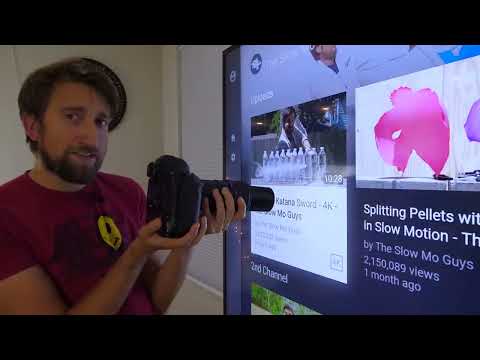 11:39
How a TV Works in Slow Motion - The Slow Mo Guys
45.7M views • 8 years ago
The Slow Mo Guys
The Slow Mo Guys film a TV and screens with a high-speed camera to show how displays build an image. The footage includes CRT-style scanning and how pixels light up over time.
Topic match · Audio & video engineering 18:28
The Antique Toaster that's Better than Yours
3.4M views • 7 years ago
Technology Connections
Technology Connections takes apart a 1940s Sunbeam Radiant Control toaster. It senses the toast's own browning and lowers and raises it automatically using purely mechanical parts and no electronics.
 6:49
Quantitative Easing Explained
6.4M views • 16 years ago
malekanoms
An animated xtranormal explainer on quantitative easing, what the Federal Reserve was doing and how things got there. It was made by Omid Malekan.
 10:48
RSA ANIMATE: Drive: The surprising truth about what motivates us
20.2M views • 16 years ago
Royal Society of Arts
An RSA Animate whiteboard adaptation of Dan Pink's talk on what motivates people at work. It argues that beyond simple tasks, autonomy, mastery and purpose drive performance more than money.
 14:27
All the Numbers - Numberphile
1.8M views • 7 years ago
Numberphile
Matt Parker talks Numberphile through the different kinds of numbers: algebraic, transcendental, computable, normal, and beyond. It shows how few numbers we can actually name or describe.